
Is Your Well Water Pressure Acting Up? Start Here
Well pressure tank repair is something most Central Indiana homeowners will face at some point — and the symptoms are hard to ignore. When your water system begins to fail, it doesn’t just affect your morning shower; it impacts your dishwasher, your laundry, and even your home’s plumbing integrity. Understanding the early warning signs can save you thousands of dollars in secondary damage to your well pump.
Here are the most common problems and what they usually mean for your system’s health:
| Symptom | Likely Cause |
|---|---|
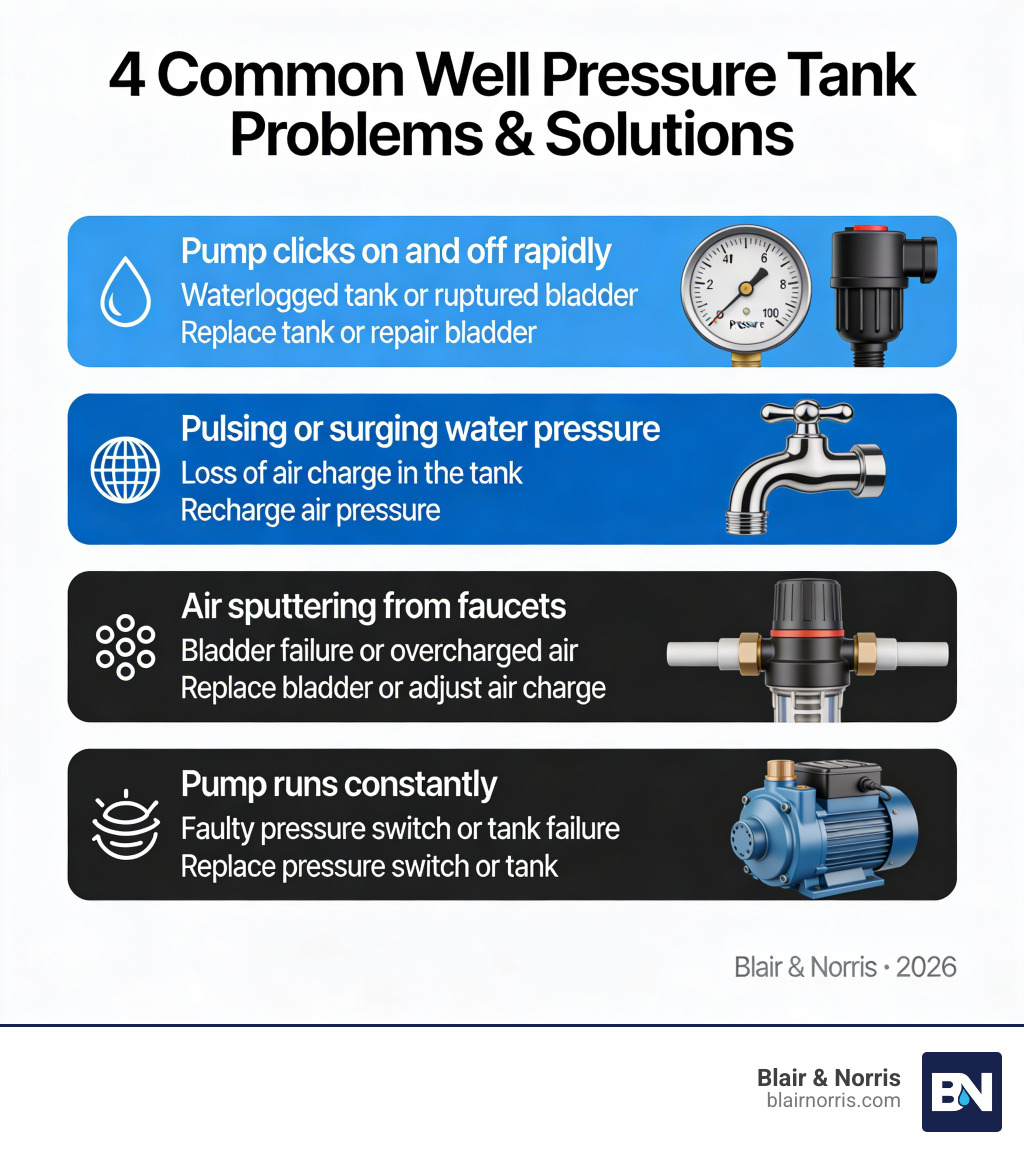
| Pump clicks on and off rapidly | Waterlogged tank or ruptured bladder |
| Pulsing or surging water pressure | Loss of air charge in the tank |
| Air sputtering from faucets | Bladder failure or overcharged air |
| Pump runs constantly | Faulty pressure switch or tank failure |
| Banging pipes | Water hammer from short cycling |
| Low water volume | Sediment buildup or failing pressure switch |
In most cases, the fix is one of four things: recharging the air pressure, replacing the pressure switch, repairing a minor leak, or replacing the tank entirely. However, the complexity of these systems means that a symptom in one area often points to a failure in another. For instance, a pulsing shower head isn’t just a nuisance; it’s a sign that your pump is working ten times harder than it was designed to, leading to rapid wear and tear.
Imagine turning on your shower and getting a weak trickle — then a surge — then nothing. Or hearing your well pump click on and off every few minutes, even when nobody is using water. These aren’t just annoyances. Left alone, a failing pressure tank puts serious strain on your well pump, which is a far more expensive fix. In the Indianapolis area, where our groundwater can be heavy with minerals, these components are under constant stress.
The good news is that many pressure tank problems follow predictable patterns. Once you know what to look for, you can diagnose the issue quickly and decide whether it’s a simple fix or time to call in a professional. I’m Mack Blair, owner of Blair & Norris, and with over 30 years of hands-on experience in well drilling and pump systems across Central Indiana, I’ve seen nearly every well pressure tank repair scenario imaginable. In this guide, I’ll walk you through the four most common pressure tank problems and exactly what to do about each one.
Well pressure tank repair word guide:
Understanding the Role of Your Well Pressure Tank
Before we dive into the repairs, it is essential to understand why this big blue (or grey) tank is sitting in your basement or utility room. Many homeowners mistake the tank for a simple storage vessel, but its role is far more dynamic. Think of the pressure tank as a storage battery for your water system. It doesn’t just hold water; it holds energy in the form of compressed air. This energy is what provides the consistent flow you expect when you open a tap.
When your well pump turns on, it pushes water into the tank, compressing the air inside. Once the pressure reaches a certain point (usually 50 or 60 PSI), the pressure switch tells the pump to stop. When you turn on a faucet, that compressed air pushes the water out to your shower or sink. This process allows you to use several gallons of water without the pump having to turn on every single time. This is critical because the electric motor in your well pump uses a massive amount of energy and generates significant heat every time it starts up.
This “buffer” is known as the drawdown. The drawdown is the actual amount of usable water stored in the tank between the pump’s “cut-off” and “cut-in” cycles. Without a healthy drawdown, your well pump would “short cycle,” turning on and off dozens of times an hour. This rapid starting and stopping is the number one killer of well pumps in Indiana. Maintaining normal water pressure for well systems is not just about comfort; it is about protecting your bank account from a premature pump replacement. A properly functioning tank ensures that your pump only runs when absolutely necessary, extending its lifespan by years, if not decades.
4 Common Problems Requiring Well Pressure Tank Repair
If you notice your water pressure is inconsistent or you hear constant clicking from your utility room, you are likely dealing with one of these four issues. Knowing How to Fix a Waterlogged Well Water Pressure Tank starts with identifying which component has failed. In our decades of service, we’ve found that most issues stem from the delicate balance between air and water within the tank.
1. Waterlogged Tanks and Ruptured Bladders
This is perhaps the most frequent issue we see in the Indianapolis area. Most modern tanks use a rubber bladder or diaphragm to separate the water from the air. Over time, this rubber can become brittle, lose its elasticity, or develop a hole due to the constant stretching and contracting. When the bladder ruptures, air escapes and dissolves into the water, eventually leaving the tank completely full of water.
When a tank is waterlogged, there is no air left to compress. Since water cannot be compressed, the moment you open a faucet, the pressure drops instantly, and the pump kicks on. The moment you close the faucet, the pressure spikes, and the pump kicks off. This is called short cycling. If you ignore this, you are effectively pump up the volumefixing common pressure tank issues by replacing the entire tank, as a ruptured bladder in a sealed tank cannot be repaired. The constant hammering of the pump starting and stopping can also lead to pipe leaks throughout your home.
2. Faulty Pressure Switch and Electrical Issues
The pressure switch is the “brain” of your well system. It monitors the PSI inside the tank and tells the pump when to work. Because this switch uses electrical contacts to complete a circuit, those contacts can become “pitted” or burnt over time due to electrical arcing. In Indiana, we also see many switches fail because small insects like ants are attracted to the warmth of the electrical current and get stuck between the contacts.
Common settings for Indiana homes are 30/50 (turns on at 30 PSI, off at 50) or 40/60. If the switch is clogged with sediment or the contacts are stuck, the pump might not turn on at all, or worse, it might never turn off. A pump that runs constantly can quickly overheat and burn out, leading to a very expensive repair bill. You can find more details on Well Pressure Tank Troubleshooting: A Step-by-Step Guide to see if your switch is the culprit.
3. Sediment Buildup and Internal Corrosion
In many parts of Central Indiana, we deal with “hard” water containing high levels of calcium, magnesium, or even iron. Over several years, these minerals can settle at the bottom of the pressure tank. This sediment can clog the “nipple” or the small tube leading to the pressure switch, giving the switch a false reading. This often results in the pump not turning on until the pressure is dangerously low.
Internal corrosion is another silent killer. If the protective lining inside the tank fails, the steel will begin to rust. This not only weakens the tank—potentially leading to a flood—but also contributes to what does it mean when my home has low water pressure as flakes of rust clog your aerators and valves. If you see orange or brown flakes in your water, your tank’s internal structure may be disintegrating.
4. Air Leaks and Pressure Loss
Just like a tire, a pressure tank can lose air over time. This doesn’t always mean the bladder is ruptured; sometimes the air simply leaks out of the Schrader valve (the same type of valve found on a bicycle tire). If the air charge drops too low, the tank won’t have enough “push” to maintain steady pressure, leading to a noticeable PSI drop before the pump kicks in. According to the Life Expectancy of Home Components, a tank that is properly maintained can last significantly longer than one left to lose its air charge. Checking this air pressure annually is the single best thing a homeowner can do for their well system.
DIY Diagnostics and Homeowner Maintenance
Before calling for professional well pressure tank repair, there are a few simple tests you can perform yourself. These checks can save you a diagnostic fee and help you understand the health of your system. Being proactive allows you to catch a failing bladder before it burns out your submersible pump.
The Knock Test
Walk up to your tank and tap the side with your knuckles or a screwdriver handle. Start at the top and work your way down. The top third of the tank should sound hollow (because it contains air). The bottom portion should sound like a solid “thud” (because it contains water). If the tank sounds solid all the way to the top, it is almost certainly waterlogged. This is a quick, non-invasive way to check the air-to-water ratio inside the unit.
Visual Inspection
Look for “sweating” or condensation on the outside of the tank. While some condensation is normal in humid Indiana summers, a tank that is sweating all the way to the top in the middle of winter often indicates that the tank is full of cold well water and lacks an air cushion. You should also check for winter pressure tank problems such as frozen lines if your tank is located in an unheated crawlspace or garage. Inspect the base of the tank for any signs of rust or pinhole leaks, which are common in older galvanized units.
Minor Well Pressure Tank Repair for Homeowners
If your tank is simply low on air but the bladder is still intact, you can perform a “recharge.” This is a common DIY task that should be part of your annual home maintenance routine.
- Turn off power to the well pump at the circuit breaker. This is vital for safety.
- Drain the tank completely by opening a faucet or the drain valve at the base of the tank. The tank must be empty of water to get an accurate air reading.
- Check the pressure at the Schrader valve using a standard tire gauge.
- Add air using a compressor until the pressure is 2 PSI below your pump’s cut-in setting. (For example, if your pump turns on at 30 PSI, your tank should be set to 28 PSI). Do not overcharge the tank, as this can cause air to enter your plumbing lines.
- Restore power and check for leaks. Watch the gauge to ensure the pump cuts out at the correct pressure.
For a more visual guide, you can refer to this resource on How to Replace a Well Pressure Tank.
Testing for a Ruptured Bladder or Diaphragm
If you suspect the bladder is gone, there is one definitive test. Locate the Schrader valve on top of the tank and remove the plastic cap. Use a small screwdriver to briefly depress the center stem of the valve.
- If air comes out: The bladder is likely still intact, and you may just need a recharge. However, if the air smells musty, it could indicate a very small leak in the bladder.
- If water squirts out: The bladder is definitely ruptured. Water has moved into the air chamber where it doesn’t belong. In this case, no amount of air will fix the problem, and you should consult our well pressure tank replacement guide to prepare for a new unit. A ruptured bladder is a terminal diagnosis for most modern tanks.
The Risks of DIY Solutions and When to Call a Pro
While we encourage homeowners to be informed, well pressure tank repair involves a dangerous combination of high-voltage electricity and high-pressure water. Attempting a repair without the proper tools or knowledge can lead to catastrophic failure of your entire water system.
Electrical Hazards
The pressure switch and pump controller typically run on 230 volts. This is more than enough to be fatal if you touch the wrong terminal or if the system isn’t properly grounded. We often see DIY attempts where wires were crossed or improperly shielded, leading to melted components or electrical fires. Furthermore, if your home has older wiring, the surge from a short-cycling pump can damage other appliances on the same circuit.
High-Pressure Risks
A waterlogged tank can weigh several hundred pounds. If you attempt to disconnect a pressurized tank without properly draining it, the force of the escaping water can cause significant injury or flood your home in minutes. Furthermore, if a pressure relief valve is stuck or missing, a malfunctioning pump can actually cause a tank to explode. These tanks are pressure vessels, and they must be handled with the same respect you would give a boiler or a propane tank.
Pump Burnout
If a DIY repair doesn’t solve the short cycling issue, your well pump will continue to struggle. A few days of short cycling can take years off the life of a submersible pump. Considering that a pump replacement can cost thousands of dollars and requires a heavy-duty rig to pull the pump from the ground, it is often much cheaper to have a professional from Blair & Norris handle the tank repair correctly the first time. We have the diagnostic tools to ensure the pump’s amperage draw is within safe limits.
Cross-Contamination
Opening your water system introduces the risk of bacteria or sediment entering your home’s drinking supply. Professionals use specific sanitization protocols, including chlorine shocking when necessary, to ensure your water remains safe after a repair. We also check for proper venting and sealing to prevent insects or rodents from entering the well head during the repair process.
Frequently Asked Questions about Well Pressure Tank Repair
How much does well pressure tank repair typically cost?
The cost depends heavily on what part has failed. A simple pressure switch replacement is relatively inexpensive for the part itself, but requires labor for safe installation and calibration. If the tank is waterlogged, the entire unit must be replaced. Diagnostic fees are standard in the industry to cover the time and expertise required to pinpoint the exact failure point among many possibilities (pump, switch, tank, or plumbing). Investing in a high-quality tank now can save you hundreds in labor costs later.
How long do residential well pressure tanks last?
In Central Indiana, the average lifespan is between 7 and 12 years. However, this varies based on water quality. If you have high iron content or very acidic water, the tank may fail closer to the 5-year mark due to corrosion. Conversely, with a high-quality water softener and annual air-charge checks, some premium tanks can last 15 to 20 years. The environment where the tank is stored (damp crawlspace vs. dry utility room) also plays a major role.
What are the signs that my pressure tank is failing?
The most obvious sign is “short cycling”—hearing the pump click on and off rapidly. Other signs include pulsing water pressure in the shower, air bubbles in your water lines, or a sudden, unexplained spike in your electric bill caused by the pump running more often than necessary. You might also notice a metallic taste in your water if the tank’s internal lining is failing.
Can I just add air to my tank every few weeks?
While adding air can temporarily restore pressure, it is not a permanent fix if the bladder is leaking. If you find yourself needing to add air more than once a year, there is an underlying leak that needs to be addressed. Continually adding air to a failing tank will eventually lead to air entering your plumbing lines, which can damage water heaters and filtration systems.
Conclusion: Trust the Experts at Blair & Norris
Your well system is the lifeblood of your home. When you need well pressure tank repair, you need a team that understands the unique geography and water conditions of Central Indiana. At Blair & Norris, we’ve been serving Indianapolis and surrounding areas like Carmel, Fishers, Noblesville, and Greenwood for over 75 years. Our deep understanding of the local aquifers allows us to provide solutions that are tailored to your specific water chemistry.
We are a family-owned business that prides itself on ethical service and high-quality craftsmanship. Whether you are in Zionsville, Brownsburg, or down in Bloomington, we offer 24/7 live phone support because we know that well problems don’t always happen during business hours. We arrive with fully stocked trucks, meaning most repairs can be completed in a single visit, restoring your water and your peace of mind.
Don’t let a small tank issue turn into an expensive pump failure. If your water pressure is acting up or your pump won’t stop clicking, give us a call. We’ll provide a thorough diagnosis and a lasting solution to keep your water flowing smoothly for years to come. Our commitment to the community means we stand behind every repair we perform.