
Why Water Under Your House is More Than Just a Nuisance
Crawl space water damage is a pervasive and serious problem affecting thousands of Central Indiana homeowners yearly. Often hidden out of sight, this issue is far more than a simple inconvenience. Whether the water originates from a sudden torrential downpour, a slow and steady plumbing leak, or chronic poor drainage around your foundation, its presence in your crawl space initiates a cascade of destructive processes. If left unaddressed, crawl space water can escalate into major structural deterioration and serious indoor air quality concerns. Many homeowners in Indianapolis and surrounding areas like Carmel, Fishers, and Greenwood don’t realize that the health of their entire home is inextricably linked to the condition of the space beneath their feet.
In the unique climate of Central Indiana, where heavy spring rains meet humid summers and freezing winters, the crawl space acts as the lungs of the home. When those lungs are filled with moisture, the entire structure suffers. Water in your crawl space creates the perfect, dark, humid environment for mold to thrive, feeding on the organic materials of your home’s structure, like wood and even paper backing on insulation. This dampness is also a powerful attractant for destructive pests like termites and carpenter ants, as well as rodents seeking shelter. The resulting wood rot systematically weakens your home’s structural support, while the high humidity forces your HVAC system to work harder, reducing overall comfort and efficiency. The geological makeup of our region, characterized by heavy clay soils, further complicates the issue by trapping water against foundation walls for extended periods.
Because air naturally moves upward, crawl space conditions can influence air quality throughout the home. This phenomenon, known as the “stack effect,” means that air naturally flows upwards from the lowest point of the house to the highest. Consequently, any moisture, mold spores, dust mite allergens, and unpleasant odors from your crawl space are continuously drawn up and circulated throughout your living areas. This hidden moisture problem can quietly and relentlessly erode your home’s value and, more importantly, your family’s health. I’m Mack Blair, and in my 30+ years serving Central Indiana homeowners, I’ve seen firsthand how devastating crawl space water damage can be when ignored. At Blair & Norris, we’ve helped hundreds of families reclaim their homes by implementing proven drainage and sump pump solutions that create dry, healthy crawl spaces for the long term. We understand that your home is likely your largest investment, and protecting it starts from the ground up.
Uncovering the Problem: Telltale Signs of Water in Your Crawl Space
The first indication of a problem isn’t always a dramatic gushing leak or a flooded crawl space. More often, it begins with subtle changes in your home’s environment that are easy to dismiss. However, learning to recognize these early warning signs is the key to intervening before minor issues become major catastrophes, saving you significant expense and stress down the road. Many homeowners only discover the extent of the damage during a routine HVAC service or when they attempt to sell their home and a home inspector uncovers a nightmare below the floorboards.
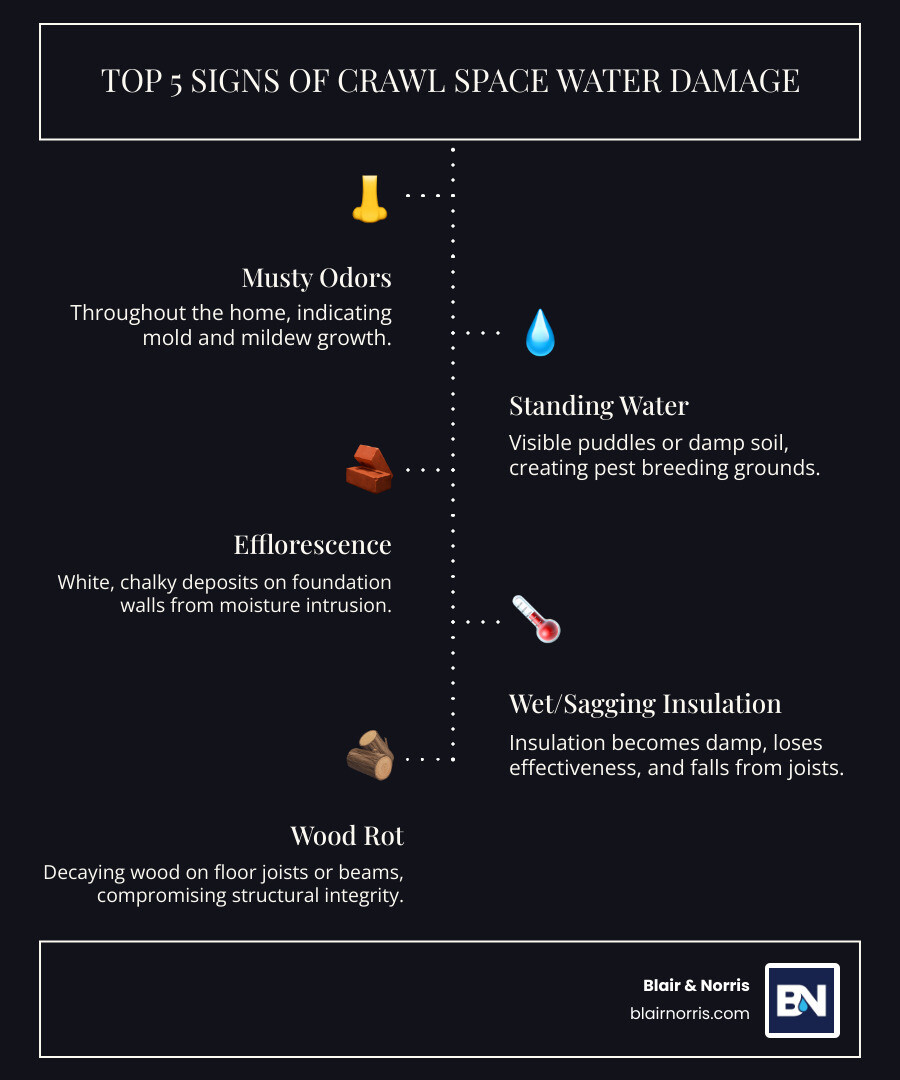
One of the most common and unmistakable indicators of crawl space water damage is a persistent musty odor that seems to permeate your home. This smell, often described as earthy or like damp soil, is the gaseous byproduct of mold and mildew growth flourishing in the dark, damp environment below. As air naturally rises into your living areas through the “stack effect,” it carries these unpleasant odors and invisible, airborne mold spores with it, impacting your entire home. You might notice this smell more prominently on humid days or after a heavy rainstorm. If you find yourself constantly using air fresheners or candles to mask a “basement smell” in your living room, the source is likely beneath you.
Beyond the smell, here are other critical signs we frequently encounter when diagnosing crawl space issues:
- Visible Standing Water: This is the most obvious red flag. Any amount of standing water under your house, whether it’s small puddles after a storm or widespread flooding, is a serious problem that requires immediate attention. It confirms that a water intrusion pathway exists, whether through the walls, the floor, or a plumbing failure. Even if the water eventually recedes, the damage to the wood and the increase in humidity remain.
- High Indoor Humidity: If you notice condensation forming on windows, metal ductwork, HVAC lines, or pipes in the crawl space, it’s a clear sign of excessive humidity. You may also feel a general dampness or clamminess in your home’s air. A simple device called a hygrometer can confirm this; relative humidity levels in a crawl space should ideally be below 60% to prevent mold growth. High humidity also makes your home feel warmer in the summer, leading to higher cooling costs.
- Efflorescence on Foundation Walls: This appears as a white, chalky, crystalline deposit on the surface of concrete or masonry walls. Efflorescence is the mineral salt residue left behind after water seeps through the foundation and evaporates, serving as a clear historical marker of water intrusion. If you see this, water is moving through your foundation blocks, which can eventually weaken the mortar and the concrete itself.
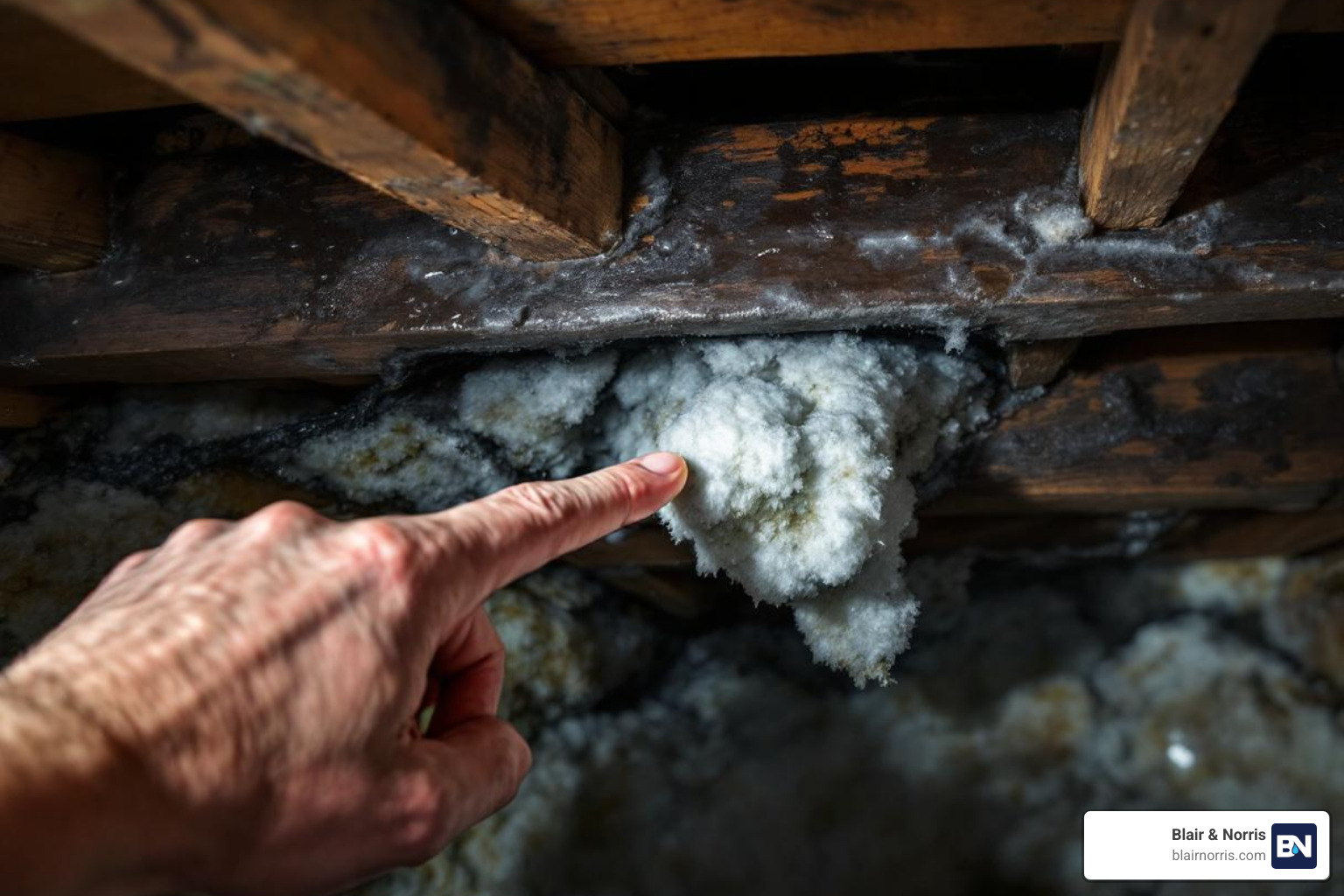
- Damp or Wet Insulation: Fiberglass batt insulation in a crawl space acts like a sponge. When it becomes soaked, it sags, loses its insulating R-value, and becomes a breeding ground for mold. This directly contributes to higher energy bills as your home loses conditioned air to the uninsulated space. Wet insulation also adds significant weight to your floor joists, contributing to structural strain.
- Wood Rot on Joists and Beams: Inspect wooden structures for discoloration, softness, or a crumbly texture. Probing a floor joist with a screwdriver can reveal the extent of the damage. If the wood is soft and spongy, it indicates that wood-destroying fungi have taken hold, compromising the structural integrity of your floor system. This is often accompanied by “bouncy” or uneven floors in the living areas above.
- Pest Infestations: Damp, dark crawl spaces are an open invitation for pests. Termites and carpenter ants are drawn to moist wood, while cockroaches, camel back crickets, spiders, snakes, and rodents seek out the moisture and shelter. An increase in pest activity in your home can often be traced back to the crawl space. Rodents, in particular, can destroy insulation and chew through wiring, creating fire hazards.
- Warped or Cupping Hardwood Floors: If the hardwood floors on your first level are starting to buckle, warp, or cup (where the edges are higher than the center), it’s a strong sign that excessive moisture is rising from the crawl space. The wood absorbs this moisture vapor, causing it to expand and deform. This damage is often permanent and expensive to repair.
- Increased Allergy Symptoms: If family members experience unexplained sneezing, coughing, or itchy eyes while at home, it could be due to mold spores and dust mites originating in the crawl space. The air you breathe is shared with the space below, making crawl space health a matter of personal health.
The Source of the Seepage: Common Causes of Crawl Space Water Intrusion
To permanently solve a water problem, you must first understand its origin. Understanding precisely where the water is coming from is the most critical step in developing an effective strategy to address crawl space water damage. We have helped countless Indianapolis and Central Indiana homeowners pinpoint these sources and implement lasting solutions. Water intrusion typically falls into two categories: sources from outside the home and sources from within. Often, it is a combination of several factors that leads to a saturated crawl space.
Exterior Water Sources and the “Clay Bowl Effect”
- Poor Yard Grading: This is one of the most common culprits. If the ground around your home’s foundation is flat or, worse, slopes toward the house, it acts like a funnel, directing rainwater and snowmelt directly against your foundation walls. Ideally, the soil should slope downward away from the foundation at a grade of at least one inch per foot for the first 5-10 feet. Over time, soil can settle, reversing a once-proper grade.
- Clogged Gutters and Defective Downspouts: Your roof collects a massive volume of water during a storm. If gutters are clogged with leaves and debris, they will overflow, dumping that water in a concentrated area right next to your foundation. Similarly, downspouts that are too short or discharge water less than six feet away from the home will saturate the soil in the worst possible spot. A single inch of rain on a 2,000-square-foot roof produces over 1,200 gallons of water; if that isn’t directed away, it’s going into your crawl space.
- Hydrostatic Pressure: This is the lateral pressure exerted by water in saturated soil. In Central Indiana, our dense clay soil is particularly problematic, creating a “clay bowl effect.” When a home is built, the soil excavated for the foundation is looser than the surrounding undisturbed clay. This loose soil (backfill) absorbs water more easily, creating a “bowl” of water around your foundation. When this bowl fills, the hydrostatic pressure builds and can exert immense force on your foundation walls, forcing water through microscopic pores, hairline cracks, and mortar joints.
- Foundation Cracks: Over time, nearly all foundations develop cracks due to soil movement, settling, or the freeze-thaw cycle. While some hairline cracks are cosmetic, larger vertical or horizontal cracks serve as direct superhighways for groundwater to enter your crawl space. In Indiana, the expansion and contraction of clay soil during seasonal changes accelerate this cracking process.
You can learn more about general moisture issues from Purdue University’s Extension on Controlling Moisture in the Home.
Interior Water Sources
- Plumbing Leaks: A burst pipe is obvious, but slow, insidious leaks from supply lines, drain pipes, or an old water heater located in the crawl space can go undetected for months or years. These drips create a state of perpetual dampness, leading to severe localized damage. Because homeowners rarely visit their crawl spaces, these leaks can cause massive wood rot before they are discovered.
- Condensation: This occurs when warm, humid summer air enters the crawl space through vents and contacts cooler surfaces like metal ducts, water pipes, or even the subfloor. The air cools to its dew point, and the moisture it holds condenses into liquid water, creating constant dripping and dampness. This is why traditional crawl space vents often do more harm than good in Indiana’s humid climate; they essentially act as a straw, pulling in humid air.
- Exposed Dirt Floors: An unsealed dirt or gravel floor in a crawl space is a massive source of moisture. Soil is naturally damp, and through evaporation, an exposed earth floor can release as much as 10-20 gallons of water vapor into the crawl space air every single day, dramatically raising humidity levels. This process, known as capillary rise, happens even if the soil looks dry on the surface.
When evaluating wet crawl spaces, we design comprehensive plans including encapsulation, drainage upgrades, and reliable pumping systems. Explore how these work together in our resources on sump pump solutions in Indianapolis and the cost of installing a sump pump in crawl space.
The High Cost of Neglect: Health, Structural, and Financial Risks
Ignoring crawl space water damage is akin to ignoring a slow-burning fire within the walls of your home. It is a problem that never improves on its own; instead, it silently grows, and its consequences become progressively more far-reaching, destructive, and expensive to remedy. The longer you wait, the more the remediation costs will climb as the damage spreads from the soil to the structure and eventually to the living areas.
Health Hazards and Poor Air Quality
The link between a damp crawl space and your family’s health is direct and well-documented. The primary threat comes from mold, which can begin to grow on wet surfaces within just 24-48 hours. A wet crawl space is a perfect incubator for various types of mold, including allergenic molds and toxigenic ones like Stachybotrys chartarum (black mold). These fungi release microscopic spores and, in some cases, harmful chemical compounds called mycotoxins. These particles are so small they easily pass through floorboards and around utility penetrations.
As the “stack effect” draws these spores and mycotoxins upward into your living space, they can trigger a host of health problems. These range from persistent allergy symptoms like sneezing, coughing, and itchy eyes to severe asthma attacks, bronchitis, and other chronic respiratory conditions. Occupants may also experience headaches, fatigue, and skin irritation. High humidity is also critical for the survival of dust mites, microscopic pests whose waste products are a major indoor allergen. The Indiana Department of Health provides guidance on mold and moisture in homes and how damp conditions contribute to adverse health outcomes. For families with young children or elderly members, these risks are even more pronounced.
Long-Term Structural Damage
Water is a relentless force of destruction against the materials that make up your home’s foundation and structure. Chronic moisture enables wood-destroying fungi to thrive. These organisms consume the cellulose in your floor joists, subflooring, and support beams, breaking them down and turning them into a soft, spongy mass. This decay leads to sagging, bouncy floors, and can eventually result in catastrophic structural failure. Furthermore, water intrusion can erode the soil that supports your foundation footings, creating voids and causing parts of your foundation to sink or settle. This differential settlement manifests throughout the house as large cracks in drywall, doors, and windows that stick or won’t close properly, and sloping floors.
High humidity also creates a corrosive atmosphere that attacks any metal components in the crawl space. This includes steel support columns, HVAC ductwork, plumbing pipes, and even electrical wiring and junction boxes, creating additional maintenance costs and safety hazards. Moisture problems and structural damage are major red flags for home inspectors. When it comes time to sell, these issues must be disclosed, often leading to a significant decrease in your home’s market value or even the cancellation of a sale. The Federal Emergency Management Agency provides context on why crawl spaces require careful detailing—see their overview of crawl spaces in flood-prone areas.
The Perils of DIY: Why Homeowner Fixes Often Fail
When homeowners discover water in their crawl space, the natural instinct is to try and fix it themselves. However, crawl space water damage is a complex issue that requires more than a trip to the local hardware store. DIY attempts often lead to a false sense of security while the underlying problem continues to worsen. Without the proper diagnostic tools and industrial equipment, most DIY fixes are merely cosmetic and fail to address the root cause of the water intrusion.
The Limitations of Shop Vacs and Fans
Using a wet/dry vacuum to remove standing water is a good first step in an emergency, but it is not a solution. Similarly, placing household box fans in a crawl space to “dry it out” is often counterproductive. Without controlling the source of the water and the relative humidity of the air, fans simply circulate damp, mold-spore-laden air throughout the space and potentially into your home. Professional drying requires industrial-grade dehumidifiers and air movers capable of extracting gallons of moisture from the air and the wooden structure itself. Household fans lack the static pressure needed to move air effectively in the cramped, obstructed environment of a crawl space.
The Danger of Improper Sealing
Many DIYers attempt to seal their crawl spaces using thin 6-mil plastic sheeting from big-box stores. This material is easily punctured, often isn’t sealed correctly at the seams or foundation walls, and can actually trap moisture against the wood if installed incorrectly. Even worse, some homeowners attempt to seal foundation cracks from the inside with hydraulic cement without addressing the exterior hydrostatic pressure. This often results in the water simply finding a new path into the crawl space, sometimes causing even more damage by trapping moisture behind the repair. Without a comprehensive understanding of drainage and pressure, DIY sealing is often a temporary bandage on a deep wound. Furthermore, improper sealing can lead to soil gas buildup, such as radon, which requires professional mitigation.
Safety Risks and Cross-Contamination
Entering a damp crawl space without professional-grade personal protective equipment (PPE) is dangerous. You risk exposure to toxic mold, animal waste, and potential electrical hazards from submerged wiring. Furthermore, an untrained individual can easily spread mold spores from the crawl space into the living areas of the home during the “repair” process, turning a localized crawl space issue into a whole-house health crisis. Professional remediation involves setting up containment and using HEPA filtration to ensure the rest of the home remains safe. There is also the risk of structural collapse if a homeowner inadvertently removes or weakens a support while trying to replace rotted wood.
The Blair & Norris Professional Approach: Engineered Solutions
Achieving a dry, healthy crawl space requires a multi-faceted, engineered approach that addresses both the symptoms and the root causes of water intrusion. At Blair & Norris, we don’t believe in one-size-fits-all fixes. We provide comprehensive professional sump pump solutions in Indianapolis tailored to the specific needs of your home. Our process begins with a thorough inspection to identify every point of entry for water and moisture.
Full Crawl Space Encapsulation
Encapsulation is the gold standard for long-term protection. This process involves lining the entire crawl space with a heavy-duty, 20-mil, puncture-resistant vapor barrier. Unlike DIY plastic, our liners are mechanically fastened to the foundation walls and every seam is permanently sealed with waterproof tape. We also seal all foundation vents and insulate the walls, effectively bringing the crawl space into the conditioned envelope of your home. This stops the “stack effect” from pulling contaminated air into your living spaces and significantly reduces energy costs. An encapsulated crawl space becomes a clean, dry area that can even be used for extra storage.
Advanced Sump Pump and Drainage Systems
For homes facing groundwater issues, a robust sump pump installation is essential. We install high-capacity, cast-iron pumps in specialized basins designed to prevent clogging. These systems are often paired with interior French drains—perforated pipes installed in a trench along the perimeter of the crawl space—to collect water before it ever reaches your floor. To ensure your home is protected even during the worst Indiana storms, we offer battery backup systems that take over if the power fails, providing 24/7 peace of mind. Our drainage systems are designed to handle the specific volume of water common in Central Indiana’s heavy rain events.
Commercial-Grade Dehumidification
Even an encapsulated crawl space needs humidity control. We install energy-efficient, commercial-grade dehumidifiers specifically designed for the low-clearance, high-moisture environment of a crawl space. These units are self-draining, meaning you never have to crawl under your house to empty a bucket. They maintain the relative humidity below 50%, ensuring that mold can never gain a foothold in your home again. These units are far more powerful and durable than anything found in a retail store, and they are designed to operate efficiently in the cooler temperatures of a crawl space.
Conclusion: Your Foundation for a Healthy Home
Crawl space water damage is a formidable threat that silently undermines your home’s structural foundation, your family’s respiratory health, and your property’s long-term value. As we’ve explored, the consequences are far-reaching, progressing from musty odors and annoying pests to rampant mold growth and devastating structural decay. Ignoring the signs of water in your crawl space is a gamble that never pays off; the problem will only worsen, leading to exponentially more complex and costly repairs down the line. A dry crawl space is not just a luxury; it is a fundamental requirement for a safe and durable home.
At Blair & Norris, we have spent over 75 years perfecting the art of keeping Indiana homes dry. Our family-owned business is built on a legacy of trust and ethical, high-quality service. We understand the unique challenges of Central Indiana’s clay soil and seasonal weather patterns. Whether your home requires exterior grading improvements, a full crawl space encapsulation, or a state-of-the-art sump pump system, we conduct a thorough assessment and provide clear, honest recommendations. We take pride in our craftsmanship and the peace of mind we provide to our neighbors throughout the Indianapolis metropolitan area.
Don’t allow moisture to compromise your home’s integrity or your family’s health. Take the proactive step today to protect your property and secure your peace of mind for years to come. A healthy home starts with a dry foundation. For an expert assessment and reliable, long-term solutions, contact the professionals who know Indiana foundations best. We are ready to help you transform your crawl space from a liability into an asset.
Contact us for professional sump pump solutions in Indianapolis to book your on-site evaluation and let us help you build a dry, healthy foundation for your home’s future.