
What Is a Geothermal Heat Pump — and Is It Right for Your Indiana Home?
For over 75 years, the families of Central Indiana have looked to the ground for their most essential resources. At Blair & Norris, we have spent decades mastering the art of water systems and underground infrastructure. Today, that same earth that provides your water is offering a revolutionary way to manage your home’s climate. A geothermal heat pump is a sophisticated heating and cooling system that taps into the stable, moderate temperatures found just a few feet below the frost line. By utilizing the earth as a massive thermal battery, these systems provide unparalleled comfort while using significantly less energy than conventional combustion-based systems.
In the heart of the Midwest, our weather is anything but predictable. We experience the biting chill of Arctic blasts in January and the sweltering, humid heat of July. Traditional HVAC systems are forced to fight these extremes, working harder as the outside air becomes more hostile. A geothermal heat pump changes the game by relying on stable ground temperatures instead of outdoor air. Instead, it connects your home to the constant 55-degree environment of the Indiana soil. This stability allows the system to operate at peak efficiency regardless of whether there is a blizzard or a heatwave outside your window.
Here’s a quick summary of what you need to know about a geothermal heat pump:
| Question | Quick Answer |
|---|---|
| How does it work? | Transfers heat between your home and the ground via buried pipe loops |
| Ground temperature used | 50–60°F year-round, just 10 feet below the surface |
| Energy savings | 30–70% less on heating and cooling costs |
| Works in cold climates? | Yes — ground temperature stays constant even when it’s freezing outside |
| Typical payback period | 5–10 years depending on energy costs and available incentives |
| System lifespan | Indoor unit: up to 24 years; ground loop: 50+ years |
If your home struggles to stay consistently comfortable through Indiana’s winter cold and summer humidity, you are not alone. Many homeowners in Marion, Hamilton, and Johnson Counties are stuck in a cycle of rising fuel costs and unpredictable performance from aging equipment. The good news is that there is a proven, long-term alternative that has been quietly working underground for decades.
Geothermal heat pumps are widely recognized for high efficiency and low on-site emissions compared with combustion-based heating. ENERGY STAR certified models use 61% less energy than standard conventional systems. This is not just a minor upgrade; it is a complete rethink of how your home manages temperature by partnering with the natural geology of the Midwest. By moving heat rather than creating it through combustion, we can achieve efficiencies that seem impossible to those used to traditional furnaces.
This guide covers everything: how these systems work, the different types of loops available, what a professional installation involves, the financial incentives available to you, and why getting it right the first time matters more than you might think. I’m Mack Blair, and my experience with well systems and ground-based infrastructure across Central Indiana has given me a front-row seat to how this technology performs in real-world conditions. If you’re considering making the switch, I want to make sure you have the honest, practical information you need to make a confident decision for your family’s future.
The Hidden Costs of Traditional Heating and Cooling
For many families in Indianapolis and the surrounding communities like Carmel and Fishers, the “standard” way of managing a home’s climate is starting to feel like a financial burden. Traditional systems rely heavily on fossil fuel dependency. Whether you are utilizing natural gas, propane, or heating oil, you are at the mercy of volatile market prices that seem to spike exactly when the Indiana frost hits its hardest. These fluctuations make it nearly impossible to budget for winter months, leading to seasonal financial stress and the dreaded “sticker shock” of a mid-winter utility bill.
Beyond the monthly bill, there is the environmental toll. Conventional combustion systems contribute significantly to greenhouse gas emissions, releasing carbon dioxide and other pollutants directly into the atmosphere. There is also the invisible danger: any system that burns fuel indoors carries a risk of carbon monoxide leaks. While we all use detectors, the safest combustion is the one that never happens. By moving away from flame-based heating, you eliminate a primary source of indoor air quality concerns and the potential for catastrophic equipment failure related to gas lines or burners.
Furthermore, ambient air-exchange systems often struggle in our Midwestern winters. When the temperature drops below freezing, an air-source unit has to work overtime to “squeeze” heat out of the frigid air, often relying on expensive electric backup heat strips. These “emergency heat” settings can cause your electric meter to spin at an alarming rate. This leads to massive energy waste and a shorter equipment lifespan as the unit strains to meet demand. ENERGY STAR certified geothermal heat pumps solve this by ignoring the air temperature entirely and looking to the ground for a steady, reliable partner. By avoiding the extreme wear and tear caused by sub-zero air, geothermal systems maintain their efficiency and integrity for much longer than conventional alternatives, providing a smoother, more consistent heat that doesn’t feel “dry” or “forced.”
How a Geothermal Heat Pump Works
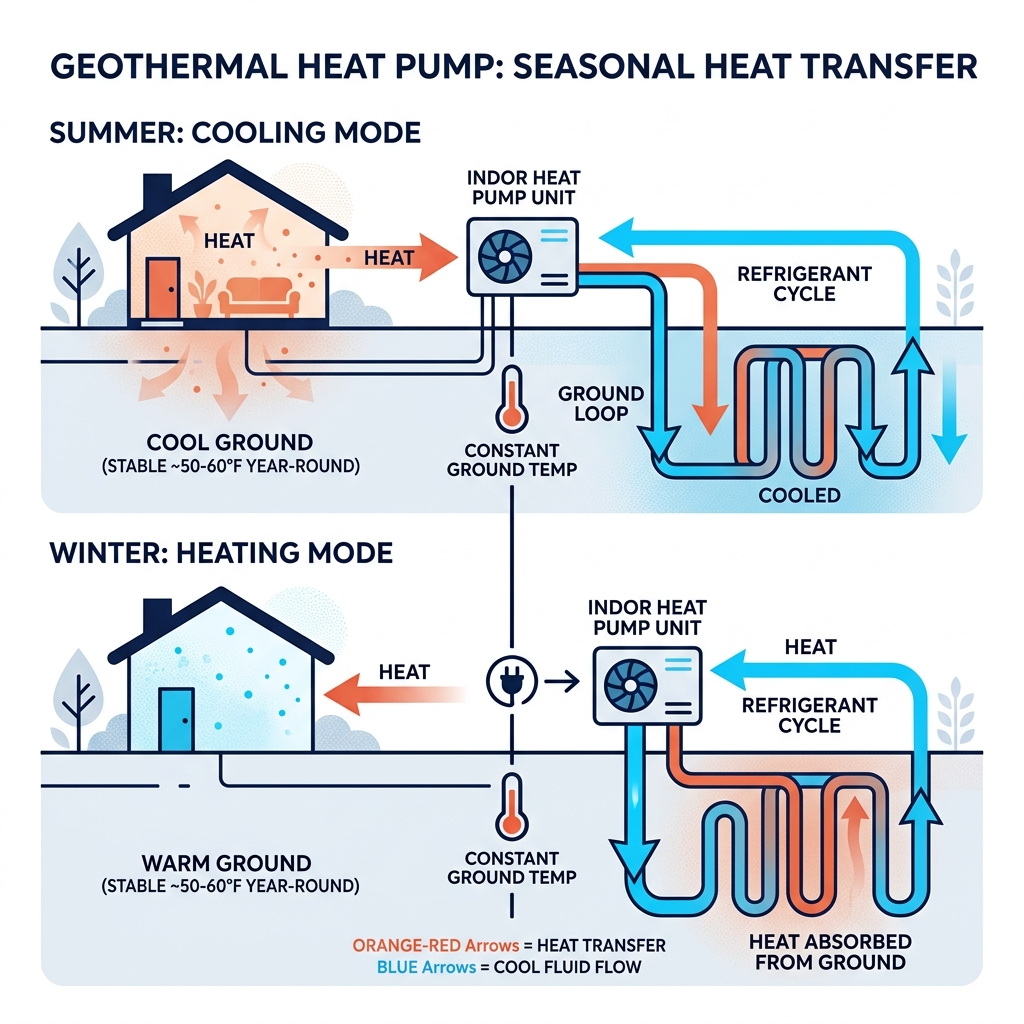
To understand a geothermal heat pump, think of it like a refrigerator that can run in reverse. While a fridge moves heat from inside the box to your kitchen, a geothermal system moves heat between your home and the earth. This process is grounded in the laws of thermodynamics, specifically the movement of thermal energy from a warmer area to a cooler one. It is a cycle of extraction and rejection that leverages the earth’s natural ability to store solar energy.
The magic happens because of thermal energy transfer. While Indiana air temperatures can swing from -10°F in January to 95°F in July, the earth just 10 feet below our feet stays a remarkably consistent 50–60°F. This is our “baseline.” In the winter, the system circulates a water-based solution through buried pipes. This fluid absorbs the natural heat from the earth and carries it to the indoor heat exchanger. The heat pump then uses a compressor to concentrate that energy, raising its temperature significantly before distributing it through your home’s ductwork. This is the core advantage of a geothermal heat pump: it starts from stable ground temperatures instead of extreme outdoor air.
In the summer, the process reverses seamlessly. The unit pulls excess heat out of your home and “rejects” it into the cooler ground. Because the ground is significantly cooler than the 90-degree Indiana summer air, the system doesn’t have to work nearly as hard to keep your living space comfortable. Many systems even include a “desuperheater,” which is a secondary heat exchanger. This component takes the heat pulled from your home during the cooling cycle and uses it to provide virtually free hot water for your showers, dishwasher, and laundry. It’s a closed-loop cycle of efficiency that works with nature rather than fighting against it, providing a level of consistency and humidity control that ambient air systems simply cannot match. The result is a home that feels perfectly tempered year-round without the noisy cycling of a traditional outdoor AC condenser.
Types of Geothermal Heat Pump Systems
No two properties in Central Indiana are exactly alike. A farm in Shelbyville has different land options than a suburban lot in Noblesville or Zionsville. Choosing the right configuration is essential for comfort, efficiency, and long-term reliability. The geology of your specific lot, whether it is heavy clay, loamy soil, or sits atop a high water table, will dictate the most efficient loop design.
| System Type | Best For… | Key Requirement |
|---|---|---|
| Horizontal Loop | New construction or large rural lots | Sufficient yard space for trenching |
| Vertical Loop | Typical suburban lots or commercial sites | Deep drilling (100–400 feet) |
| Pond/Lake Loop | Properties with existing bodies of water | Minimum depth and water volume |
| Open-Loop | Homes with high-yield water wells | Quality groundwater and discharge options |
When choosing and installing geothermal systems, we look closely at soil thermal conductivity. Some soils, like the heavy clay found in parts of Hendricks County, transfer heat differently than the sandy soils of northern Indiana. This dictates exactly how much pipe we need to bury to keep your home comfortable. If the soil is dry and sandy, we might need more loop length; if it is moist clay, the heat transfer is often superior.
Closed-Loop Geothermal Heat Pump Configurations
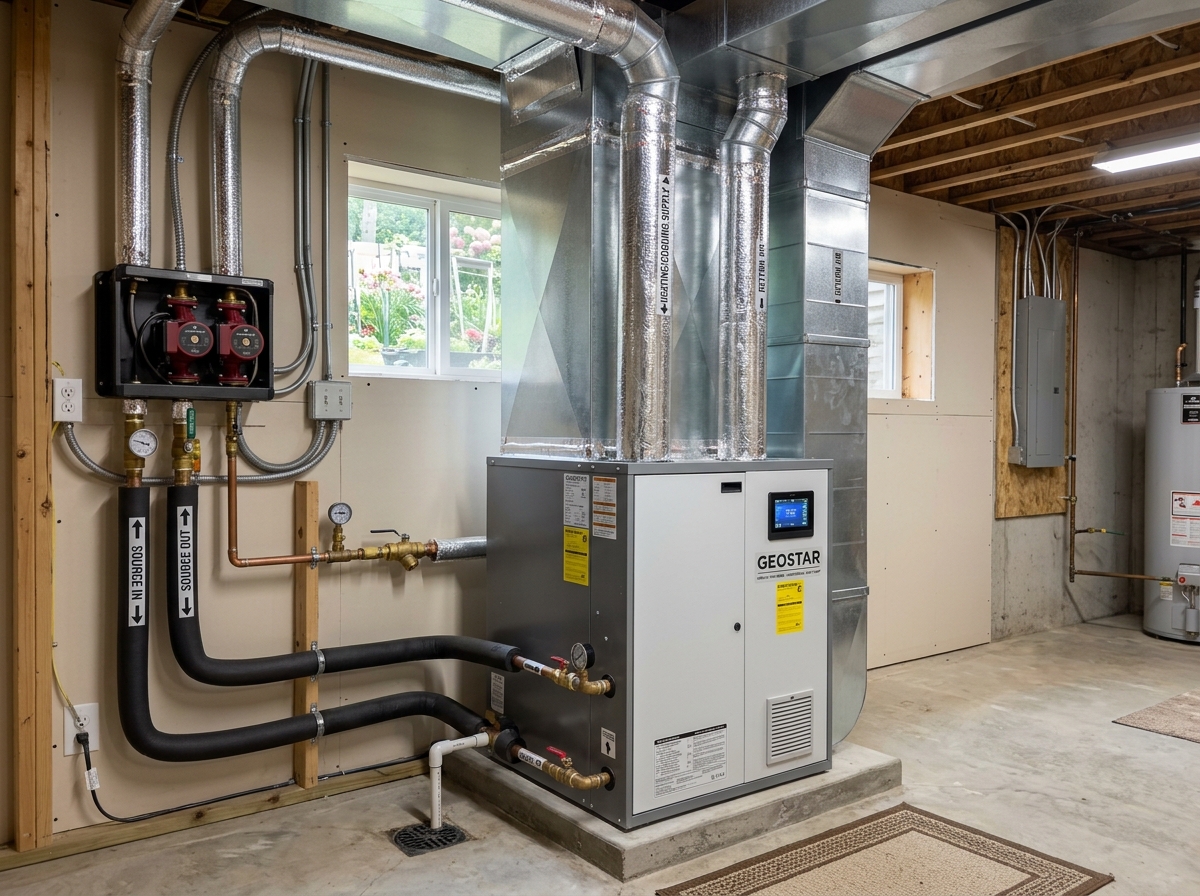
Most residential geothermal heat pump installations use a closed-loop system. These consist of high-density polyethylene (HDPE) pipes filled with an environmentally friendly antifreeze solution.
- Horizontal Trenches: These are often the most cost-effective if you have the space. Pipes are placed in trenches roughly 4 to 6 feet deep. A common variation is the “slinky” loop, where the pipe is coiled to fit more heat-exchange surface area into a shorter trench. This is a popular choice for homeowners in more rural areas like Danville or Martinsville.
- Vertical Boreholes: If space is tight, we drill small-diameter holes 100 to 400 feet deep. This requires specialized drilling equipment—the kind Blair & Norris has operated for decades—but leaves a very small footprint on your landscaping. Once the pipes are inserted, the holes are filled with a specialized thermal grout that ensures a tight bond between the pipe and the earth for maximum heat transfer.
Proper grouting techniques are vital here. The “grout” is a thermal conductor that fills the space between the pipe and the earth, ensuring the heat actually moves efficiently into the system. To keep these running at peak performance, we recommend professional maintenance services to check loop pressures and fluid integrity.
Open-Loop Geothermal Heat Pump Requirements
In some properties, a geothermal heat pump can use an open-loop design that draws groundwater—this is where experienced well pump services matter most. Instead of circulating the same fluid over and over, it draws fresh groundwater directly from a supply well. After the heat is extracted (or added), the water is discharged back into the ground through a second “return” well or a surface drainage area. This requires a reliable groundwater source and strict adherence to water quality standards to prevent mineral buildup in the heat exchanger. Because this system interacts with your well, having emergency well pump support is a smart safety net. While highly efficient, these systems are subject to local environmental regulations to ensure we are protecting Indiana’s aquifers and maintaining the integrity of the local water table.
The Risks of DIY Geothermal Installation
We know Hoosiers are a handy bunch. We love a good weekend project, but a geothermal heat pump is not the place for DIY. This isn’t just about “plugging it in”—it involves complex geology, physics, and high-pressure mechanical systems that require specialized training and expensive equipment. Attempting to install these systems without proper training can lead to performance failures, property damage, and compliance issues.
One of the biggest risks is improper loop sizing. If the loop is too short, the system won’t be able to keep up with an Indiana heatwave or a polar vortex, leading to a home that is never quite comfortable. We’ve seen DIY attempts lead to excavation hazards, refrigerant handling errors, and even soil contamination if the wrong materials are used. Furthermore, most manufacturers will void your warranty if the system isn’t installed by a certified professional, leaving you with no recourse if a major component fails.
Our geothermal cooling guide 2025 emphasizes that system balancing is an art. If the flow rates aren’t perfect, you’ll lose all those energy savings you were hoping for. Following International Ground Source Heat Pump Association (IGSHPA) standards is the only way to ensure your system is safe, legal, and efficient. At Blair & Norris, we handle the permitting, the drilling, and the technical calibration so you can enjoy the comfort without the stress of potential regulatory violations or system underperformance. We use fusion-welding techniques on the pipes that create joints stronger than the pipe itself—something that is impossible to replicate with standard plumbing tools.
Incentives, Eligibility, and Why Installation Quality Matters
The initial investment of a geothermal installation can be higher than that of conventional systems, but it is important to look at the total cost of ownership. The long-term financial picture is incredibly bright for Indiana homeowners. Federal programs may offer credits for qualifying geothermal heat pump installations; eligibility depends on current rules and how the system is placed in service. This credit is uncapped, meaning it applies to the full project cost, significantly lowering the barrier to entry and shortening the time it takes for the system to pay for itself.
When you look at certified product performance data, you see that these units can cut home heating and cooling costs by 30 to 70 percent. In a typical Indiana home, that can mean saving over $1,600 in energy costs in just the first year. Over time, these savings add up to tens of thousands of dollars. Most of our customers see a full payback period in 5 to 10 years. After that, the energy savings are pure profit, effectively shielding your family from future energy price hikes.
Plus, because the ground loops are warranted for 50 years (and often last much longer), you are essentially installing a permanent piece of energy infrastructure that increases your property value significantly. Real estate studies have shown that energy-efficient homes sell faster and for higher prices. Unlike conventional units that need replacement every 12-15 years, the most expensive part of your geothermal system—the loop—will likely outlast the mortgage on your home. This makes geothermal one of the few home improvements that truly pays for itself while providing superior comfort and a smaller carbon footprint. For business owners, there are even additional accelerated depreciation benefits (MACRS) that can further enhance the return on investment for commercial geothermal applications.
Frequently Asked Questions about Geothermal Systems
How long does a geothermal system last?
One of the best things about geothermal is its longevity. The indoor components typically last about 24 to 25 years—significantly longer than a standard conventional unit which usually lasts 12 to 15 years. The ground loop itself is virtually permanent, with most installers offering a 50-year warranty, though the high-density polyethylene pipes are expected to last 75 to 100 years. This durability is a hallmark of the technology, providing peace of mind for generations and reducing the frequency of major capital expenditures for your home.
Do geothermal heat pumps work in cold climates?
Absolutely. In fact, they are better for cold climates like ours in Central Indiana than ambient air-source pumps. Because they draw from the 50–60°F earth rather than the 0°F air, they don’t lose efficiency when the temperature drops. They provide consistent, comfortable heat even in the middle of a blizzard without needing a gas-fired backup or expensive electric resistance heat. This reliability is why they are becoming the standard for high-end, energy-conscious homes throughout the Midwest and even into Canada.
What are the maintenance requirements for these systems?
Maintenance is surprisingly low compared to traditional HVAC. You’ll need to change your air filters regularly, just like any climate control system, to ensure proper airflow. Beyond that, an annual inspection to check loop pressure, antifreeze levels, and pump station performance is all it takes to keep things running smoothly. There are no outdoor condensers to get clogged with cottonwood seeds, damaged by Indiana hail storms, or rusted by the elements. This lack of outdoor equipment further reduces the long-term maintenance burden and the potential for emergency repairs during peak season. Additionally, because the system doesn’t use combustion, there is no need for annual chimney inspections or burner cleanings.
Conclusion
Making the switch to a geothermal heat pump is a significant step toward energy independence and long-term home comfort, but it is one that pays dividends for decades. At Blair & Norris, we have spent 75 years serving the Indianapolis community with ethical, high-quality water systems and mechanical services. As a family-owned business, we believe in doing things the right way—not the fast way. We understand the unique geology of Indiana, from the heavy clays of the south to the glacial tills of the north, and we have the specialized equipment and expertise to ensure your ground loop is installed perfectly.
Whether you are in Noblesville, Greenwood, or right here in Marion County, we are ready to help you navigate the transition to renewable home comfort. We offer 24/7 live phone support because we know that when it comes to your home’s climate and water systems, questions don’t always happen during business hours. Our reputation is built on three generations of trust, and we bring that same commitment to every geothermal project we undertake, ensuring your system is sized correctly and installed to last a lifetime.
A geothermal heat pump performs best when the design matches the property. Soil conditions, available land area, and groundwater requirements (for open-loop systems) can all impact reliability—especially when well pump services are part of the setup. If you want fewer surprises and a system designed to run as intended, contact us today to talk through options with Blair & Norris.