
Why Geothermal Drilling Services in Indiana Are Worth Your Attention
Geothermal drilling services in Indiana give homeowners a reliable way to improve year-round comfort by using the earth’s stable temperatures. However, the decision to transition to geothermal is often born out of a core problem: the growing uncertainty around conventional heating and cooling performance in Indiana’s extreme seasons in the Midwest. Indiana homeowners face a unique challenge with a climate that swings from sub-zero winters to sweltering, humid summers. This puts an immense strain on conventional HVAC systems, leading to more strain on HVAC equipment and inconsistent comfort.
Here’s a quick snapshot of what you need to know:
| Topic | Key Facts |
|---|---|
| Energy impact | Geothermal systems can significantly reduce heating and cooling energy use. |
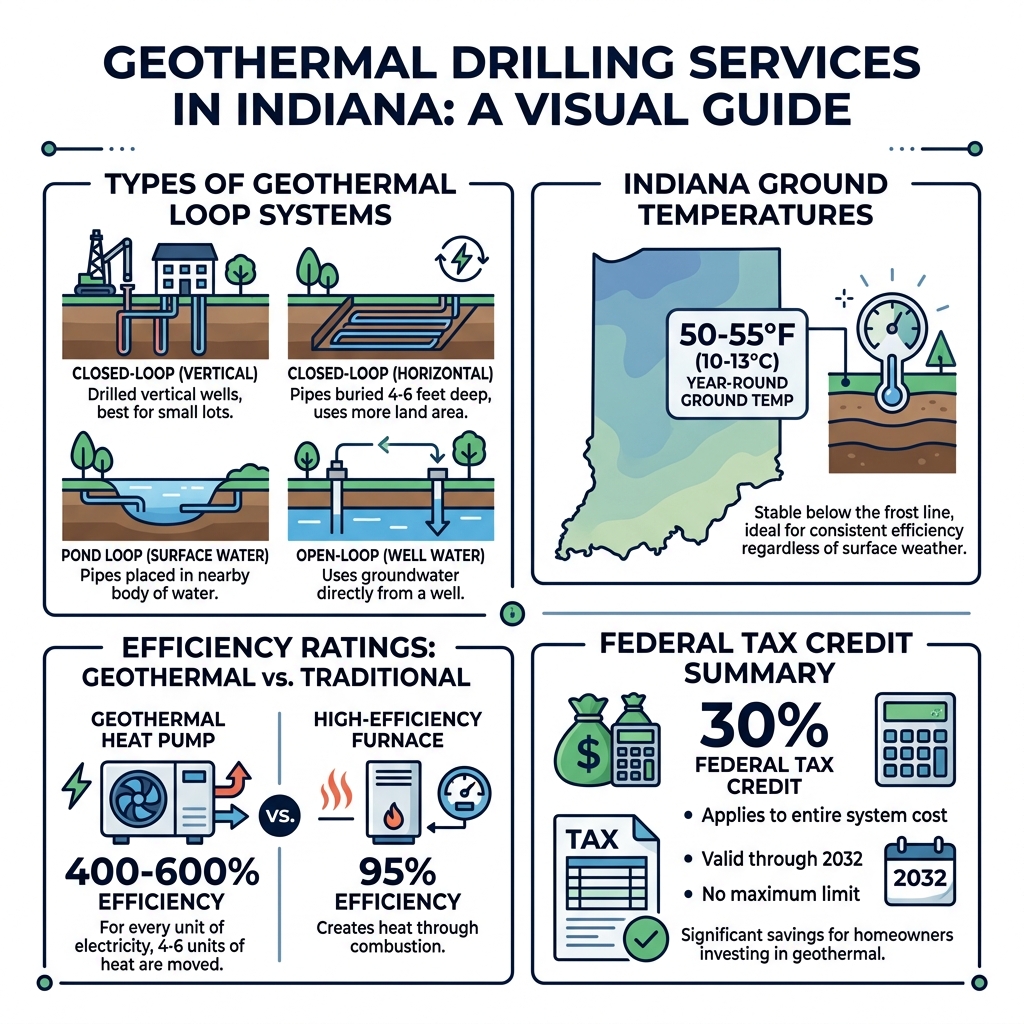
| Efficiency rating | 400-600% vs. 95% for high-efficiency furnaces |
| Project timeline | Most installations can be planned and completed in phases (site assessment → drilling → loop install → HVAC integration). |
| Federal tax credit | 30% through 2032 |
| Ground loop lifespan | 50+ years |
| Indiana ground temp | 50-55°F year-round — ideal for geothermal |
| Main system types | Open-loop, closed-loop (horizontal or vertical), pond loop |
Indiana’s climate is actually ideal for geothermal. Below the frost line, ground temperatures hold steady at around 50-55°F no matter how cold or hot it gets at the surface. That consistency is what makes geothermal heat pumps so efficient here — your system isn’t fighting extreme temperatures to do its job. But the core problem remains: how do you access that energy safely and efficiently?
Choosing the wrong contractor can mean wasted money, damaged property, or a system that never performs the way it should. This guide walks you through everything — from how these systems work to what separates a great contractor from a risky one — so you can make a confident decision for your home. If you are ready to see how geothermal can transform your home’s efficiency, Contact Blair & Norris for a Geothermal Estimate.
I’m Mack Blair, founder of Blair & Norris and a Central Indiana drilling professional with over 30 years of hands-on experience in well drilling, pump systems, and geothermal drilling services in Indiana. I’ve built this company from the ground up, and everything in this guide reflects what I’ve learned working in this region’s soil, geology, and climate firsthand.
The Economic and Environmental Impact of Indiana HVAC
When we talk about heating and cooling in Indiana, we aren’t just talking about comfort; we’re talking about one of the largest expenses a homeowner faces. Traditional HVAC systems—like gas furnaces and electric air conditioners—are essentially “fighting” the outside air. In a humid Indiana July, your AC is trying to dump heat into 90-degree air. In a freezing January, your furnace is trying to create heat from scratch. This “brute force” approach to climate control is the core problem. It is inefficient, expensive, and environmentally taxing. To understand why this is so effective, we have to look at the physics of heat transfer. Traditional systems rely on the Second Law of Thermodynamics in a way that forces them to work harder as the temperature gradient increases. In Indiana, where summer humidity can make 90 degrees feel like 105, a standard air conditioner is struggling to push heat into an already saturated atmosphere.
Geothermal changes the game. Instead of creating heat, it simply moves it. Because the ground in Central Indiana stays between 50°F and 55°F year-round, the system has a massive head start. This allows for a geothermal-heating efficiency that is truly staggering. While a high-efficiency gas furnace might hit 95% efficiency, geothermal systems regularly achieve 400% to 600% efficiency. For every unit of electricity used to power the pump, you get four to six units of heat. This isn’t just a minor improvement; it is a fundamental shift in how we power our lives. Geothermal bypasses the struggle of traditional units entirely. By utilizing the earth as a heat sink in the summer and a heat source in the winter, the system operates within a much narrower temperature range. This “thermal equilibrium” is the secret behind the massive savings.
This efficiency translates directly to your wallet and the planet. Geothermal heat pumps can reduce energy consumption and corresponding emissions by up to 44% compared to air-source heat pumps and up to 72% compared to standard electric resistance heating. If you’re looking for a comprehensive geothermal-cooling-guide-2025, you’ll find that the summer savings are just as impressive, as the earth acts as a perfect heat sink. The implications are clear: lower bills, a more comfortable home, and a reduced reliance on the fluctuating prices of fossil fuels.

Maximizing ROI with Geothermal Drilling Services in Indiana
We often get asked if the initial investment is worth it. The answer lies in the “Payback Period.” Homeowners typically evaluate geothermal by looking at comfort consistency, equipment longevity, and energy-use efficiency. After that point, the system has essentially paid for itself through lower utility bills, and you continue to save for decades. One of the biggest boosters for your Return on Investment (ROI) is the 30% Federal Tax Credit, which is currently available through 2032. This credit applies to the entire cost of the system, including the geothermal drilling services in Indiana. When you factor in these incentives and the fact that a ground loop lasts over 50 years, the long-term value is undeniable. For a deeper look at how these costs break down, check out the-well-drilling-cost-guide. If you’re considering geothermal, start with a site assessment to confirm loop options and drilling requirements. Contact Blair & Norris for a Geothermal Estimate to get a customized quote for your property.
The Dangers of Unqualified and DIY Geothermal Drilling
It might be tempting to think that “digging a hole is just digging a hole,” but when it comes to geothermal, that mindset is dangerous. Geothermal drilling involves navigating complex soil mechanics and protecting our precious Indiana aquifers. The risks of DIY or unqualified drilling are not just financial; they are environmental and legal.
When an unqualified person attempts drilling-wells, they risk hitting underground utility lines—gas, fiber optic, or water—which can lead to massive fines, service interruptions for your neighbors, and severe safety hazards. Furthermore, Indiana has strict regulations regarding how wells are bored and sealed to prevent surface contaminants from reaching the groundwater. An improperly sealed borehole can act as a direct conduit for pesticides, fertilizers, and bacteria to enter the local water supply, creating a liability that could haunt a property owner for years.
Risks of Improper Loop Installation
The success of a geothermal system depends entirely on “thermal conductivity”—how well the heat moves between the ground and your pipes. If a driller doesn’t use the correct specialized grout, or if they leave air pockets around the loop, the system won’t work. It’s like having a high-performance engine with no fuel line. You will have paid for a premium system that performs no better than a standard air-source unit.
Improper installation can also lead to loop leaks. While the antifreeze solutions used are generally eco-friendly, a leak still means your system fails and requires expensive excavation to fix. We always recommend reading these 6-crucial-questions-to-ask-before-drilling-a-well to ensure your contractor knows their stuff. A botched job doesn’t just cost money; it can lead to environmental contamination that you, as the property owner, are liable for. To understand the full scope of what can go wrong, see our drilling-well-ultimate-guide-2025. Avoid the nightmare of a failed installation by choosing a partner who understands the unique geology of Central Indiana.
Top 10 Standards for Geothermal Drilling Services in Indiana
If you are looking for the best geothermal drilling services in Indiana, you need to look for specific credentials. You shouldn’t just hire anyone with a rig. A great service partner must demonstrate technical mastery and ethical business practices. Here are the standards we live by at Blair & Norris:
- IGSHPA Certification: The International Ground Source Heat Pump Association is the gold standard for geothermal professionals.
- State Licensing: Every driller must be licensed through the Indiana Department of Natural Resources (DNR).
- Advanced Equipment: Using modern rigs that can handle Indiana’s varied glacial till and limestone.
- Grouting Expertise: Ensuring a “bottom-up” grouting process for 100% thermal contact and aquifer protection.
- Site Assessment: Performing a thorough geological survey before the first bit hits the dirt.
- Clean Site Management: Using mud recycling systems to keep your yard from becoming a swamp.
- Insurance: Full liability and workers’ comp—no exceptions.
- Experience: A track record of hundreds, if not thousands, of successful loops in the local area.
- Transparent Communication: Explaining the “why” behind the loop design and depth.
- Ethical Business Practices: Clear scope and documentation: written drilling plan, loop design details, and permitting responsibilities defined upfront.
You can actually look up Indiana DNR Well Logs to see the history of drilling on or near your property. For more on what to look for, see our guide on the 11-traits-of-the-best-well-drilling-companies.
Technical Precision: The Mud Puppy Advantage
One thing that sets the “pros” apart is the equipment. At Blair & Norris, we are big believers in using Mud Puppy Equipment. If you aren’t familiar, a Mud Puppy is a specialized mud recycling system that is essential for high-quality geothermal drilling services in Indiana.
When we drill, we use “drilling mud” to keep the bit cool and bring cuttings to the surface. Without a recycler, that mud ends up all over your lawn, creating a massive mess and requiring significant remediation. The Mud Puppy filters the mud, separates the dirt and rock using centrifugal force, and allows us to reuse the clean fluid. This means a much cleaner job site, less water waste, and a more efficient drilling process. The Mud Puppy system is not just about cleanliness; it’s about the integrity of the borehole. By continuously filtering the drilling fluid, we ensure that the viscosity is perfect for stabilizing the walls of the hole as we descend through Indiana’s tricky limestone layers. This prevents cave-ins and ensures that when we drop the loop, it reaches the full intended depth without obstruction.
It’s the difference between a surgical procedure and a mud wrestle. By using Mud Puppy Equipment, we ensure that your property remains as pristine as possible while we install your new energy system. This commitment to clean, efficient drilling is why we are the preferred choice for homeowners in Carmel, Fishers, and beyond. Furthermore, the clean mud recycling process significantly reduces the amount of water we need to bring onto your property, making the entire operation more sustainable and less intrusive for your neighbors.
Understanding the Installation: Geothermal Drilling Services in Indiana
There isn’t a “one-size-fits-all” loop. The right choice depends on your property size, soil type, and whether you have a body of water nearby. Understanding these options is key to a successful installation.
- Vertical Loops: These are the most common in Central Indiana, especially on smaller residential lots in places like Carmel or Fishers. We drill holes 150 to 400 feet deep, insert the U-bend pipe, and grout it solid. This method requires the least amount of surface area and is ideal for established neighborhoods.
- Horizontal Loops: If you have an acre or more of open space, we can use a trencher or backhoe to lay pipes about 4 to 6 feet deep. This option can be a practical fit when you have sufficient open space, though it may involve more surface disruption during installation.
- Pond Loops: Pond loops can reduce the need for deep boreholes when a suitable body of water is available.
The 7-steps-that-need-to-happen-for-well-drilling apply here too—from permitting to final hookup. If you’re in the city, you’ll want to check out what-to-know-about-residential-well-drilling-in-indianapolis to navigate local ordinances. Ready to find out which loop is right for you? Contact Blair & Norris for a Geothermal Estimate.
Long-term Reliability of Geothermal Drilling Services in Indiana
Once the loops are in the ground, they are incredibly durable. High-density polyethylene (HDPE) pipes are fused together using heat, creating a joint that is actually stronger than the pipe itself. These ground loops are designed to last 50 to 100 years.
The indoor components—the heat pump itself—typically last about 25 years, which is significantly longer than the 12-15 year lifespan of a standard air conditioner. Because the system is indoors, it isn’t exposed to Indiana’s harsh snow, rain, or nesting critters. We use a specialized antifreeze solution (often a mix of water and ethanol or propylene glycol) to ensure the fluid never freezes, even during a “Polar Vortex.” This reliability is why so many Central Indiana residents are making the switch.
Good, Better, Best: Investment, Financing, and ROI
We believe in giving our neighbors options. Here is how we typically categorize geothermal projects based on property needs and budget. Each level provides incredible efficiency, but the “Best” option offers the most versatility for Indiana’s varied landscapes.
| Feature | Good (Pond Loop) | Better (Horizontal) | Best (Vertical) |
|---|---|---|---|
| Land Needed | Existing 8ft Deep Pond | Large Open Field | Small/Standard Yard |
| Drilling Depth | N/A (Submerged) | 4-6 Feet | 150-400 Feet |
| Efficiency | High | High | Maximum |
| Property Impact | Minimal | High (Trenching) | Low (Boreholes) |
| Ideal For | Rural properties with water | New construction on acreage | Suburban lots/Retrofits |
For larger residential or commercial installations, plan for additional design coordination, permitting, and site logistics. To get a better sense of the numbers, see our cost-to-drill-well resource.
Incentives and Rebates for Indiana Homeowners
Beyond the federal tax credit, Indiana’s incentive rules can change. For current guidance, rely on official state resources and a qualified tax professional before making assumptions. In Indiana, state law (IC 6-1.1-12-34.5) allows for a deduction from the assessed value of your real property if it contains a solar, wind, or geothermal energy heating or cooling system. This means that the added value a geothermal system brings to your home is exempt from property tax. If your system adds $20,000 in value to your home, you aren’t taxed on that increase. This ensures that your investment in green technology doesn’t result in a higher annual tax burden.
Some homeowners may be eligible for incentives depending on equipment and program rules; verify current options with official sources. You can learn more about the financial side in our guide: what-is-the-water-well-drilling-cost. The combination of the 30% federal tax credit, which covers both the heat pump unit and the extensive geothermal drilling services in Indiana, along with property tax exemptions and utility rebates, makes geothermal one of the smartest financial moves an Indiana homeowner can make. You are essentially using future energy savings and tax breaks to pay for a premium asset today.
Frequently Asked Questions
How long does the geothermal drilling process take in Indiana?
For a standard residential home, the drilling and loop installation usually takes 2 to 4 days. The total HVAC transition, including indoor work, typically takes about a week. We strive to minimize disruption to your daily life during this process.
What maintenance is required for a geothermal ground loop?
Almost none! The ground loop is a closed system. We recommend an annual checkup of the indoor heat pump—checking air filters, condensate drains, and loop pressure—but the pipes in the ground are “set it and forget it.” This is a major advantage over traditional systems that require frequent outdoor maintenance.
Is my Indiana property suitable for a vertical or horizontal loop?
If you have a large, clear backyard with no underground utilities, a horizontal loop is a great cost-saver. If you have a wooded lot or a standard suburban yard in a place like Noblesville or Greenwood, a vertical loop is the way to go because it has a very small “footprint.” We can help you determine the best fit during our initial site assessment.
Will geothermal work during an Indiana winter?
Absolutely. Because the ground temperature 200 feet down stays at 50-55°F, the system always has a warm source to draw from, even when it’s -10°F outside. This is why geothermal is far superior to air-source heat pumps in the Midwest.
Conclusion: Your Local Central Indiana Provider
At Blair & Norris, we’ve been serving Central Indiana for over 75 years. We aren’t a massive national franchise; we are a family-owned business that lives in the same communities we serve—from Indianapolis and Carmel to Franklin and Shelbyville. We understand the local geology, the local regulations, and the local weather better than anyone else.
Our reputation is built on ethical, high-quality service. We offer 24/7 live phone support because we know that when your HVAC or water system goes down, it’s always at the most inconvenient time. We don’t believe in high-pressure sales; we believe in providing the best geothermal drilling services in Indiana and letting our work speak for itself.
Don’t just take our word for it—just take a look at our Google Reviews for Blair & Norris Well and Pump Services to see how we treat our neighbors. We take pride in every loop we install and every well we drill. If you’re ready to stop fighting the Indiana weather and start using the earth to your advantage, we’re here to help.
Don’t guess on what’s underground. Choosing geothermal drilling services in Indiana is about protecting your property, your water source, and your system performance from day one. Contact Blair & Norris to walk through loop feasibility, identify drilling risks early, and map a clear plan for coordination, permitting, and installation sequencing.