
Why Geothermal Heating is the Smart Choice for Indiana Homeowners
Geothermal heating harnesses the earth’s stable underground temperature to efficiently heat and cool your home. Unlike traditional systems that battle extreme weather, geothermal taps into the ground’s consistent 40-70°F temperature to provide reliable comfort while cutting energy bills by up to 70%.
Quick Answer: What is Geothermal Heating?
- How it works: Uses underground pipes to exchange heat with the earth
- Winter heating: Extracts heat from the ground to warm your home
- Summer cooling: Transfers heat from your home back into the ground
- Energy source: Earth’s constant temperature (40-70°F year-round)
- Efficiency: 300-600% efficient vs. 80-95% for traditional systems
- Lifespan: 20-25 years for indoor unit, 50+ years for ground loops
- Savings: 25-50% less electricity than conventional systems
Geothermal systems use the earth’s consistent underground environment as a heat source in winter and a heat sink in summer. The technology isn’t new—it’s been proven for over 30 years. What makes it so attractive now are the dramatic energy savings and environmental benefits. Geothermal systems produce zero on-site emissions and can significantly reduce your carbon footprint.
For Central Indiana homeowners dealing with high energy bills and unreliable comfort, geothermal offers a permanent solution that pays for itself over time.
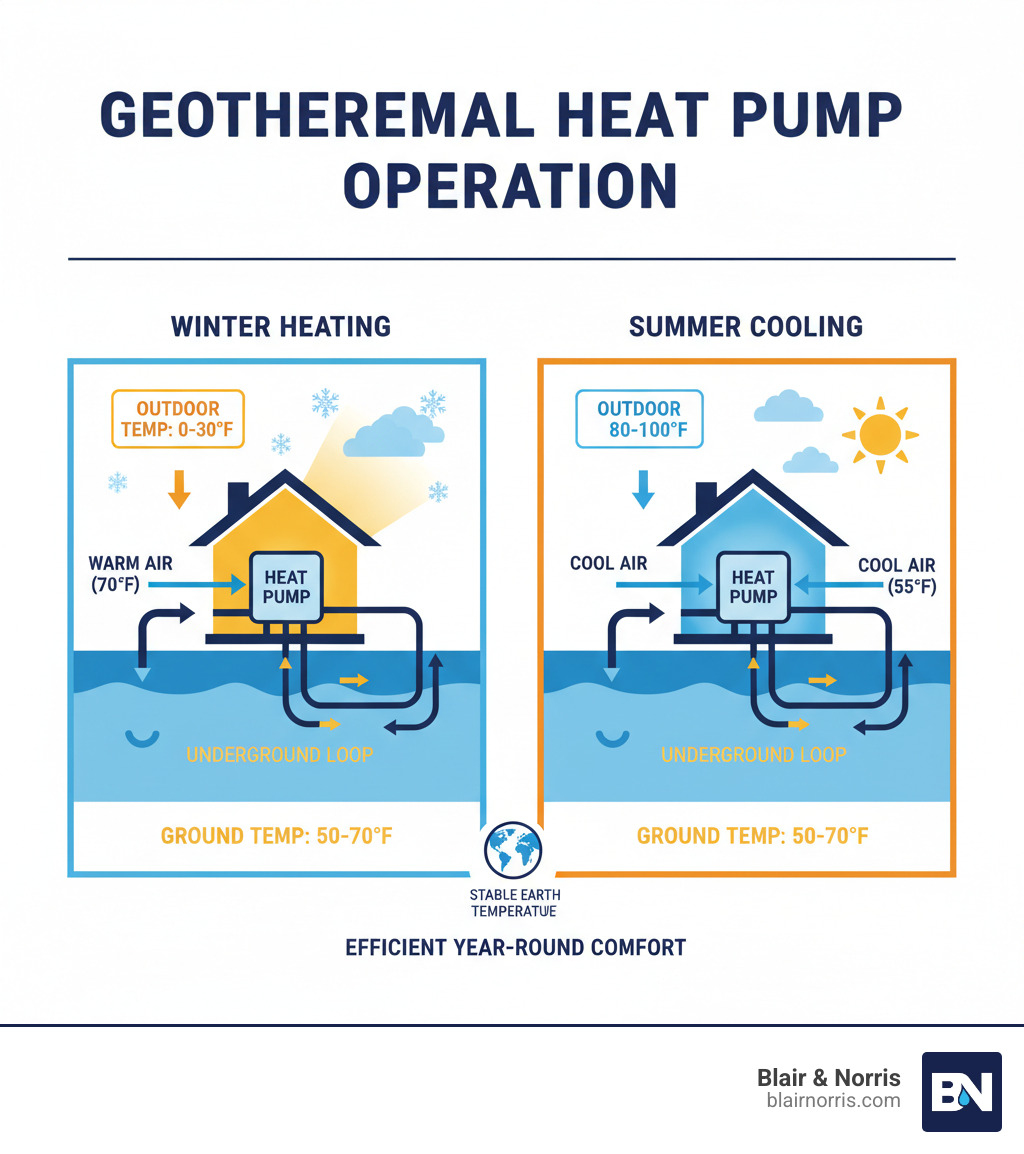
How Geothermal Heating and Cooling Works
Just a few feet beneath your yard, the ground maintains a constant 40-70°F, regardless of the season. This natural temperature stability is what makes geothermal heating so incredibly efficient.
Geothermal systems don’t create heat—they move it. In winter, the system pulls warmth from the ground and brings it into your home. In summer, the process reverses, taking heat from your house and transferring it into the cooler earth. The geothermal heat pump works like a refrigerator, concentrating this energy. For every unit of electricity used, it delivers 3 to 4.5 units of heating or cooling, achieving 300-450% efficiency, far surpassing traditional furnaces that max out around 95%.
When cooling, these systems use 50-70% less electricity than regular air conditioners because they transfer heat to the cool earth instead of fighting hot outdoor air. The Energy 101: Geothermal Heat Pumps guide from the Department of Energy offers more detail on these mechanics.
The Main Components of a Geothermal System
- Ground Loop System: Durable pipes buried underground circulate a water-based solution to exchange heat with the earth. These loops are built to last over 50 years.
- Geothermal Heat Pump: An indoor unit that uses a refrigeration cycle to concentrate and move heat. It operates quietly, unlike noisy outdoor AC units.
- Distribution System: Connects to your home’s existing ductwork or radiant floor system to deliver conditioned air.
- Desuperheater: An optional component that captures waste heat to help heat your home’s water, potentially covering up to 50% of your hot water needs for free.
The Different Types of Geothermal Loop Systems
Choosing the right ground loop depends on your property. At Blair & Norris, our 75 years of experience with Indiana soil and water conditions helps us determine the best fit.
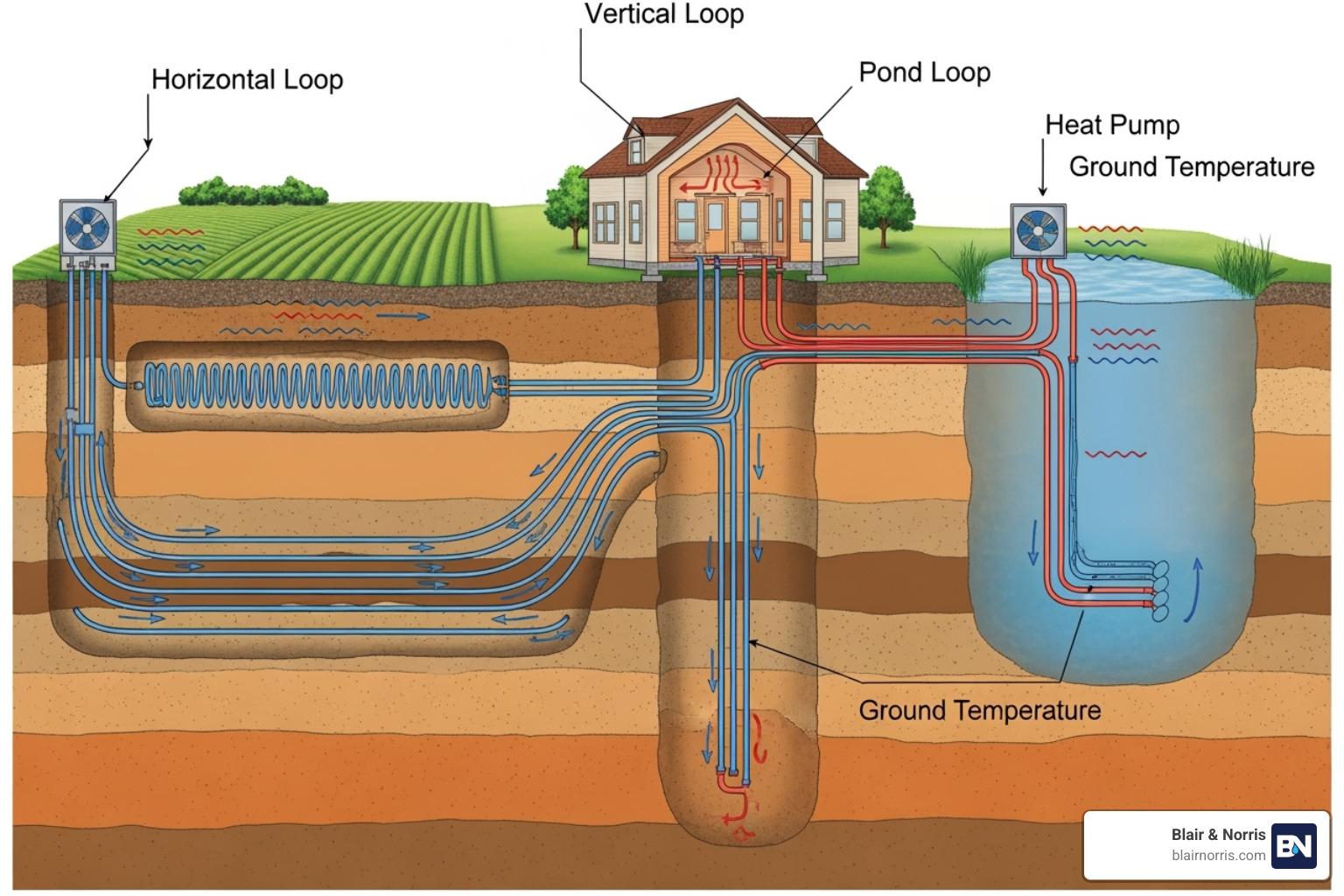
- Horizontal Loops: Ideal for properties with ample space. Trenches are dug 4-6 feet deep. This is often the most budget-friendly option.
- Vertical Loops: Used when yard space is limited. We drill holes 100-400 feet deep, minimizing disruption to landscaping.
- Pond Loops: A highly efficient option if you have a nearby pond or lake of adequate size and depth.
- Open Loop Systems: These use well water as the heat exchange medium. Water is pumped from a well, run through the heat pump, and returned to the ground. Our decades of experience with well pumps make us uniquely qualified to design and install these systems for long-term success.
This video shows these systems in action: Watch how geothermal heat pumps work. The best system for you depends on land size, soil type, water availability, and installation costs.
The Pros and Cons of Geothermal Heating
A geothermal system is one of the smartest long-term investments for your home, but it’s important to understand both the benefits and the considerations.
The advantages are significant:
- Energy Savings: Customers often see heating and cooling costs drop by 40-70%. Geothermal systems operate at 300-600% efficiency, while traditional furnaces top out at 95%.
- Environmental Impact: With zero on-site combustion, installing one system is equivalent to removing two cars from the road, according to the U.S. Department of Energy on geothermal benefits.
- Quiet Operation: The heat pump sits indoors and is typically no louder than a refrigerator. There is no noisy outdoor unit.
- Durability: Indoor components last 20-25 years, while the underground loops can last 50 years or more, far outliving traditional HVAC systems.
- Improved Comfort: Geothermal provides steady, even temperatures, eliminating the hot and cold spots common with conventional systems.
| Feature | Geothermal HVAC | Traditional HVAC (Furnace/AC) |
|---|---|---|
| Upfront Cost | $15,000-$35,000 installed | $8,000-$15,000 installed |
| Operating Cost | 40-70% lower energy bills | Standard energy consumption |
| Lifespan | 20-25 years (indoor), 50+ years (loops) | 10-15 years average |
| Environmental Impact | Zero on-site emissions, highly efficient | Burns fossil fuels, moderate efficiency |
Potential Costs and Drawbacks
- Upfront Investment: A complete system typically costs $15,000-$35,000, which is significantly more than a traditional HVAC system. Federal tax credits and rebates can help offset this.
- Installation Disruption: The process involves excavation or drilling on your property, which is temporary but disruptive.
- Payback Period: It typically takes 5-10 years for the energy savings to offset the higher installation cost.
- Installation Risks: Improper installation can lead to problems. Choosing an experienced installer is critical. With 75 years of experience in well drilling, Blair & Norris understands the underground environment and minimizes these risks.
How Geothermal Heating and Cooling Works
Geothermal systems use the Earth’s steady subsurface temperature (about 50-70°F a few feet down) to move heat, not make it. In winter, they pull heat from the ground and concentrate it for your home; in summer, they reject indoor heat back into the cooler earth. Because the heat pump is mostly moving energy, not generating it, you get exceptional performance: for every unit of electricity used, the system typically delivers 3 to 4.5 units of heating or cooling.
When cooling, geothermal systems use significantly less electricity than standard air conditioners because they exchange heat with the ground instead of hot outdoor air. For a clear explainer, see the Department of Energy’s Energy 101: Geothermal Heat Pumps.
The Main Components of a Geothermal System
- Ground Loop System: Long-lasting underground piping (often 50+ years) that exchanges heat with the earth.
- Geothermal Heat Pump: An indoor, quiet unit that concentrates and moves heat.
- Distribution System: Uses your ducts or hydronic/radiant system to condition your home.
- Desuperheater: Captures waste heat to help preheat your domestic hot water.
The Different Types of Geothermal Loop Systems
Horizontal, vertical, pond/lake, and open-loop systems are selected based on land area, soil/rock conditions, water availability, and cost. Our local experience with Indiana geology helps us recommend the right loop for reliable, efficient performance.
The Pros and Cons of Geothermal Heating
Geothermal offers long-term comfort, efficiency, and durability with very low operating costs.
Top advantages
- Energy savings: Often 40-70% lower heating/cooling bills.
- Environmental impact: Zero on-site emissions and a smaller carbon footprint.
- Quiet operation: No noisy outdoor condenser.
- Long life: 20-25 years for the indoor unit; 50+ years for ground loops.
- Comfort: Even temperatures without hot/cold spots.
| Feature | Geothermal HVAC | Traditional HVAC (Furnace/AC) |
|---|---|---|
| Upfront Cost | $15,000-$30,000+ installed | $5,000-$15,000 installed |
| Operating Cost | 40-70% lower energy bills | Standard energy costs |
| Lifespan | 20-25 years (indoor), 50+ years (loops) | 10-15 years typical |
| Environmental Impact | Zero on-site emissions, renewable energy | Burns fossil fuels, higher emissions |
Potential Costs and Drawbacks
- Higher upfront cost than conventional systems, offset over time by energy savings and incentives.
- Temporary property disruption from trenching or drilling.
- Payback period typically 5-10 years, depending on usage and rates.
- Installation quality matters: choose experienced installers to reduce risk.
The Environmental Benefits of Geothermal Heating
Geothermal systems are highly efficient (often 300-600%), reducing energy use and emissions compared with traditional HVAC. Learn more from the U.S. Department of Energy on geothermal benefits.
How Does Geothermal Energy Work?
Geothermal heat pumps tap the Earth’s stable subsurface temperature to transfer heat, delivering 3 to 4.5 units of heating/cooling for every unit of electricity used. In winter, they extract heat from the ground; in summer, they move unwanted indoor heat back into the earth—saving 50-70% electricity versus conventional AC. See Energy 101: Geothermal Heat Pumps for a quick overview.
The Main Components of a Geothermal System
- Ground loop: Durable HDPE piping (50+ year design life) that exchanges heat with the earth.
- Geothermal heat pump: Indoor unit with compressor and heat exchangers that moves heat efficiently.
- Distribution: Uses ductwork or hydronic systems to condition the home.
- Desuperheater: Reclaims waste heat to help preheat domestic hot water.
The Different Types of Geothermal Loop Systems
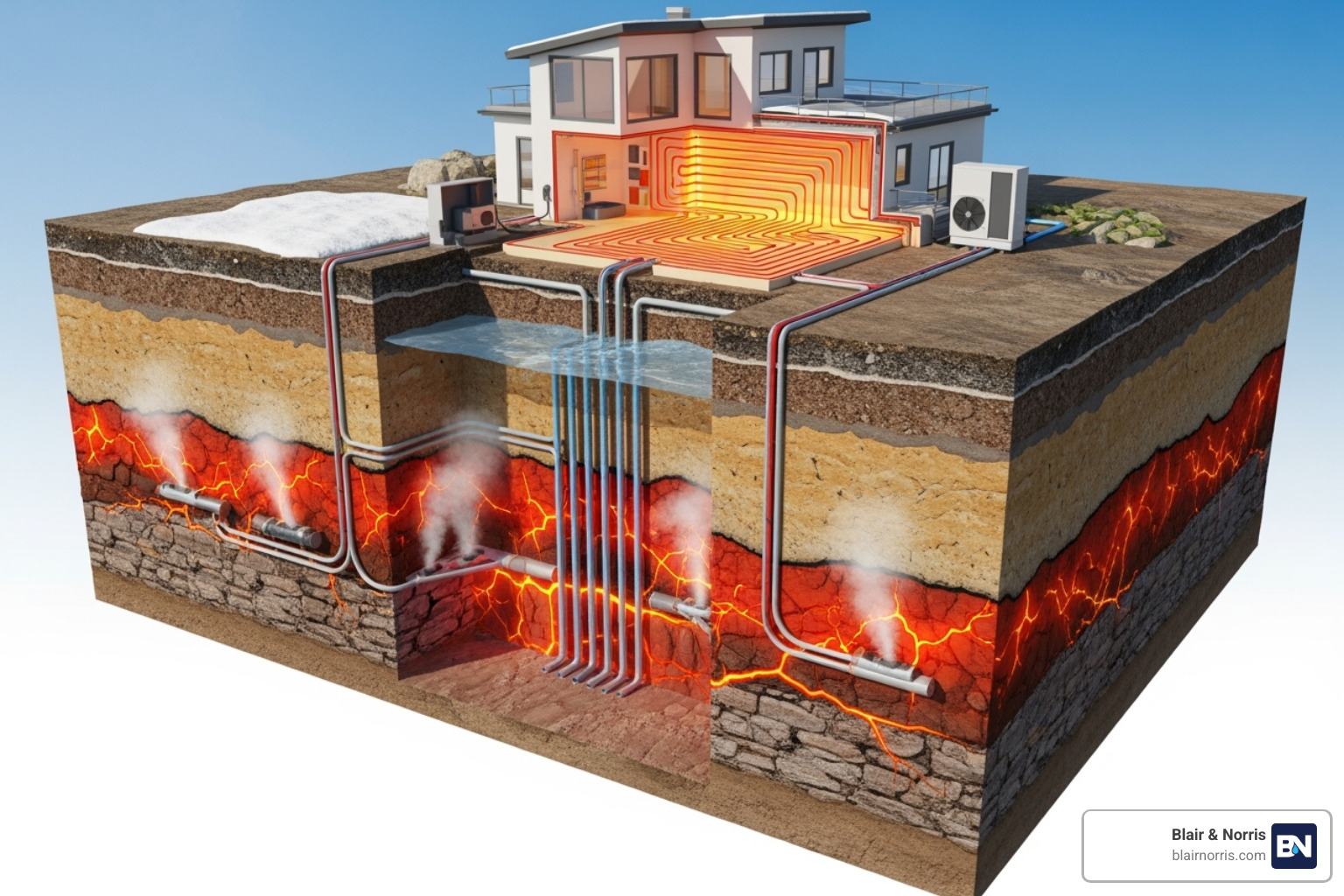
- Horizontal closed loop: Cost-effective where space allows; trenches 4-6 ft deep.
- Vertical closed loop: Minimal yard disruption; boreholes typically 100-400 ft deep.
- Pond/lake closed loop: Excellent efficiency if suitable water body exists (depth/size needed).
- Open loop: Uses well water for heat exchange; requires adequate, clean groundwater and proper discharge.
The best choice depends on land size, soil/rock conditions, water availability, and budget. To see how these systems operate, Watch how geothermal heat pumps work.
The Pros and Cons of Geothermal Heating
Geothermal is a premium, high-efficiency solution that can dramatically cut operating costs and improve comfort, but it comes with a higher upfront price and requires expert installation.
Key advantages
- 40-70% lower heating and cooling bills.
- Zero on-site emissions and quiet indoor operation.
- Long life: 20-25 years for the heat pump; 50+ years for loops.
- Consistent, even temperatures year-round.
Potential Costs and Drawbacks
- Higher initial investment than traditional HVAC.
- Temporary yard disruption for trenching or drilling.
- Typical payback in 5-10 years via energy savings.
- Performance and longevity depend on proper design and installation.
The Environmental Benefits of Geothermal Heating
With 300-600% efficiency, geothermal systems reduce energy use and carbon footprint while enhancing comfort. Learn more from the U.S. Department of Energy on geothermal benefits.
Installation, Lifespan, and Maintenance
Installing a geothermal heating system is a significant project, but one with lasting rewards. Understanding the process helps build confidence in this smart investment.
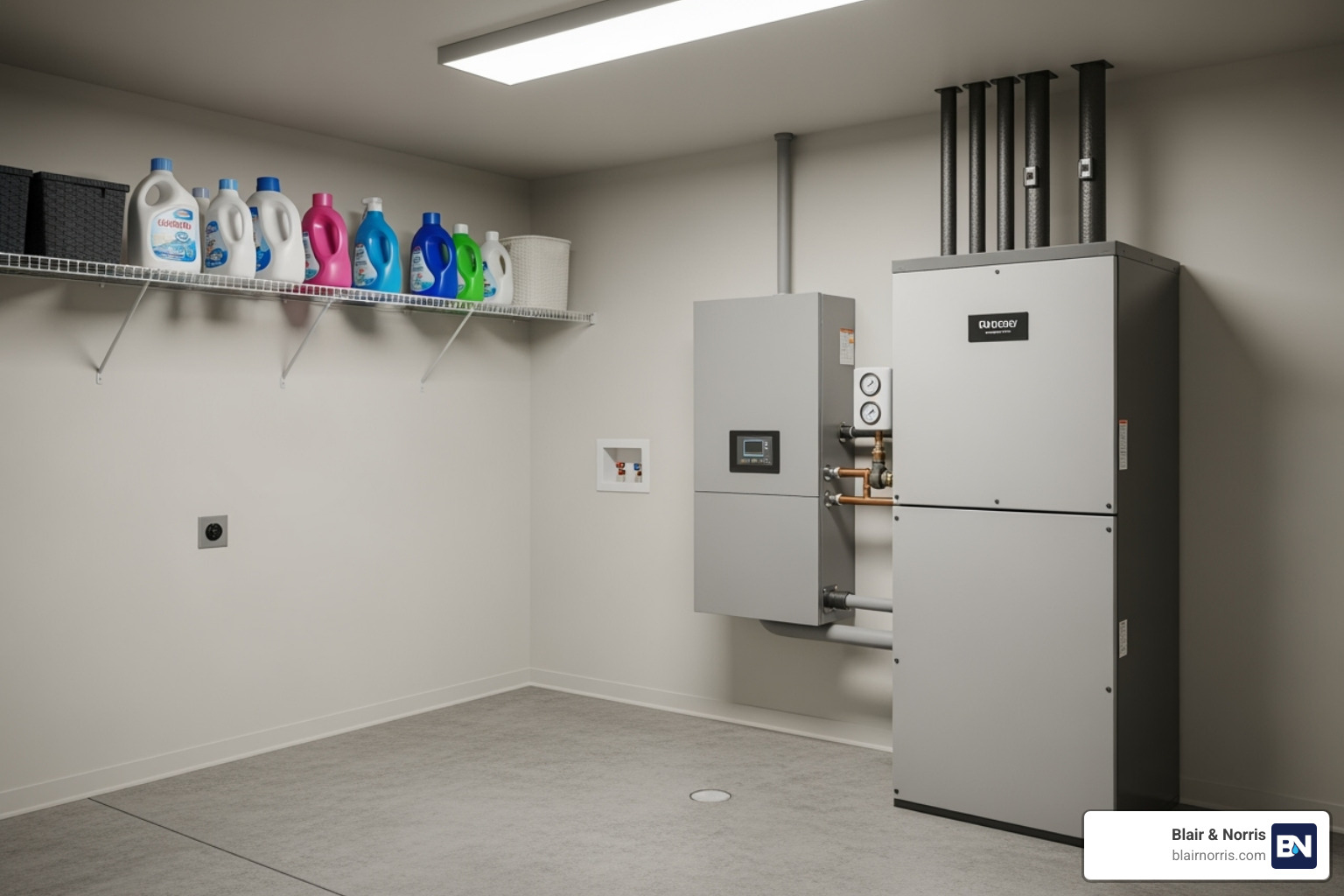
New Construction vs. Existing Homes
Geothermal systems are an excellent choice for both new and existing homes.
- New Construction: Installation is simplest during a new build, as the ground loop can be installed before landscaping, saving money and hassle.
- Existing Homes (Retrofitting): We have extensive experience retrofitting systems in existing homes. If you have ductwork, the new heat pump can often connect directly to it. For homes without ducts, this can be an opportunity to upgrade to a central heating and cooling system. Our team at Blair & Norris assesses each property to find the least disruptive installation method. You can learn more about our installation services.
Lifespan and Maintenance of a Geothermal System
Longevity is where geothermal heating truly excels.
- Lifespan: The indoor heat pump unit provides reliable service for 20-25 years. The underground loop system is designed to last over 50 years.
- Maintenance: Geothermal systems require minimal maintenance. The main tasks are changing air filters regularly and scheduling an annual professional check-up to ensure peak efficiency. We offer comprehensive maintenance plans to protect your investment.
Can Geothermal Systems Provide Hot Water?
Yes, your geothermal heating system can also help with your hot water needs. Most units can be equipped with a desuperheater, a device that captures waste heat during normal operation and uses it to preheat water in your hot water tank. This can provide up to 50% of your hot water at virtually no additional cost, adding another layer of savings to your investment.
Frequently Asked Questions about Geothermal Systems
Homeowners exploring geothermal heating in areas like Greenwood, Mooresville, and Lebanon, IN often have similar questions. Here are answers to the most common ones.
How much can I save with a geothermal system?
You can expect your monthly energy bills to drop by 25% to 70% compared to conventional systems. Most homeowners see the system pay for itself in energy savings within 5 to 10 years, a period that can be shortened by federal tax credits and local incentives. Your exact savings will depend on your home’s insulation, your current energy rates, and the efficiency of your old system.
Can I install a geothermal system on my property?
The good news is that geothermal systems work virtually anywhere. We have installed systems on large rural properties and compact suburban lots throughout Central Indiana.
- For large yards, a horizontal loop system is often the most cost-effective.
- For smaller properties, vertical drilling provides a highly efficient system with minimal disruption.
- If you have a pond or well, a pond loop or an open-loop system can be extremely efficient. Our 75 years of well experience makes us experts in designing and installing open-loop systems.
The best way to know for sure is to have us assess your property.
Is geothermal energy truly renewable and safe?
Absolutely. Geothermal energy is renewable because the Earth constantly replenishes its subsurface heat. It’s also one of the safest home comfort systems available. There is no on-site combustion, which means no flames, no fumes, and no risk of carbon monoxide poisoning. In closed-loop systems, the water-based solution is sealed in durable pipes. In open-loop systems, we ensure water is managed responsibly to protect groundwater resources.
Conclusion
Geothermal heating is more than just an HVAC system; it’s a smart, long-term investment in your home’s comfort, efficiency, and value. By using the Earth’s stable temperature, you can enjoy dramatically lower energy bills, superior year-round comfort, and the peace of mind that comes with a durable, low-maintenance system.
With a lifespan of 50+ years for the underground components, a geothermal system is a lasting upgrade that reduces your environmental footprint and frees you from volatile fossil fuel prices. For homeowners in Central Indiana, the climate and geology are ideal for this technology, especially for properties with well systems suited for high-efficiency open-loop configurations.
Ready to take control of your energy future and find how much you could save? Our team is here to assess your home’s needs, explain your options, and provide a detailed suggestions.
Don’t wait another season. Take the next step toward sustainable comfort and significant savings. Call Blair & Norris today or visit our contact page to discuss how your well and pump system can impact the addition of geothermal heating.