
What Indiana Homeowners Need to Know About Geothermal HVAC Installation
Geothermal HVAC installation Indiana is one of the most effective ways to heat and cool your home year-round — using the earth’s own stable temperature instead of burning fossil fuels or fighting outdoor air extremes. While traditional systems struggle against the volatile Midwestern climate, geothermal technology leverages the massive thermal battery right beneath your feet. A geothermal HVAC installation Indiana system is a well-established approach that uses stable ground temperatures to move heat efficiently.
Here’s a quick summary of what you need to know about geothermal HVAC installation Indiana projects—how the system works, what affects the scope, and what to expect during installation.
| Topic | Key Facts |
|---|---|
| How it works | Loops buried underground exchange heat with the earth (stable \~55°F year-round) |
| Typical cost range | Project scope varies based on home size, loop type, site conditions, and installation approach (horizontal, vertical, or pond loop). |
| Federal tax credit | Federal incentives have specific eligibility rules and deadlines; confirm current eligibility before you plan a geothermal HVAC installation Indiana project. |
| Energy savings | Many homeowners pursue geothermal for steadier comfort and improved efficiency versus conventional systems, especially in Indiana’s temperature swings. |
| Payback period | Geothermal is best viewed as a long-term comfort and efficiency upgrade rather than a short-term swap. |
| System lifespan | Indoor unit: 20–25 years; ground loop: 50+ years |
| Best candidates | Homeowners with adequate yard space, high energy bills, or aging HVAC systems |
Indiana’s climate is notoriously tough on traditional HVAC systems. Our summers are characterized by thick, oppressive humidity and temperatures that frequently climb into the 90s. Conversely, our winters can be brutal, with polar vortex events sending temperatures plummeting well below zero. In these conditions, your standard furnace and air conditioner work overtime, cycling constantly and struggling to maintain a set point. This mechanical stress leads to premature system failure and skyrocketing energy bills.
Geothermal systems sidestep those extremes entirely. In Indiana, shallow ground temperatures are far more stable than outdoor air, which is why geothermal HVAC installation Indiana systems can operate efficiently year-round. That consistency is what makes geothermal so efficient — and so well-suited to this state. By tapping into this constant temperature, the system doesn’t have to “create” heat or cold from scratch; it simply moves it from one place to another.
Whether you’re replacing an aging system, building a new custom home, or you are simply tired of unpredictable energy bills that fluctuate with the price of natural gas and propane, this guide walks you through everything you need to make a confident decision. We will explore the science, the financial ROI, and the logistical requirements for a successful installation in the Hoosier state.
I’m Mack Blair — With decades of field experience across Central Indiana subsurface work, our team approaches geothermal HVAC installation Indiana projects with a focus on proper loop placement, site protection, and long-term performance. My family has been working in the Indiana soil for 75 years, and we understand the unique geological challenges of our region. Let’s break down exactly how these systems work, what they cost, and whether your property is a good fit for this “forever” HVAC solution.
The Inefficiency of Traditional HVAC in Indiana’s Climate
Living in places like Indianapolis, Fishers, or Bloomington means dealing with the “Indiana Rollercoaster.” One week it’s a humid 95°F, and by the next month, we’re bracing for sub-zero wind chills. Traditional HVAC systems—specifically air-source heat pumps and gas furnaces—are forced to fight these extremes. An air-source heat pump, for instance, relies on the outside air to provide heat. When the temperature drops below freezing, the unit must work significantly harder, often relying on expensive “emergency heat” or electric resistance coils to keep the home warm. This is inherently inefficient and costly.
When it’s 90°F outside with 80% humidity, your standard air conditioner is trying to dump heat into already hot air. This is thermodynamically difficult and puts immense pressure on the compressor. This leads to massive spikes in utility costs and a significant carbon footprint. Most conventional systems in Indiana rely on the combustion of fossil fuels, such as natural gas or propane. These fuels not only fluctuate wildly in price based on global markets but also require venting and regular safety checks for carbon monoxide leaks, adding a layer of risk and maintenance to your home.
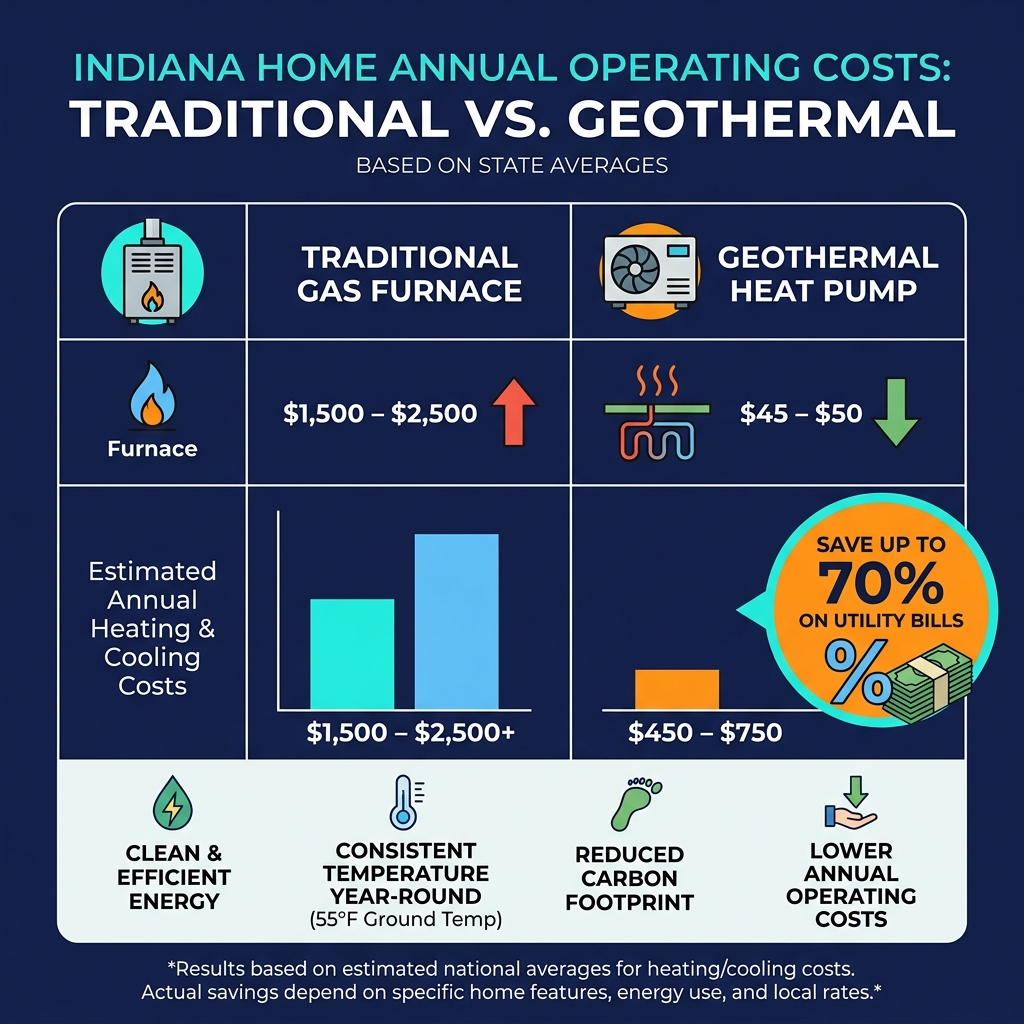
In contrast, geothermal systems don’t “create” heat through combustion; they simply move it. Because they aren’t battling the air temperature, they operate with a level of efficiency that traditional units can’t touch. Geothermal systems can deliver high effective efficiency because electricity primarily powers heat transfer rather than combustion. For every unit of electricity used to power the system, you get three to five units of heat from the earth. This is possible because the electricity is only used to move the heat, not to generate it. To see how Indiana is supporting these transitions and to find potential financial assistance for renewable energy projects, you can Learn more about Indiana energy grants offered through state programs.
Furthermore, traditional systems have a relatively short lifespan in Indiana. The outdoor condenser unit is exposed to rain, snow, ice, and debris, leading to corrosion and mechanical wear. A typical air conditioner might last 12 to 15 years before requiring a major overhaul. Geothermal systems eliminate the outdoor unit entirely, protecting the most sensitive components from the elements and significantly extending the life of the equipment.
How Geothermal HVAC Installation Indiana Works
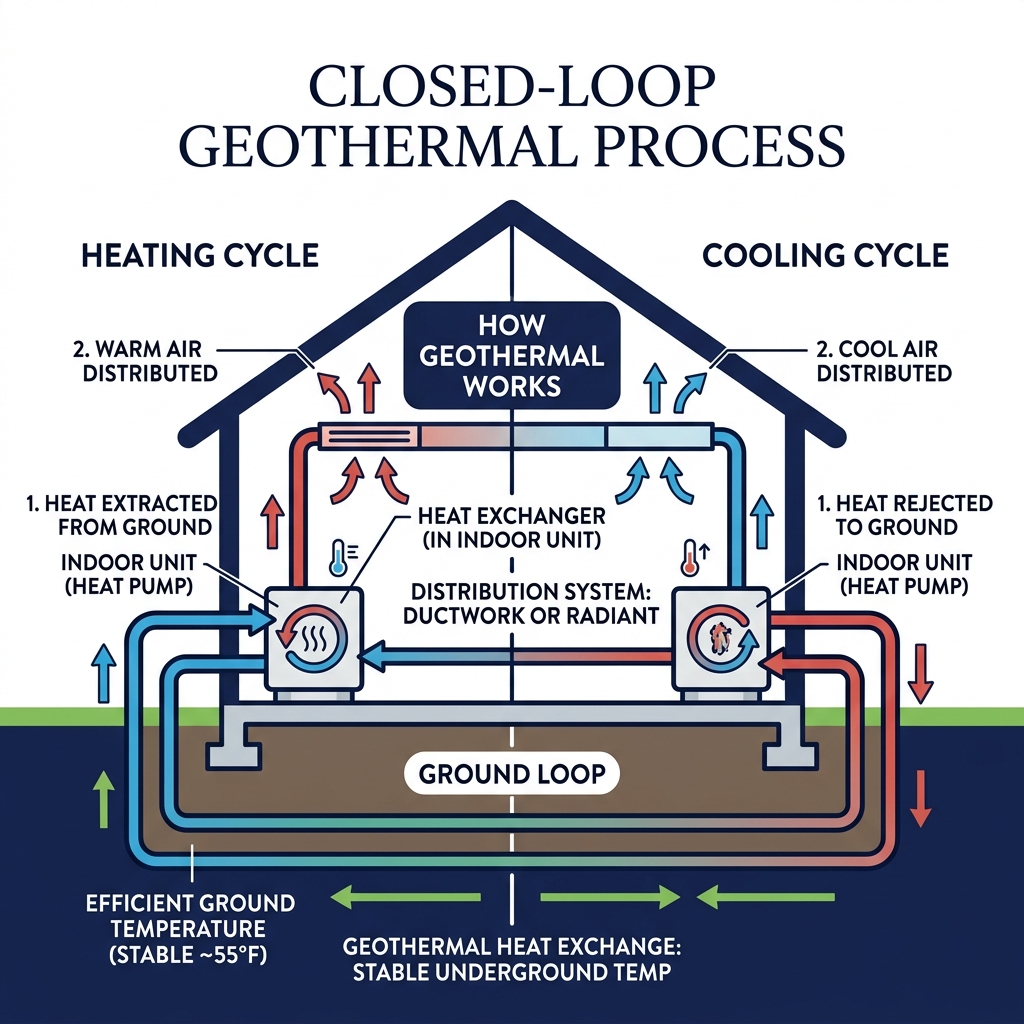
At its heart, a geothermal system is a heat transporter. While the air temperature in Carmel or Noblesville changes daily, the temperature six feet underground stays a constant 50°F to 55°F. This is due to the earth’s ability to absorb and store solar energy, acting as a massive, natural battery.
The process involves three main components that work in a continuous loop:
- The Ground Loop: A series of high-density polyethylene (HDPE) pipes buried in your yard. These pipes are filled with a water-based solution (often mixed with a food-grade antifreeze) that circulates through the ground.
- The Heat Pump: An indoor unit, usually located in a basement or utility closet, that replaces your furnace and AC. This unit contains the compressor and heat exchanger that facilitate the transfer of energy.
- The Distribution System: Your existing ductwork that moves the conditioned air through the home. Geothermal systems can also be paired with radiant floor heating for even greater comfort.
In the winter, the solution circulates through the loops, absorbing the natural heat from the earth. Even at 50°F, there is a tremendous amount of thermal energy available. The indoor heat pump then concentrates that heat using a refrigeration cycle and distributes it through your home. In the summer, the process reverses. The system pulls heat out of your house and “deposits” it back into the cool earth. It’s a clean, quiet, and incredibly elegant solution to home comfort. For a deeper dive into the specific mechanics of how we keep Indiana homes warm, check out our geothermal heating services and our geothermal cooling guide 2025.
Understanding the Investment of Geothermal HVAC Installation Indiana
A geothermal HVAC installation Indiana project has more site work than a typical equipment changeout, so planning and proper design matter. Residential installations vary widely based on loop type, drilling/trenching needs, and equipment sizing. This price variation depends on the size of your home, the type of loop system required (horizontal vs. vertical), and the specific geological conditions of your property. However, looking at the sticker price alone is a mistake.
This is a long-term infrastructure investment, much like a high-quality roof or a modern septic system. Over time, homeowners often value geothermal for consistent comfort, fewer outdoor components, and long service life. After that “payback period,” the savings are pure profit. Furthermore, these systems are a boon for property value. In a competitive real estate market like Hamilton County or Johnson County, a home with a “forever” HVAC system that is designed for efficient, steady operation is a major selling point. To help offset that initial check, the Federal Tax Credit details show a significant 30% credit available for homeowners through 2025. This credit applies to the total cost of the system, including labor and equipment, with no upper limit.
Why DIY Geothermal HVAC Installation Indiana is a High-Risk Gamble
We love a good weekend warrior project as much as anyone, but geothermal installation is not the place for DIY. This isn’t just about hooking up a few wires or connecting some PVC; it involves heavy excavation, precision engineering, and specialized knowledge of thermodynamics.
If a ground loop is buried at the wrong depth or the manifold is improperly fused, the system will never reach its rated efficiency. Even worse, you risk hitting underground utilities, including your own water or septic lines, which can lead to thousands of dollars in repairs. Improperly handled refrigerants can lead to environmental fines and total system failure. At Blair & Norris, we often see the aftermath of “budget” or DIY installs that went wrong, where the homeowner ends up paying more to fix the mistakes than they would have for a professional installation. DIY mistakes can cause serious damage, safety risks, and performance issues that require professional remediation.
Financial Breakdown: Costs, Savings, and 2025 Incentives
Incentives and utility programs change over time, so verify what applies before starting a geothermal HVAC installation Indiana project. The 30% Federal Tax Credit, part of the Residential Clean Energy Credit (Section 25D), is the heavy hitter here. If you qualify, federal incentives may apply to eligible installed costs—confirm details with the IRS guidance and a tax professional. Unlike a deduction, which only reduces your taxable income, a credit is a dollar-for-dollar reduction in the actual tax you owe.
But it doesn’t stop there. Many local utilities, such as Duke Energy, AES Indiana, and CenterPoint Energy, offer specific rebates for ground-source heat pumps because they reduce the load on the electrical grid during peak summer days. Some homeowners report lower energy use after switching, but results depend on sizing, insulation, and operating habits. Over a decade, that’s over $15,000 in savings—and that’s assuming energy prices don’t go up (which we all know they will). When you factor in the avoided costs of replacing a traditional AC unit every 12 years, the ROI becomes even more compelling.
When planning your loops, it’s also vital to ensure you are following all Indiana DNR water well regulations if you are opting for an open-loop or vertical system that might interact with local aquifers. Proper permitting and adherence to state standards are essential for protecting our groundwater and ensuring your system remains compliant for years to come. We handle all the necessary paperwork and regulatory checks as part of our comprehensive installation service.
Suitability Factors: Is Your Indiana Property Ready?
Is every home in Indiana a candidate for geothermal? Most are, but the type of installation depends on your property’s size, soil composition, and existing infrastructure. Indiana’s geology is diverse, ranging from the sandy soils of the north to the heavy clay and limestone of the south.
- Horizontal Loops: These are the most common in rural areas like Shelby County or Morgan County where there is plenty of land. We dig trenches about five to six feet deep and several hundred feet long. This is generally the most cost-effective method if space allows.
- Vertical Bores: If you live on a smaller lot in Fishers, Zionsville, or downtown Indianapolis, we use a specialized drilling rig to go 150 to 400 feet down. This requires very little surface space and is ideal for urban or suburban environments.
- Pond/Lake Loops: If you have a pond at least eight feet deep and of sufficient size, we can coil the pipes on the bottom. This method is often the most cost-effective because it eliminates the need for extensive trenching or drilling.
Soil composition matters too. Indiana’s mix of clay, loam, and occasional limestone affects how easily heat moves through the ground (thermal conductivity). Clay is actually an excellent medium for geothermal because it holds moisture well, which aids in heat transfer. A professional site assessment is the only way to know for sure which loop is right for you. Once the system is in, keeping it running is simple, but don’t forget to check out our system maintenance tips to keep your warranty valid and your efficiency at its peak.
The Installation Process and Long-Term Maintenance
When we handle a geothermal HVAC installation Indiana, we follow a strict multi-step process to ensure 50+ years of performance. We don’t believe in shortcuts because we know that a geothermal system is only as good as its weakest link.
- Site Assessment & Load Calculation: We don’t guess. We perform a Manual J load calculation to determine exactly how much heating and cooling your home needs based on insulation, window types, ceiling heights, and square footage. This ensures your system is perfectly sized.
- Loop Installation: Whether drilling or trenching, this is where our 75 years of experience in Indiana soil pays off. We use specialized equipment to minimize impact on your landscaping and ensure the loops are placed for maximum thermal exchange.
- Indoor Integration: We install the high-efficiency heat pump and, if necessary, modify your ductwork to handle the specific airflow requirements of the new system. We also integrate the “desuperheater,” which can provide much of your home’s hot water for free.
- Testing & Calibration: We pressure-test the loops to ensure there are no leaks and then calibrate the system for Indiana’s specific climate. We walk you through the operation of your new thermostat and explain how to monitor the system.
The beauty of geothermal is the low maintenance. Because the “condenser” is buried safely underground, it isn’t exposed to rain, snow, salt, or lawnmower debris. The indoor unit typically lasts 20 to 25 years—nearly double the lifespan of a standard AC—and the ground loops are often warrantied for 50 years or more. Annual inspections usually involve a simple filter change and a quick check of the loop pressure and pump operation. It is truly a “set it and forget it” solution for home comfort.
Frequently Asked Questions about Geothermal in Indiana
Is geothermal HVAC installation in Indiana a good fit for my home?
Yes, especially if you plan to stay in your home for at least 5 to 7 years. Between the 30% tax credit and the 40-70% reduction in monthly bills, the system pays for itself and then begins “paying you” through avoided costs. Furthermore, the comfort level is vastly superior; geothermal provides a more consistent, gentle heat compared to the “blast” of a gas furnace, and it dehumidifies much more effectively in the summer.
How long does a typical installation take to complete?
A standard residential installation usually takes about one to two weeks from start to finish. The “messy” part—the drilling or trenching—usually takes 2-3 days. After the loops are in, the indoor equipment installation and final hookups take another few days. We work hard to minimize the disruption to your daily life during this process.
Can I use my existing ductwork for a geothermal system?
In most cases, yes! Geothermal systems use standard forced-air ductwork. During our initial assessment, we’ll check your current ducts to ensure they are sized correctly for the airflow required by a high-efficiency heat pump. If modifications are needed, we can usually handle them during the installation.
Does geothermal work during a power outage?
Like any modern HVAC system, a geothermal heat pump requires electricity to run the compressor and the blower fan. However, because it is so efficient, it can be powered by a smaller backup generator or a solar battery system more easily than a traditional electric furnace or air conditioner.
Is the system noisy?
Actually, geothermal systems are incredibly quiet. Because there is no outdoor condenser unit, there is no loud fan noise in your backyard. The indoor unit is roughly as loud as a modern refrigerator or a high-end dishwasher. You won’t even know it’s running most of the time.
Conclusion
Switching to a geothermal system is more than just an HVAC upgrade; it’s a commitment to a sustainable, cost-effective future for your home. In a state like Indiana, where the weather is anything but predictable, relying on the constant temperature of the earth is the smartest move a homeowner can make. You are essentially insulating your family from future energy price spikes while reducing your environmental impact.
At Blair & Norris, we’ve built a 75-year reputation on ethical, high-quality service. We aren’t just contractors; we’re your neighbors in Indianapolis, Carmel, Bloomington, and across Central Indiana. We understand the local soil, the local climate, and the local people. As a family-owned business with 24/7 live phone support, we take pride in helping our community find long-term solutions for their water and climate needs. We stand behind every loop we bury and every unit we install.
Ready to see if your property is a candidate for the most efficient heating and cooling on the planet? Contact us for an expert estimate today and let our family take care of yours.