
How Does a Well Pump Work? Quick Answers for Homeowners
A well pump is the heart of your well water system, moving water from underground directly to your home when you need it. Whether you live in the Indiana countryside or anywhere with private well water, understanding this process helps you keep your water flowing strong and steady.
Here’s a quick, step-by-step answer for anyone wondering how does a well pump work:
- Pump pulls or pushes groundwater up from the well (using either suction or a submerged motor).
- Water travels through pipes into a pressure tank inside your home.
- Pressure tank stores water and maintains steady water pressure.
- Pressure switch monitors tank pressure (common settings: pump turns on at 40 psi, off at 60 psi).
- When you turn on a faucet, the system releases water from the tank.
- Pump turns on automatically whenever more water (and pressure) is needed.
In simple terms: The pump brings water up, the tank stores it under pressure, and the switch tells the pump when to run—so you always have water at your tap.
“If you use a well for your home’s water source, you understand the importance of a well pump.”
—Well Pump Basics
In fact, over 13 million American households rely on private wells for their water every day. Most need 60–100 gallons per person—so having a reliable, efficient pump isn’t just a convenience, it’s peace of mind.
Below, we’ll dive deeper into what happens underground, how the system works together, and what you need to know to keep your water supply running smoothly.

How does a well pump work terms to learn:
Understanding Well Systems & Water Demand
Before we get to the nuts and bolts of well pumps, let’s talk about where your water comes from and what your system is up against.
Aquifers & Water Table:
Groundwater is stored in layers of rock, gravel, or sand called aquifers. Picture these as underground rivers or sponges holding water between tiny pores. The top level of this groundwater is the water table—when you dig or drill a well, you’re tapping into this hidden reservoir.
Well Casing & Screen:
Wells are lined with a casing (usually PVC or steel) to keep dirt and contaminants out. At the bottom, a well screen lets water in but blocks sand and grit—think of it as your water’s security gate.
Static Level & Drawdown:
- Static level: The resting height of water in your well when the pump is off.
- Drawdown: How much that level drops when you’re pumping water.
Water Demand:
- The average American uses 60–100 gallons of water per day—from showers to laundry.
- A typical home needs a well that can deliver 6–12 gallons per minute (GPM) to meet peak demand.
Well Types:
- Drilled wells: Most common—deep, narrow holes (can go 100–1000+ feet).
- Driven wells: Shallow, pipe pounded into the ground (up to ~50 feet).
- Dug wells: Old-school, hand-dug, wide, and shallow (rare today).
Contamination Risks:
Shallow wells are more prone to contamination from surface runoff, septic systems, or farm chemicals. Deeper wells tap cleaner, safer water but need a more robust pump.
Want to geek out on groundwater?
Scientific research on groundwater facts
How Does a Well Pump Work?
Let’s dig into the real action: how does a well pump work, from deep underground to your kitchen sink!
When you turn on a faucet, you set off a well-coordinated dance between several key parts of your well system. The pump is the star of the show, lifting water from your well. Connected to the pump is the drop pipe, which acts like a water elevator, carrying fresh groundwater up and delivering it into your house. To get the water from your well into your plumbing (without the risk of pipes freezing in winter), your system uses a pitless adapter—this clever part keeps everything frost-proof and sealed below ground.
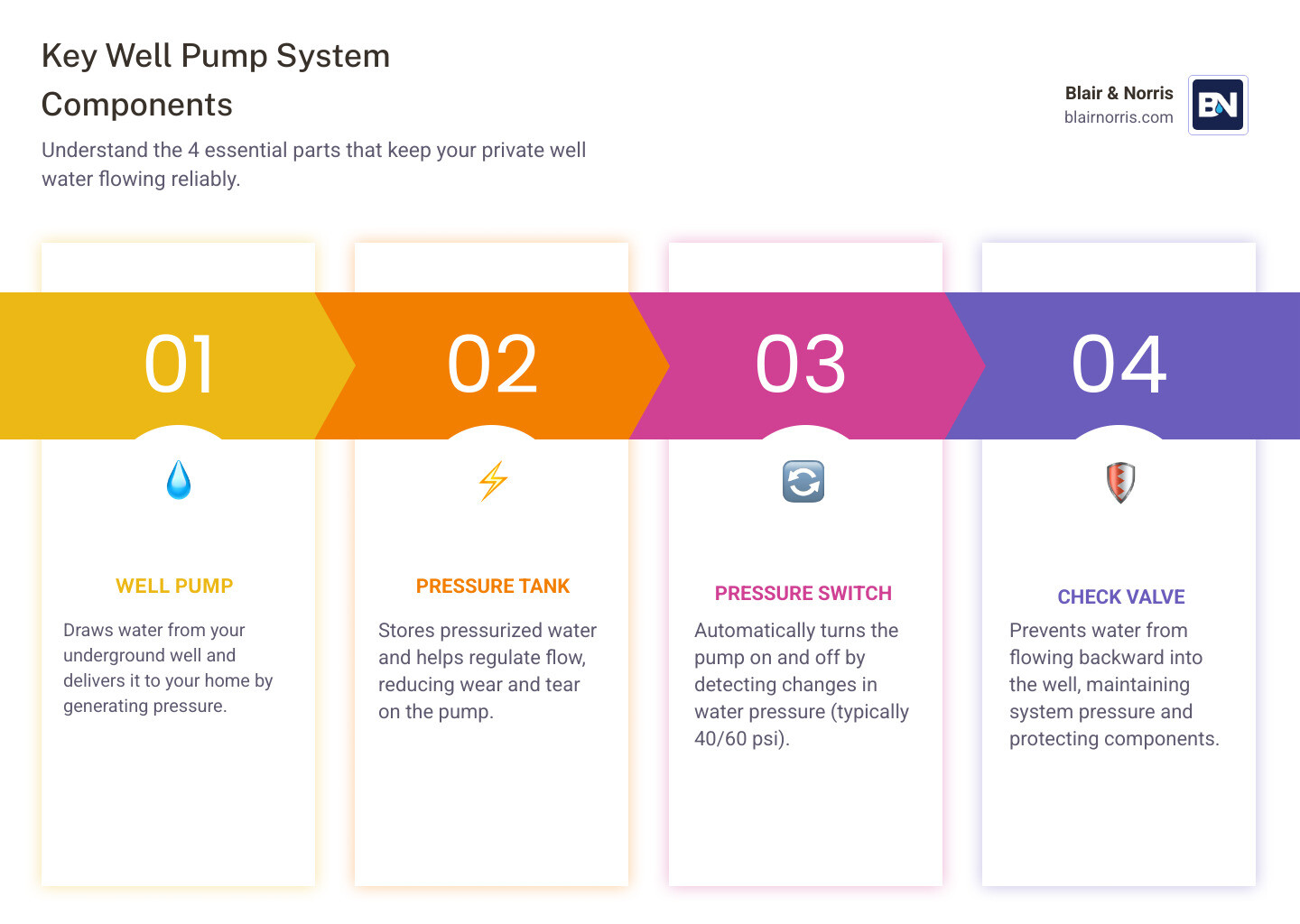
Inside your home, the pressure tank is quietly waiting. This tank stores water under pressure, so you can get steady flow every time you turn on a tap. The pressure switch is like the conductor—watching the pressure in the tank (usually set to start the pump at 40 psi and stop it at 60 psi). And don’t forget the check valve—it stops water from sneaking back down the well after you’ve pumped it up!
At the heart of it all is some simple physics. Most well pumps use a spinning impeller. As the pump’s motor turns the impeller, it uses centrifugal force—imagine water spraying off a spinning umbrella—to move water through the system. This creates the flow that keeps your water supply going.
Here’s what happens every time you use water—the classic 6-step well pump cycle:
- The pressure in your tank drops as you use water.
- When the pressure falls to the “cut-in” point (usually 40 psi), the pressure switch turns the pump on.
- The pump springs to life, pulling or pushing water from the aquifer, up the drop pipe.
- Water fills the pressure tank, squeezing the air inside the bladder.
- Once the pressure reaches the upper “cut-out” limit (often 60 psi), the switch shuts the pump off.
- The cycle repeats whenever you need more water.
Now, how does a well pump work in shallow wells versus deep wells? Let’s break it down:
In shallow wells (25 feet deep or less), you’ll usually find a jet pump sitting above ground. Jet pumps use suction—a bit like sipping through a straw. The pump’s impeller and a venturi nozzle team up to create a powerful pull, drawing water up a single pipe. Jet pumps need to be “primed” (filled with water) to get started, and a foot valve at the bottom keeps water from draining back down between uses.
Deep wells (over 25 feet, often 110–400+ feet) need extra muscle. That’s where submersible pumps come in. These pumps live underwater, way down in your well. Their strong electric motors turn multiple stacked impellers, pushing water up to the surface with impressive force. Because they’re always submerged, submersible pumps cool themselves naturally and don’t need priming. A pitless adapter ensures a tight, frost-proof, and sanitary connection to your plumbing.
Fun fact: Most submersible pumps last 15–25 years and are champions when it comes to energy efficiency!
If you want to see how everything connects, take a peek at the well water system diagram and all 22 key components.
Understanding how does a well pump work helps you spot issues early and keep your system running smoothly. And if you ever need a helping hand, Blair & Norris is just a call away—24/7, every day of the year.
Pump Types, Components & Pressure Tanks
When it comes to choosing the right well pump, the most important factors are how deep your well is and how much water your home uses. Let’s break down the options, so you know which type will keep your water flowing smoothly.
Types of Well Pumps
For most homes in Indiana, the submersible pump is the workhorse. It sits way down in the well (usually 110–400+ feet deep), quietly pushing water up through your pipes with great efficiency. Submersible pumps are reliable, powerful, and can last 15–25 years with minimal maintenance. Picture a slender, waterproof cylinder—about 42 inches long and 4 inches across—doing its job deep out of sight.
If your well is shallow (25 feet or less), a jet pump is more common. Jet pumps are installed above ground and use suction (like a giant straw) to pull water up. They work well for shallow wells but can be a bit finicky if any air sneaks into the system. If you need a little more flexibility, convertible jet pumps can be set up for either shallow or mid-depth wells (up to about 90 feet), just by adding a second pipe.
For very shallow wells (like those used for garden irrigation), there are also centrifugal pumps. These sit above ground, are simple and affordable, but aren’t usually strong enough for whole-house water supply.
Here’s a handy comparison to see how each pump type stacks up:
| Pump Type | Ideal Depth | Location | Efficiency | Maintenance |
|---|---|---|---|---|
| Submersible | 110–400+ ft | In the well | High | Low |
| Jet (shallow) | ≤25 ft | Above ground | Moderate | Moderate |
| Jet (convertible) | 0–90 ft | Above ground | Moderate | Moderate |
| Centrifugal | ≤25 ft | Above ground | Low | Low |
Understanding how does a well pump work is easier when you know what’s inside your system. Every setup has a handful of key parts working together behind the scenes.
Key Components
Pressure tanks are essential for any well water system. They store water under pressure so your pump doesn’t have to start and stop every time you run the tap. This not only gives you steady water flow, but also makes the pump last much longer.
There are a few different pressure tank styles:
- Bladder tanks have a flexible air bladder inside to keep water and air separate—these are the most common and help prevent waterlogging.
- Diaphragm tanks use a flat diaphragm for the same job.
- Air-over-water tanks are the old-school type and need regular air added.
To keep everything running automatically, a pressure switch monitors the tank. When pressure drops below a certain point (like 40 psi), it tells the pump to turn on. When pressure climbs back up (usually 60 psi), the switch turns the pump off.
Many systems also use a control box—especially for larger or deeper submersible pumps. The control box helps start the pump motor and provides electrical protection.
Finally, a check valve is a simple but vital part: it stops water from draining backward into the well when the pump is off, so you don’t lose pressure or risk damage.
For a closer look inside a pressure tank, check out this cutaway photo: 
Knowing what each part does helps you understand how does a well pump work—and gives you the confidence to talk repairs or upgrades with your local experts. If you ever need help, Blair & Norris is just a phone call away, 24/7.
Choosing, Maintaining and Troubleshooting Your Pump
Your well pump is a big investment—and the heart of your water system. Choosing the right one, keeping it healthy, and knowing what to do when things go wrong are the best ways to protect your water (and your wallet) for years to come.
Choosing the Right Pump
Start by figuring out how does a well pump work for your setup. First, check your well’s depth. You can find this in your well construction report, or you can measure it with a weighted string if you’re feeling old-school. The deeper the well, the more powerful pump you’ll need.
Next, count up every spot in your home where you use water—sinks, showers, washing machines, dishwashers. Each one adds to your demand. A typical two-bathroom home needs a pump that can deliver about 8–12 gallons per minute (GPM).
Horsepower matters too. Deeper wells and higher flow rates call for more powerful pumps. The average household uses 60–100 gallons per person, per day—so choose a pump that fits your family’s daily needs.
The type of pump you need depends mostly on well depth:
- For wells less than 25 feet deep, a jet or centrifugal pump does the trick.
- Wells between 25 and 110 feet might need a convertible jet pump (these can handle either shallow or mid-depth).
- Deep wells (110–400+ feet) call for a submersible pump.
Budget is important. Submersible pumps usually cost $400–$2,000, while jet pumps are a bit less at $300–$1,200. Professional installation can bring your total to anywhere from $1,300 to $5,300, depending on your setup and location. Annual maintenance averages around $900, but can range from $300 to $1,500. The good news? A well-chosen submersible pump can last up to 25 years with proper care.
Don’t forget about energy bills. Submersible pumps are the most energy-efficient for deep wells. Jet and centrifugal pumps have a smaller upfront price tag, but they may use more electricity over the years.
When installing, make sure you meet all local codes. Place your well at least 50 feet from any septic system. And for deep wells, always trust a pro. Safety shut-offs are a must for every system to prevent nasty surprises.
Curious about what’s involved?
More info about installing pumps
Maintenance & Troubleshooting
Just like your car, your well pump needs a little TLC to keep running smoothly. A yearly checkup is key.
Make sure to check the pressure tank’s air charge and the pressure gauge. Listen for rapid pump cycling (that’s when your pump turns on and off a lot—called short-cycling). Look for leaks, rust, or odd noises coming from your system. Regularly test your water for bacteria and sediment, and swap out water filters as needed. It’s also smart to inspect the wiring and control box for any wear or loose connections.
If something feels off, here are a few issues to watch for:
- Short-cycling can mean your pressure tank’s air bladder is failing or the tank is waterlogged. Usually, this means you need to recharge the air or replace the bladder.
- Low water pressure might be due to a clogged filter, a worn-out impeller, or your pressure switch needing adjustment.
- No water at all? Check for power outages, tripped breakers, a failed pump, or a dry well.
- Air in your lines often points to a leaky suction pipe or a faulty check valve.
- If you see sediment or grit in your water, your well screen could be worn out, or your pump could be installed too low in the well.
For a deeper dive on pump problems (and how to avoid them), check out:
More info about pump problems
And the EPA’s private well maintenance guide.
Thinking of doing it yourself?
You might be able to handle simple jobs on a shallow jet pump, like priming or changing filters. But deep well submersible pumps are a whole different animal—best left to licensed pros like Blair & Norris. After all, your water supply is too important to risk.
Frequently Asked Questions
1. What determines the size of well pump I need?
Well depth, how much water your home uses, the number of fixtures, and your required gallons per minute (GPM) all matter. Deeper wells and bigger homes need larger pumps with more horsepower and more impeller stages. For example, if you have two bathrooms, a kitchen, and laundry, you’ll likely need 8–12 GPM.
2. What are signs my well pump is failing?
Watch out for low or fluctuating water pressure, no water at the tap, the pump running non-stop, air sputtering from faucets, higher electricity bills, or odd noises like grinding or clicking. If you spot any of these, give us a call before things get worse.
3. How often should a pressure tank be serviced?
At least once a year. Check the air charge, look for leaks, and test the pressure switch. A healthy pressure tank keeps your pump running efficiently and can add years to its life.
Need help or have other questions? Blair & Norris is here with 24/7 live phone support and 75 years of experience to keep your water flowing—rain or shine.
Conclusion
A well pump is more than just a machine in your yard—it’s the lifeline for your home’s water, from that first glass in the morning to the last load of laundry at night. When you understand how does a well pump work, you gain the power to make better choices, spot issues before they become headaches, and keep your water dependable for years to come.
At Blair & Norris, we know how much your water matters. That’s why we’re always just a call away—really, 24/7, with a real person on the line—ready to help with honest answers, advice, or hands-on service. Serving Indiana families for over 75 years, we take pride in helping our neighbors enjoy pure, reliable water, no matter where you live—city, suburbs, or way out in the woods.
Whenever you have a question about your well system, want to learn more, or need service, don’t hesitate to reach out. Our team is here to take the mystery out of well water, fix problems fast, and help you feel confident about your private water supply.
Curious about every part that keeps your water flowing?
More info about well system components
A little knowledge—and a reliable well pump—go a long way. For questions big or small, Blair & Norris is your partner in water peace of mind. Stay water-wise, and let’s keep your taps running for years to come!