
Common Control Box Failures and the Risks of DIY Electrical Repairs
When your residential or commercial water supply suddenly stops, the control box is often the primary location where electro-mechanical issues originate. In a conventional three-wire submersible pump layout, the control box houses the vital starting components that route high-voltage electrical current down the well casing to your submerged pump motor. When these sensitive components degrade due to age, heat, or voltage irregularities, you will experience sudden water outages, rapid line pressure drops, or continuous electrical circuit breaker tripping. Anyone shopping for a well pump control box Speedway homeowners can rely on should look for equipment matched directly to the motor and properly maintained to avoid unexpected system failures.
A frequent misconception among property owners is assuming that any sudden loss of water pressure requires pulling hundreds of feet of drop pipe out of the ground. In many cases, the issue is simply an isolated electro-mechanical component failure located in the above-ground control box. Diagnosing these symptoms early prevents minor surface electrical faults from turning into catastrophic downhole motor burnout. For a deeper breakdown of system symptoms, our Complete Well Pump Troubleshooting Guide details how different mechanical and electrical faults interact across residential and agricultural setups.
Identifying Relay and Capacitor Failure in 3-Wire Systems
The heart of a standard well pump control box consists of start capacitors, potential relays (voltage relays), and run capacitors. The start capacitor delivers the high phase-shifted electrical torque needed to accelerate the submerged motor from a complete standstill to operational speed within a fraction of a second. Once the motor reaches approximately 75 percent of its full operating speed, the voltage relay senses the generated counter-electromotive force and disconnects the start capacitor from the active circuit.
When a start capacitor fails, it frequently shows visible bulging, ruptured rubber relief plugs, or oily electrolytic residue inside the metal enclosure. If the voltage relay fails to drop out as designed, the start capacitor remains energized too long, causing rapid overheating and permanent blowout. Bleed resistors connected across start capacitor terminals help dissipate residual electrical charges after motor shutdown. If these resistors burn out, repeated high-voltage arcing will rapidly pit and weld the relay contact points.
When you notice your well pump is not working, listen closely to the control enclosure. A loud, continuous buzzing sound indicates that the relay contacts are chattering, unable to latch cleanly due to low line voltage or pitted contact surfaces. You can isolate relay faults by reviewing standard well pump relay troubleshooting procedures and testing the auxiliary start winding circuit with professional diagnostic equipment.
Dangers of Improper High-Voltage Wiring and Sizing Mistakes
Attempting DIY electrical repairs on a 230-volt well control panel carries severe safety hazards and costly financial risks. Well pump starting capacitors store lethal electrical charges long after the main circuit breaker is switched off. Touching these terminals without proper discharge techniques can deliver dangerous, high-amperage electrical shocks to unwary homeowners.
Beyond immediate physical hazards, installing incorrect replacement components creates substantial mechanical risks underground. Installing an undersized capacitor prevents the submerged motor from generating sufficient starting torque, causing the motor to stall under heavy static head pressure. Conversely, installing an oversized capacitor pushes excessive electrical current into the auxiliary start winding, melting motor insulation deep underground. When downhole windings burn out, simple surface repairs escalate into costly downhole pump replacements. Proper electrical matching is essential to prevent total well pump failure.
Technical Guide to Well Pump Control Box Speedway Configurations
Selecting the correct control architecture depends on your daily water demand, well depth, static water level, and incoming power supply. Whether you need standard electro-mechanical starting or advanced constant pressure delivery, matching control specifications to motor design ensures decades of dependable operation across Central Indiana properties.
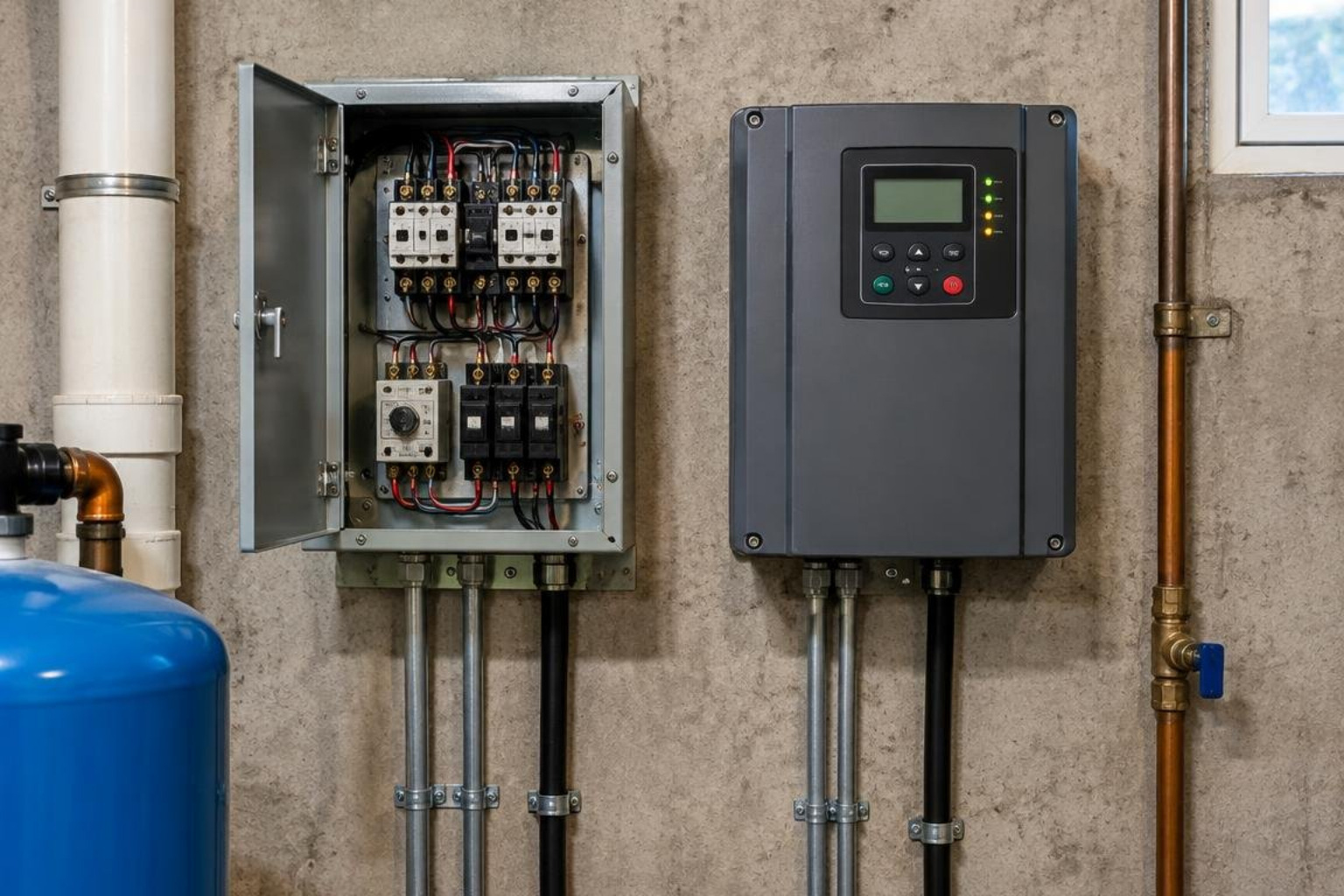
Submersible well motor control panels generally fall into three tiers based on operational complexity and performance:
| Control Panel Category | Operating Voltage & Phase | Ideal Application | Key Advantages |
|---|---|---|---|
| Standard Starter Box (Good) | 115V / 230V Single-Phase | Basic residential 3-wire systems (0.5 to 5 HP) | Low initial equipment cost, straightforward replacement parts, robust electro-mechanical design |
| Simplex Logic Panel (Better) | 115V / 230V Single-Phase | High-demand residential, light commercial, wastewater | Built-in circuit breakers, HOA switches, 360-degree alarm beacons, NEMA 4X weatherproofing |
| VFD Constant Pressure Panel (Best) | 208V to 480V 1-Phase In / 3-Phase Out | Large homes, farms, commercial irrigation, pressure boosting | Eliminates pressure fluctuations, soft-start motor protection, lowers operating electrical consumption |
Reliable manufacturers like Faradyne Motors Control Boxes engineer heavy-duty electro-mechanical enclosures rated from 0.5 to 15 HP, incorporating quick-disconnect covers, voltage relays, and built-in run capacitors to maximize motor lifespan across demanding water supply applications.
Standard Residential Starter Boxes vs. Advanced VFD Panels
Standard electro-mechanical boxes operate on a simple binary principle: the mechanical pressure switch closes when line pressure drops, the control box engages the starting capacitor, the pump accelerates instantly to 3,450 RPM, and it runs at full speed until the cut-out pressure is reached. Standard systems utilize either Capacitor Start / Induction Run (CSIR) or Capacitor Start / Capacitor Run (CRC) circuits. CRC systems incorporate an extra run capacitor to boost motor efficiency and smooth out running amperage during extended pumping cycles.
In contrast, Variable Frequency Drive (VFD) systems utilize dynamic pressure transducers and Proportional-Integral-Derivative (PID) controllers. When you turn on a faucet, the VFD senses the minute pressure drop and ramps the pump up smoothly to the exact speed required to maintain stable water pressure, whether you run one sink or four outdoor irrigation zones simultaneously. This soft-start capability eliminates pipe stress and water hammer throughout your plumbing system.
For shallow wells and smaller homes, a standard 120 volt submersible well pump starter may be sufficient. For larger 230V residential systems, pre-engineered enclosures like the ECO FLO 1-1/2 HP Control Box offer rugged NEMA 3R outdoor protection, heavy-duty wire terminals accepting up to #4 AWG conductors, and clear terminal schematics for straightforward field service.
Clarifying the Speedway Brand Confusion: Water Well Controls vs. Digital Automotive Ignitions
When searching for a well pump control box in Speedway, Indiana, you might encounter search results for the Speedway Motors Digital Ignition Control Box. It is vital not to confuse automotive performance electronics with water well control equipment.
The Speedway Motors digital ignition module is an automotive racing component designed to manage 520 to 540-volt capacitive spark discharge in 4, 6, and 8-cylinder internal combustion engines. It has zero compatibility with potable water systems, alternating current (AC) power grids, or well pump motors. Potable water well systems require dedicated AC control panels manufactured to meet strict electrical safety codes (cULus) and water industry standards.
Equipment Sizing, Enclosure Ratings, and Multi-Pump Configurations
Installing the right control panel requires precise matching of motor horsepower, voltage, phase, and full load amperage ratings. An electrical mismatch can destroy an expensive submersible pump motor within minutes of initial startup.
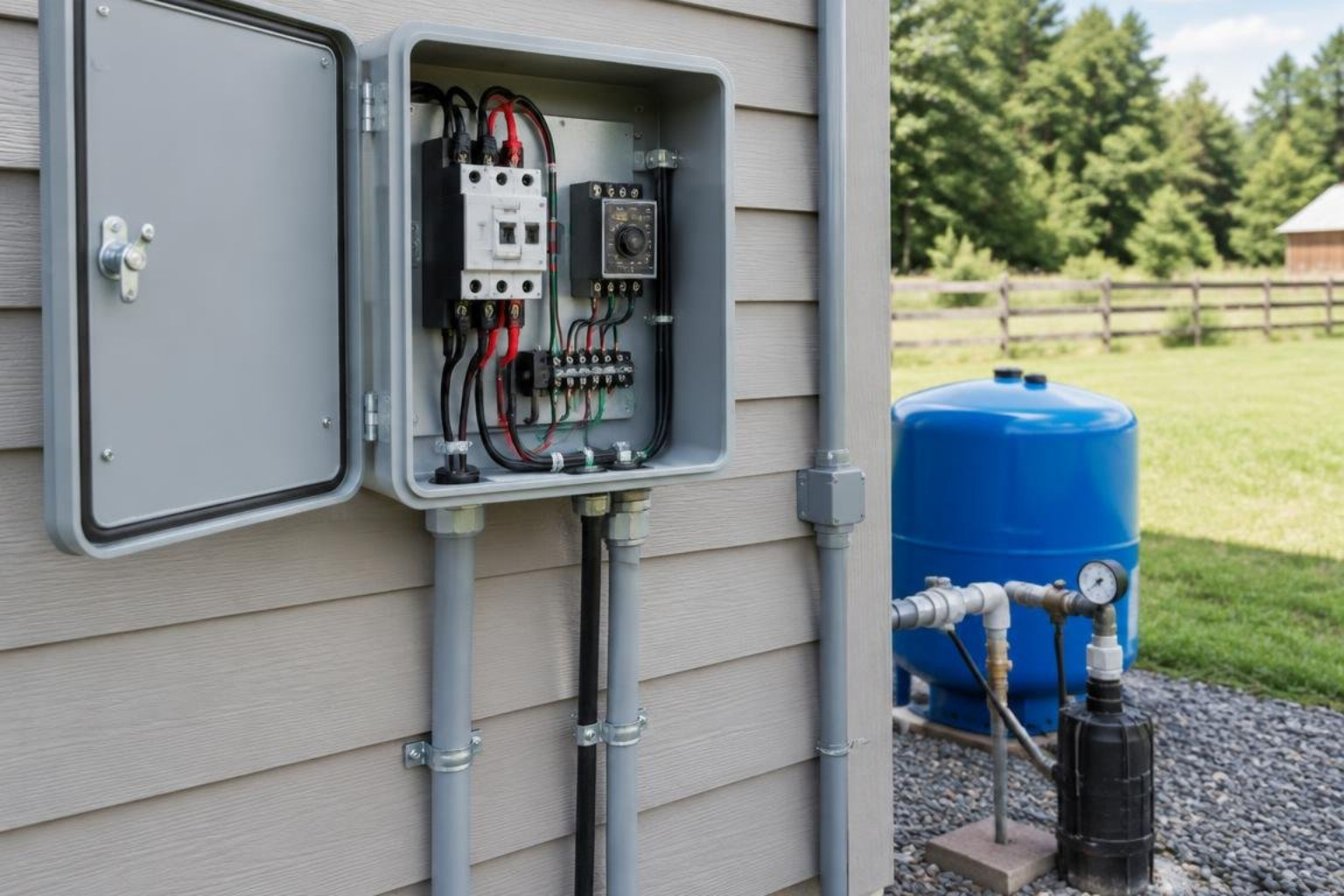
When sizing panels, technicians evaluate three primary electrical ratings on the motor nameplate:
- Operating Voltage: Must match your supply line (115V single-phase, 230V single-phase, or 208/230/460V three-phase).
- Full Load Amps (FLA): The continuous electrical current drawn by the motor under normal operating load.
- Service Factor Amps (SFA): The maximum current the motor can safely handle under full continuous workload. Submersible pump control boxes and thermal overloads must be sized to the motor’s SFA rating.
Choosing the Right Well Pump Control Box Speedway Systems Require
Environmental protection determines where and how your control box is mounted. Enclosure safety standards are defined by National Electrical Manufacturers Association (NEMA) ratings:
- NEMA 3R Enclosures: Weather-resistant enclosures designed for outdoor or indoor mounting. They protect internal components against falling rain, sleet, snow, and external ice formation. They feature drainage weep holes at the bottom of the enclosure.
- NEMA 4X Enclosures: Heavy-duty, watertight, and corrosion-resistant enclosures made from fiberglass or ultraviolet-stabilized thermoplastics. They protect sensitive electronics against direct hose-directed washdown water, airborne dust, corrosive agricultural atmospheres, and extreme weather.
For high-reliability residential applications, advanced simplex units like the Fusion Single Phase Simplex Control Panel combine NEMA 4X protection with lockable latches, Hand-Off-Auto (HOA) toggle switches, IEC magnetic motor contactors, and audible alarm horns reaching 83 to 85 dB for early fault notification.
Ensuring your control panel operates within factory tolerances also requires proper mechanical integration with your pressure tank and switch. Dialing in your well pump pressure switch correctly protects electrical components from rapid short-cycling damage and premature relay degradation.
Commercial and High-Capacity Multi-Pump Control Panels
Commercial properties, multi-family housing complexes, and agricultural operations require multi-pump panels configured in duplex or triplex designs to handle massive fluctuations in water demand.
Multi-pump architectures use dynamic sequencing to optimize performance and prevent downtime:
- Simplex Systems: Single pump managed by dedicated electro-mechanical or logic controls, ideal for single-family residences.
- Duplex Systems: Two pumps running in alternating lead-lag operation. The panel alternates which pump starts first, ensuring even mechanical wear across both units. If demand spikes or the lead pump fails, the lag pump automatically starts.
- Triplex Systems: Three pumps operating in parallel via multi-VFD controllers, commonly used in large municipal, agricultural, or commercial booster stations.
In demanding wastewater or commercial well setups, heavy-duty panels like the SJE-Rhombus VARIOspeed Simplex Grinder Control Panel provide advanced motor protection. This 5 HP, 208/230V three-phase unit features auto-reverse startup cycles that briefly counter-rotate the motor to shred and dislodge bound debris before coming up to full operating speed.
For large commercial water boosting, systems described in Endura Duplex/Triplex Booster Panel documentation utilize load reactors when motor lead wiring runs exceed 50 to 400 feet, protecting submersible windings from damaging voltage spikes and reflective wave phenomena.
Professional Diagnosis, Cold Weather Protection, and Replacement Guidelines
Indiana winters bring sustained freezing temperatures that place intense strain on residential well water infrastructure. Control boxes installed in unheated pump houses, crawl spaces, basements, or exterior well pits are particularly vulnerable to seasonal failure.
Freezing temperatures alter electrical resistance, degrade aged capacitor electrolytes, and cause moisture condensation inside warm electrical housings. When condensation freezes across relay contacts, contacts can weld shut, locking the pump motor into continuous operation until thermal overloads trip or windings burn out. Reviewing guidelines on well pump cold weather prep and freeze protection safeguards electrical and mechanical hardware from severe winter damage.
Professional Solutions for Well Pump Control Box Speedway Emergencies
When your well system fails completely, you need rapid, experienced support from certified technicians. Our field service vehicles carry comprehensive testing instruments, genuine manufacturer parts, and a wide inventory of replacement control boxes to restore your water supply quickly.
If your system experiences sudden electrical failure, our team provides emergency well pump control box replacement to get your water flowing again without delay. Whether you need complete panel upgrades or precision troubleshooting, our dedicated Indianapolis well pump service covers Speedway and all surrounding Central Indiana communities.
Evaluating Replacement Costs vs. Long-Term Reliability
When a control box malfunctions, homeowners must decide whether to replace individual internal components or install a complete, factory-matched control enclosure.
While replacing a single start capacitor carries a lower initial parts cost, aged voltage relays and worn contactors often cause repeated failures within months. Installing a brand-new, factory-calibrated control enclosure ensures that all capacitors, relays, and overload protections are perfectly synchronized, protecting your valuable downhole pump motor and extending your overall system life cycle.
Expanding Beyond Residential Wells: Clean Drilling and Commercial Utility Management
Maintaining clean, dependable groundwater requires advanced installation and maintenance standards. When drilling or upgrading well systems throughout Central Indiana, we utilize specialized equipment such as Mud Puppy mud recycling systems. This advanced mud-cleaning technology separates drill cuttings and recirculates clean fluids, minimizing property disruption and protecting local aquifers during drilling operations.
In addition to our freshwater well and pump expertise, proper groundwater protection relies on comprehensive waste management. As Your Local Central Indiana Provider, we offer full-service maintenance and pumping solutions for residential septic tanks, commercial grease traps, car wash drainage pits, and wastewater holding facilities across Marion County and surrounding areas. Our septic services are dedicated strictly to professional septic tank pumping, cleaning, and routine service rather than septic system or riser installation. Regular commercial and residential pumping prevents drainfield contamination, protecting the subterranean water tables that supply your clean drinking water.
Frequently Asked Questions About Well Pump Controls
How do I know if my well pump problem is the control box or the pump itself?
A technician tests line voltage at the control box input terminals, checks capacitor microfarad ratings with a multimeter, and verifies relay coil continuity. If the surface control box tests normal, we measure electrical resistance (Ohms) across the red, black, and yellow downhole motor leads. A short circuit, open circuit, or ground fault in those downhole wires indicates that the pump motor itself or the downhole cable has failed.
What is the difference between a NEMA 3R and NEMA 4X control box enclosure?
A NEMA 3R enclosure is a weather-resistant housing built for outdoor use to protect components against rain, sleet, snow, and ice formation, utilizing bottom drainage weep holes. A NEMA 4X enclosure provides higher protection with a watertight, dust-tight, and corrosion-resistant seal made from UV-stabilized thermoplastics or fiberglass. It completely blocks windblown dust, direct hose washdowns, and corrosive environmental exposure.
Can I replace a single-phase control box with a variable frequency drive?
Yes. Upgrading from a standard single-phase control box to a modern VFD constant pressure system provides smooth, city-like water pressure across all fixtures. The conversion involves replacing the mechanical pressure switch with an electronic pressure transducer, installing the VFD drive controller, and properly matching the drive parameters to your pump motor’s electrical ratings.
Reliable Water System Solutions in Speedway
At Blair & Norris, we have delivered dependable water and wastewater solutions for more than 75 years. As Your Local Central Indiana Provider serving Speedway and all surrounding communities, we take pride in quality craftsmanship, ethical recommendations, and transparent service. We back every project with 24/7 live phone support, ensuring that when you experience a water emergency, you speak directly with a dedicated professional ready to help.
Whether your control box needs immediate troubleshooting, a total panel upgrade, or seasonal maintenance, our experienced technicians have the tools and expertise to restore your water quickly. Contact Blair & Norris today for an estimate and experience the difference of working with Central Indiana’s trusted well water specialists.
- Need immediate assistance? Schedule Well and Pump Service with our local service team.
- Experiencing an outage? Request Emergency Well Pump Repairs for rapid dispatch.