
Is Your Leach Field Healthy? Here’s What Every Indiana Homeowner Needs to Know
Leach field inspection is the comprehensive process of evaluating your septic system’s drainfield to confirm it is properly absorbing, treating, and filtering wastewater before it reaches the groundwater. In the state of Indiana, where soil conditions can vary wildly from the sandy banks of the Wabash to the heavy, stubborn clays of the central plains, this inspection is not just a recommendation—it is a vital part of property stewardship. Failing to monitor this underground network can turn a small, manageable maintenance task into a catastrophic, five-figure replacement project.
Here is a detailed summary of what you need to know to protect your home:
- What it is: A leach field (also known as a drainfield or absorption field) is a subsurface wastewater disposal facility used to remove contaminants and impurities from the liquid that emerges after anaerobic digestion in a septic tank. It consists of a network of perforated pipes and gravel trenches buried in your yard.
- How often: You should have a professional inspection every 1–3 years. While the septic tank itself should be pumped every 3–5 years, the leach field requires more frequent monitoring to ensure the soil’s absorption capacity hasn’t been compromised.
- Warning signs: Keep a close eye out for soggy ground over the drainfield, persistent sewage odors, slow-clearing drains, gurgling pipes, or patches of unusually lush, dark green grass that stand out from the rest of your lawn.
- Who does it: A certified septic professional is required for a full diagnostic. While homeowners can perform basic visual checks, a true assessment requires specialized tools like sewer cameras, electronic locators, and hydraulic load testing equipment.
- Why it matters: A failing leach field is a public health hazard. It can contaminate local groundwater, cause raw sewage to back up into your home’s lowest drains, and lead to the total failure of the septic system, costing tens of thousands of dollars to rectify.
More than one in five U.S. households depend on a septic system to handle their wastewater. For most homeowners, that system works quietly underground, out of sight and out of mind—until it doesn’t. By the time you notice a problem, the damage is often already extensive. The leach field is the hardest-working part of your septic system, and it’s also the most vulnerable to environmental changes and usage habits. Sludge builds up when tanks aren’t pumped. Soil gets compacted by heavy machinery or vehicles. Tree roots invade looking for moisture. Without regular inspection, you won’t know there’s a problem until sewage is surfacing in your backyard.
The good news is that the vast majority of septic failures are preventable. If you know what to look for and when to call in a professional, you can extend the life of your system by decades. I’m Mack Blair, and with over 30 years of hands-on septic experience serving Central Indiana, I’ve seen the full spectrum of septic health. In this guide, I’ll walk you through the technical details of leach field health to help you protect your property and your family.

Leach field inspection glossary:
Understanding the Critical Role of Your Leach Field
To understand why an inspection is so critical, you must first understand the mechanics of wastewater treatment. Think of your septic tank as the “settling” area and your leach field as the “treatment” plant. When wastewater leaves your home, it flows into the septic tank where solids settle at the bottom (sludge) and oils and grease float to the top (scum). The liquid in the middle, known as effluent, then travels to the leach field for final purification.
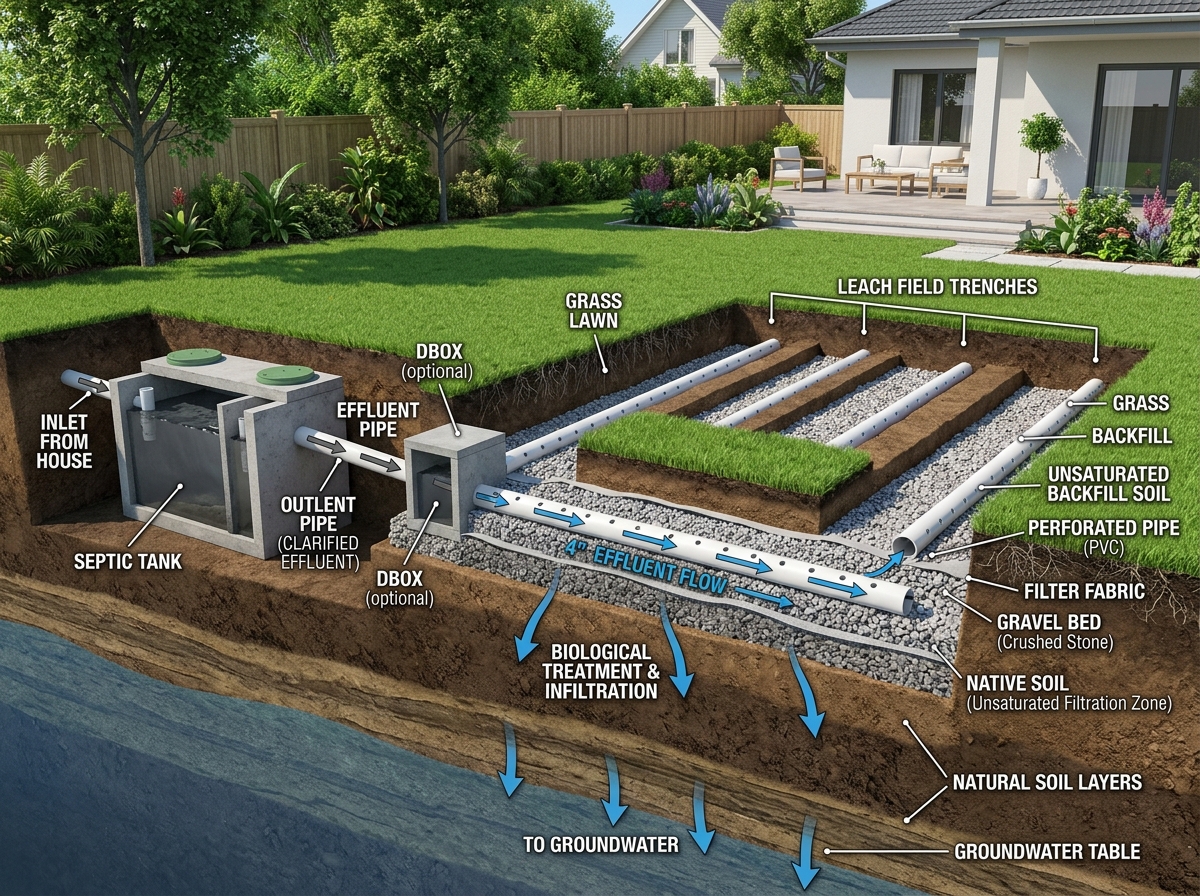
The leach field consists of a series of perforated pipes laid in gravel-filled trenches or plastic chambers. As effluent flows through these pipes, it trickles into the gravel and then into the soil. This is where the biological magic happens: naturally occurring aerobic bacteria in the soil filter out harmful pathogens, viruses, and nutrients like nitrogen and phosphorus before the water eventually returns to the groundwater table. This process is highly dependent on the “percolation rate” of your soil—how quickly it can absorb liquid.
However, this process relies on a delicate biological balance. Over time, a “biomat” — a dense layer of anaerobic bacteria, organisms, and organic matter — forms at the bottom and sides of the trenches. While a thin biomat is actually necessary for filtering out certain pathogens, a thick, overgrown biomat acts like a waterproof liner, clogging the soil and preventing water from draining. This is why understanding 7 Common Septic Tank Issues is vital; if the tank isn’t doing its job of settling solids, those solids flow into the field and accelerate biomat growth, leading to premature failure.
Professional Leach Field Inspection Techniques are designed to ensure this filtration process remains efficient. In Central Indiana, we often deal with high-clay soils that have naturally slow percolation rates. If the biomat becomes too thick in these soils, the system has nowhere to send the water, leading to the classic signs of failure.
Signs You Need an Immediate Leach Field Inspection
Your yard is often the first indicator of a system in distress. If you notice any of the following, you should contact a professional immediately:
- Soggy or Spongy Soil: Even during dry spells, if areas over your drainfield feel wet or “squishy” underfoot, it means the effluent is not being absorbed and is instead rising to the surface.
- Sewage Odors: A distinct “rotten egg” smell (hydrogen sulfide gas) wafting through your yard or near your indoor drains is a sign that gases are escaping the system because the liquid isn’t moving through the soil correctly.
- Lush, Dark Green Grass: While a beautiful lawn is usually a plus, grass that is significantly greener or taller over the leach field lines than the rest of the yard indicates it’s being “over-fertilized” by surfacing effluent that is rich in nitrogen.
- Slow Drains and Gurgling: If your toilets are sluggish or your sinks gurgle when you run the dishwasher, the system is likely backed up because the leach field can no longer accept the volume of water being produced.
- Surfacing Effluent: This is the most severe sign — actual grey or black water pooling on the surface of your lawn. This is a biohazard and requires immediate intervention.
If you see these, you may be facing one of the 5 Warning Signs of a Septic System Backup Emergency.
The Consequences of Neglect
Ignoring your leach field doesn’t just lead to a smelly yard; it leads to financial and environmental disaster. A failed leach field in Indiana can cost between $10,000 and $25,000 to replace, depending on the soil type and specific county health department requirements in places like Hamilton, Boone, or Hendricks counties. Beyond the cost, a failing system poses a significant health risk. Pathogens can leach into private wells, and excess nitrogen can contaminate local waterways, leading to algae blooms. Furthermore, if you are planning to sell your home, a failed inspection can halt a real estate transaction in its tracks. Check out our Real Estate Septic Inspection Guide 2025 for more on how these systems impact property value and the legal requirements for transfer of ownership.
The Risks and Limitations of a DIY Leach Field Inspection
We know many Indiana homeowners take pride in maintaining their own property and like to save money where possible. However, when it comes to leach field inspection, there is a very fine line between “helpful observation” and “dangerous risk.” Understanding what you can do versus what requires a professional is key to your safety and the longevity of your system.
What Homeowners Can Safely Observe
You can and should perform regular “walk-overs” of your system. This involves:
- Visual Checks: Looking for the warning signs mentioned above, such as lush grass, puddles, or depressions in the soil where trenches might be collapsing.
- Odor Detection: Sniffing around the tank and field area to catch early signs of gas leaks.
- Locating Components: Knowing exactly where your tank, distribution box, and field lines are located. If you don’t know, you can’t protect them from heavy traffic or improper planting.
- Record Keeping: Maintaining a detailed log of when the system was last pumped, inspected, or repaired. This history is invaluable to a professional inspector.
Why DIY Testing Often Fails
While you can buy “dye tablets” at the hardware store, they are often unreliable and can provide a false sense of security. A dye test only shows if there is a massive, immediate leak to the surface; it cannot tell you if the soil is slowly clogging, if the biomat is reaching a critical thickness, or if the pipes are starting to collapse under the weight of the soil. Furthermore, many homeowners use chemical “septic additives” thinking they are helping the leach field. In reality, many of these chemicals can emulsify grease, allowing it to flow out of the tank and into the leach field where it clogs the soil pores permanently.
Furthermore, attempting to open a septic tank yourself is incredibly dangerous. Septic tanks produce methane, carbon dioxide, and hydrogen sulfide gases, which can be fatal if inhaled in a confined space. There is also the risk of tank lid failure or falling into the tank, which has resulted in numerous fatalities over the years. According to the Maintaining Your Septic System Guide, professional training and specialized safety equipment are required to handle these components safely. DIY methods also lack the precision of tools like a “sludge judge” or specialized cameras. Without these, you might miss the fact that your sludge levels have reached the critical 1/3 volume mark, which is the point where solids begin flowing into and ruining your leach field. For a truly accurate assessment, refer to the Septic System Inspections – InterNACHI® standards that professional inspectors follow to ensure every component is checked thoroughly.
Professional Leach Field Inspection: What the Experts Look For
When Blair & Norris arrives for a leach field inspection, we don’t just look at the grass. We perform a comprehensive “physical” for your entire septic system, using a combination of historical data, visual cues, and high-tech diagnostic equipment.
How Often Should You Schedule a Leach Field Inspection?
In Central Indiana, we recommend a professional Septic Inspection every 1 to 3 years. If you have a large family, use a garbage disposal (which increases the solids load by up to 50%), or have an older system, you should lean toward the annual side. Regular checks are the only way to catch biomat thickening before it becomes an impermeable barrier. For more tips on timing and maintenance schedules, see our Septic System Maintenance Guide.
Advanced Diagnostic Tools and the Mud Puppy System
We use a variety of high-tech tools to see what’s happening underground without having to excavate your entire yard:
- Sewer Cameras: We snake waterproof, high-definition cameras through the lines to check for root intrusion, crushed pipes, or “sludge-outs” where solids have migrated into the field.
- Radio Transmitters: These allow us to pinpoint the exact location and depth of a blockage or a broken pipe from above ground, saving hours of exploratory digging.
- Hydraulic Load Testing: We introduce a specific, measured volume of water into the system over a set period to see how quickly the soil absorbs it. This simulates heavy usage (like a laundry day) and reveals if the field is nearing its capacity.
- Sludge Judge: A clear, calibrated tube used to measure the exact levels of scum and sludge in your tank to ensure the baffles are working correctly.
| Feature | Visual DIY Inspection | Professional Camera Scoping |
|---|---|---|
| Detects Pipe Cracks | No | Yes |
| Measures Sludge Levels | No | Yes |
| Identifies Root Intrusion | No | Yes |
| Verifies D-Box Flow | Limited | Yes |
| Safety Risk | High (if opening tank) | Low (for homeowner) |
| Soil Absorption Analysis | No | Yes |
Good, Better, Best: Solutions for a Failing Drainfield
If our inspection reveals that your leach field is struggling, don’t panic. A failing grade on an inspection doesn’t always mean you need a brand-new system. Depending on the severity of the clogging and the age of the components, we typically offer a range of solutions tailored to your budget and the specific needs of your property.
The “Good” Option: Maintenance and Pumping
If the inspection shows that the system is simply sluggish due to high water usage or a slightly neglected pumping schedule, the first step is a thorough Septic Tank Cleaning and Inspection. By removing the accumulated solids (pumping) and cleaning the effluent filter, we take the immediate pressure off the leach field. Combined with strict water conservation measures—such as installing low-flow fixtures—and the total avoidance of chemical “additives,” this can sometimes give a tired field the rest it needs to naturally break down some of the biomat and recover its absorption capacity.
The “Better” Option: Leach Field Rehabilitation
For fields that are starting to fail due to moderate sludge accumulation or biomat thickening, we can perform rehabilitation techniques that extend the life of the field without full replacement. This often involves:
- Water Jetting: Using high-pressure water streams to clear out the perforated pipes and scrub the interior of the distribution box.
- Sludge Removal: Vacuuming out excess material from the distribution box and the first few feet of the lateral lines.
- Bacterial Seeding: Introducing specific, high-potency aerobic bacteria to help break down the organic matter in the biomat.
- Soil Fracturing (Terralift): Using specialized equipment to inject air into the soil at high pressure, creating new pathways and fissures for water to flow, and then filling those fissures with polystyrene beads to keep them open.
The “Best” Option: Full System Replacement
If the field is over 25–30 years old, the pipes have collapsed, or the soil is completely saturated and “dead,” replacement is often the most cost-effective long-term move. We conduct a full site evaluation to find the best “reserve area” on your property. Using Mud Puppy mud recycling technology for the drilling and excavation phases, we can install modern chamber systems or traditional stone-and-pipe fields with minimal mess. These modern systems are often more efficient than the ones they replace, backed by our long-term service warranty and designed to meet the latest Indiana environmental standards.
Choosing Your Local Central Indiana Provider for Septic Health
Maintaining a septic system is a long-term commitment, and you need a partner who will be there for the life of your home. Blair & Norris has been serving families from Indianapolis to Zionsville, Carmel, and beyond for over 75 years. We aren’t just a service company; we are members of the community who care about the local environment and the health of our neighbors.
As a family-owned, local Central Indiana provider, we understand the specific soil conditions of our region — from the heavy, poorly-draining clays of Noblesville and Fishers to the loamy, more forgiving soils near the White River. This local knowledge allows us to accurately interpret inspection results that a national franchise might misread.
Elements of a Great Service Partner
When you’re looking for someone to handle your leach field inspection, look for these “must-haves”:
- 24/7 Live Support: Septic emergencies don’t wait for business hours. We offer 24/7 live phone support so you never have to talk to a machine when your yard is flooding.
- Licensed and Insured: We are fully licensed to operate in all Central Indiana counties and stay up-to-date with the latest ISDH (Indiana State Department of Health) regulations.
- Transparent Ethics: Our reputation is built on 75 years of honest work. We don’t recommend replacements when a repair will do, and we provide detailed written reports of every inspection.
- Advanced Equipment: From high-resolution sewer cameras to Mud Puppy recycling units for clean drilling, we invest in the tools that get the job done right the first time.
Don’t just take our word for it — our Google Reviews reflect our commitment to the community. Homeowners across Marion, Hamilton, and Johnson counties trust us to keep their water systems running smoothly. For more information, visit our septic services page.
Frequently Asked Questions about Leach Field Inspection
How do I locate my leach field if I don’t have a map?
If you don’t have the original “as-built” drawings from your local health department, we can find it for you. We look for visual cues like grass patterns (lush green lines or brown spots during drought) and use electronic locating equipment or soil probing to map out the exact layout of the trenches. We can then provide you with a digital map for your future records.
Can I plant anything on top of my leach field?
Yes, but you must be extremely selective. You should only plant shallow-rooted grasses or herbaceous flowers. Avoid trees and large shrubs at all costs, as their roots will seek out the moisture and nutrients in your pipes and eventually crush or clog them. Also, avoid planting vegetable gardens, as there is a significant risk of bacterial contamination from the effluent.
How much does a professional leach field inspection cost?
While we don’t provide flat pricing because every system is different (size, location, and accessibility all play a role), we can tell you that a professional inspection is a tiny fraction of the cost of a replacement. A basic visual inspection is the most affordable, while advanced camera scoping or hydraulic load testing requires more time and specialized equipment. We always provide a clear estimate before work begins.
Can an inspection be done in the winter?
Yes, inspections can be performed year-round in Indiana, though deep snow or frozen ground can make visual soil analysis more difficult. However, if you are experiencing a backup or are in the middle of a real estate transaction, we have the equipment to perform a thorough check regardless of the temperature.
Will a failed inspection mean I can’t sell my house?
In many Indiana counties, a functional septic system is a requirement for the transfer of property. If an inspection fails, you will likely need to perform repairs or negotiate a replacement as part of the sale. This is why we recommend a pre-listing inspection so you aren’t surprised by a failure during the closing process.
Conclusion
Your leach field is a silent hero, protecting your home and the environment every single day. But even heroes need a check-up. By staying vigilant for warning signs and scheduling a professional leach field inspection every few years, you can avoid the “nightmare scenario” of a total system failure.
A healthy septic system starts with a healthy tank and ends with a functional drainfield. Whether you’re in Carmel, Fishers, Brownsburg, or Greenwood, Blair & Norris is your local expert for everything septic and well-related.
Don’t wait for a soggy yard to take action. Protect your property and your wallet today.