
Understanding Your Water Source: How Do Wells Work?
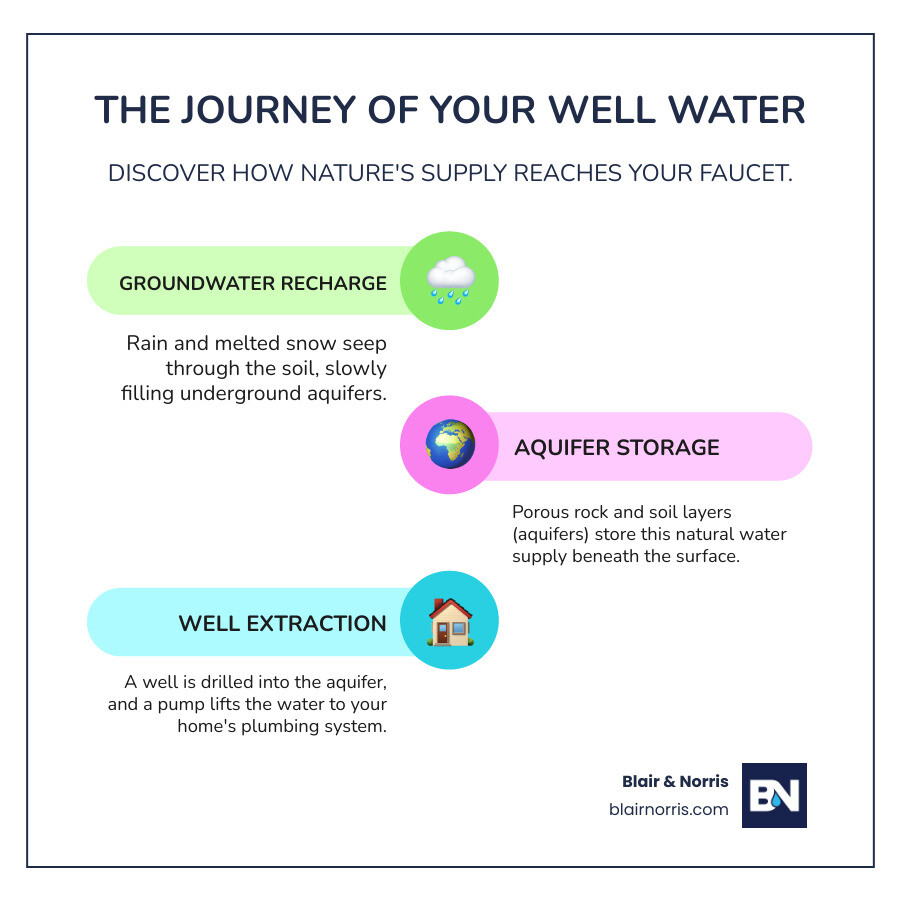
Have you ever wondered exactly how do wells work to bring water into your home? It might seem like magic, but it’s a clever system connecting your home to nature’s underground water supply. Most wells don’t draw from underground rivers. Instead, they access vast layers of rock and soil filled with water.
Here’s the quick answer:
- Wells tap into underground water sources called aquifers.
- Rain and snowmelt seep into the ground, slowly filling these aquifers.
- A well is a hole dug or drilled deep enough to reach this water-filled layer.
- A pump then draws the water from the well up to your home, ready for use.
For many, turning on the faucet means instant, clean water from a city system. But if you live a bit further out, your water likely comes from a well. Understanding your well system helps you keep your water safe and flowing.
I’m Mack Blair, with over 30 years of experience in well drilling and pump systems here in Central Indiana. My team at Blair & Norris has helped countless homeowners understand exactly how do wells work and ensure their water systems are reliable. We’re here to guide you through the journey of water from deep underground to your tap.
The Hidden Source: Where Does Well Water Come From?
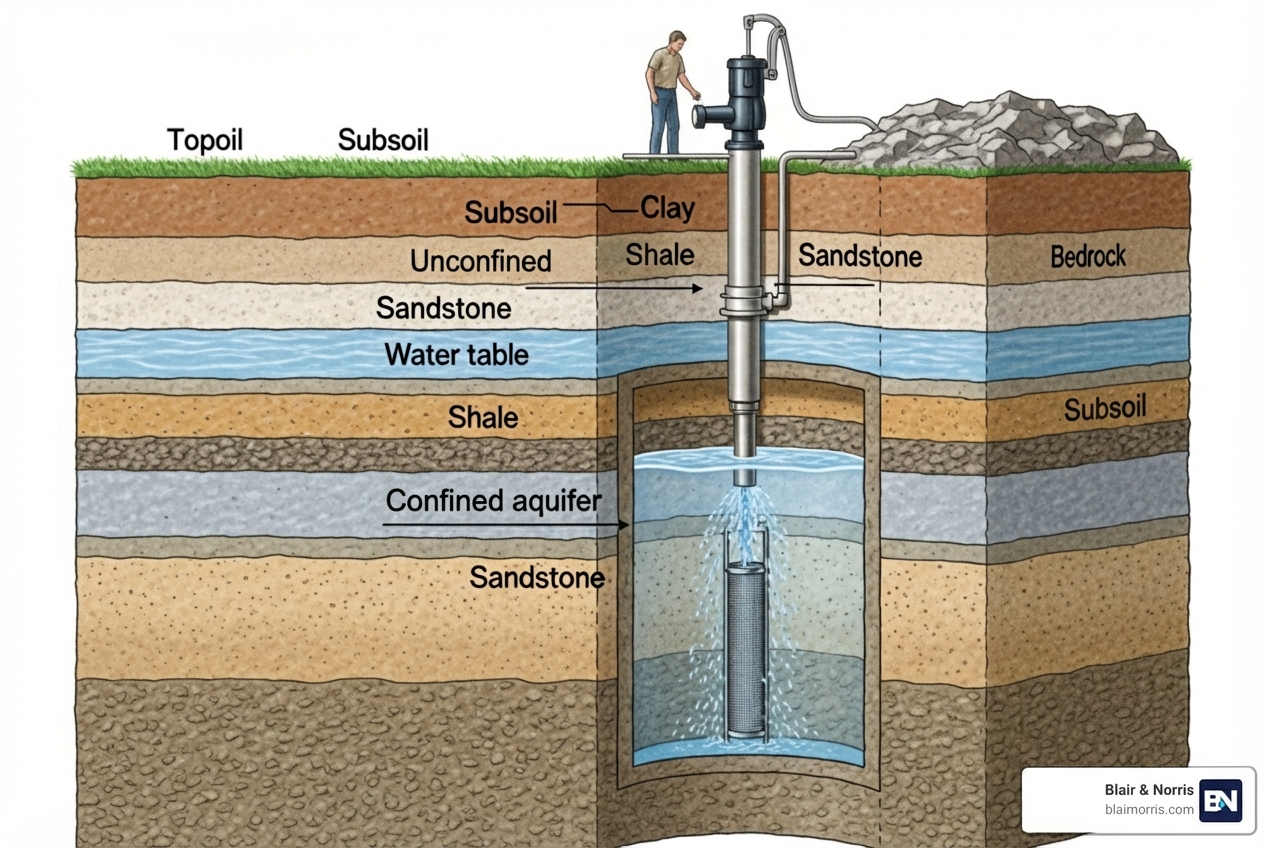
It’s undoubtedly unintuitive that water flows in the soil and rock below our feet. When we talk about well water, we’re talking about groundwater – water that has seeped into the ground from rain and snowmelt, eventually filling the tiny spaces within rock and soil layers. This isn’t water from some secret underground river, a common misconception, but rather from these porous geological formations. Most wells do not get their water from underground rivers; instead, they get it from aquifers.
An aquifer is essentially a natural underground reservoir. Imagine a sponge, but on a massive scale, made of layers of permeable rock, sand, gravel, or fractured bedrock. These layers are saturated with water, meaning all the void spaces are filled. This saturated zone is where we tap into our water supply.
Groundwater moves, albeit slowly. Groundwater moves slowly through aquifers, often on the order of feet per year, depending on the geology. This slow movement means that water in aquifers can take years to centuries to flow back to the surface or reach a well. This natural filtration process through the earth’s layers can also help purify the water, though it doesn’t guarantee safety from all contaminants.
The Role of Aquifers and the Water Table
Aquifers are the true workhorses of our underground water supply. They are layers of rock and soil with water flowing through their small pores. These geological formations are capable of transmitting and storing groundwater, making them ideal sources for wells.
The water table is a critical concept in understanding how do wells work. It’s the boundary between the unsaturated ground near the surface and the saturated ground deeper down, where all pores and cracks are filled with water. Think of it as the top surface of the groundwater. When you dig a hole, if you go deep enough, you’ll hit water. That’s the water table. A well is a hole dug deep enough to penetrate below the water table, allowing water from the surrounding saturated zone to fill it.
The water table’s level isn’t static; it fluctuates based on rainfall, snowmelt, and how much water is being pumped out by wells. These changes directly affect well function. If the water table drops significantly, a shallow well might go dry, requiring it to be deepened or a new well to be drilled. Understanding these dynamics is crucial for ensuring a reliable water supply. The Indiana Department of Natural Resources offers Indiana-specific resources on groundwater and wells, including records and guidance for homeowners.
How Do Wells Work? From Ground to Faucet
The construction of a well is essentially about creating a pathway for water to move from an aquifer to the surface. Historically, wells have been constructed for at least eight thousand years, evolving from simple hand-dug pits to sophisticated drilled systems.
When planning a well, a crucial first step is siting. Proper well location and construction are key to the safety of your well water. We work with hydrogeologists and groundwater surveyors to select the best well sites here in Indiana, ensuring optimal water access and minimizing contamination risks. The goal is to find a location that can provide a sustained yield, meaning it can supply enough water to meet demand without quickly running dry.
As water is pumped from a well, it creates a localized lowering of the water table around the well, known as a “cone of depression.” This cone forms because water moves slowly through the aquifer, and the pump pulls water faster than the aquifer can replenish it immediately around the well. The size and shape of this cone depend on the pumping rate and the aquifer’s characteristics. Understanding this phenomenon is vital for predicting well interference and ensuring the long-term sustainability of the water supply.
For a comprehensive look at the well construction process, check out our Drilling Well: Ultimate Guide 2025.
A Look at Different Well Construction Methods
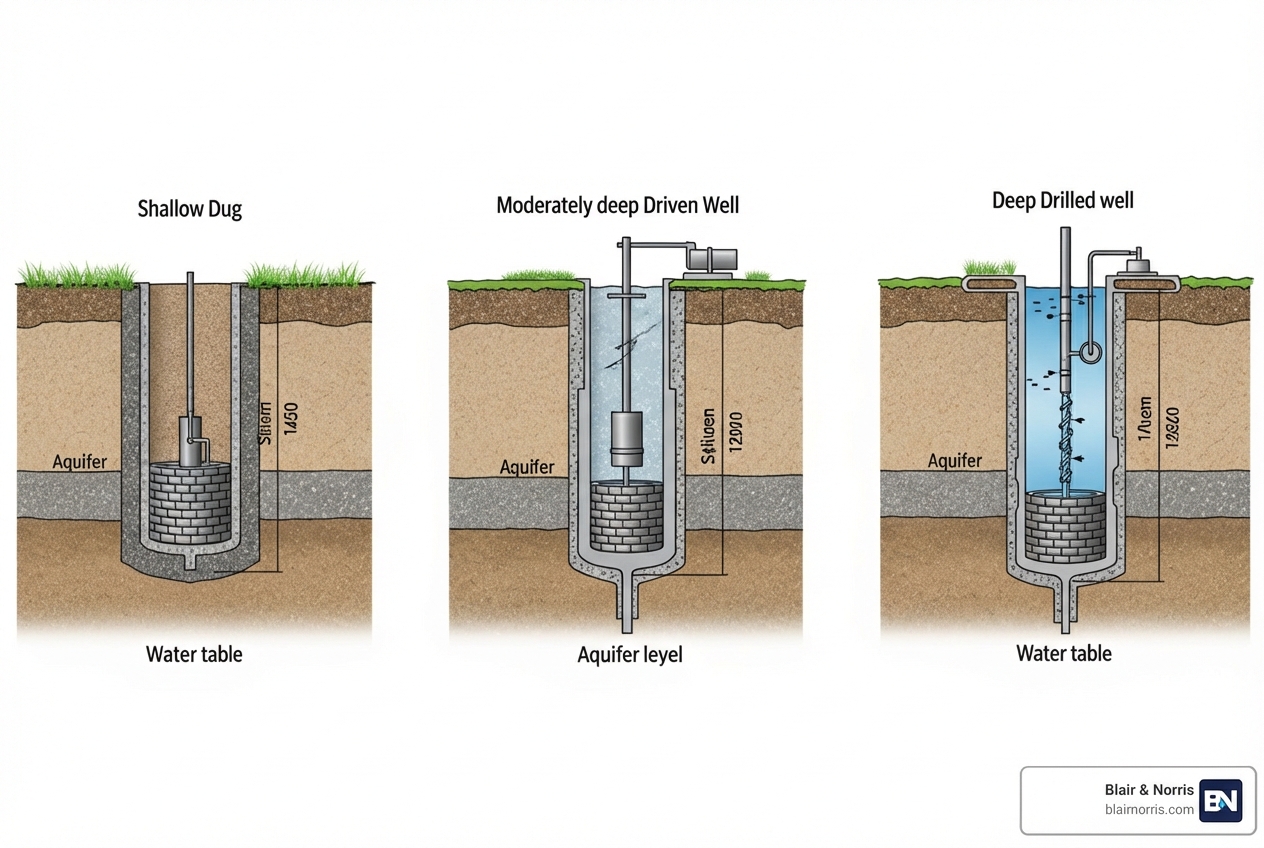
The method of well construction largely depends on the local geology, the depth of the water table, and the desired water yield. There are three primary types of wells:
- Dug Wells: As the oldest type, dug wells are manually excavated to a shallow depth of 10 to 30 feet. They are lined with materials like stone or concrete to prevent collapse, but their shallowness makes them highly susceptible to surface contamination.
- Driven Wells: These wells are created by driving a small-diameter pipe into soft ground to depths of 30 to 50 feet. While less expensive and better protected than dug wells, they are still shallow and can be vulnerable to contamination.
- Drilled Wells: The modern standard, drilled wells are constructed with powerful rigs to reach deep aquifers, often hundreds or even thousands of feet down. Their significant depth and continuous casing offer the best protection against contamination, making them the safest and most reliable choice for drinking water.
Here’s a quick comparison of these well types:
| Well Type | Typical Depth (feet) | Construction Method | Contamination Risk | Cost (Relative) |
|---|---|---|---|---|
| Dug/Bored | 10-30 | Hand/Backhoe excavation | High | Low |
| Driven | 30-50 | Driving pipe into ground | Medium | Low to Medium |
| Drilled | 100-800+ (residential) | Machine drilling | Low | High |
For more detailed information on these types of wells and their role in private water systems, the EPA provides valuable resources on Learn About Private Water Wells.
Understanding Artesian Wells and Well Depth
While most wells rely on pumps, some operate under natural pressure and are known as artesian wells. This occurs when a well taps a confined aquifer—a water-bearing layer trapped between less permeable layers called aquitards. The water within is under pressure from the weight of the overlying rock and from water entering at higher elevations.
When a well penetrates such an aquifer, this pressure can force water up the well casing. If this pressure, or hydraulic head, is high enough to push water above the land surface, it creates a flowing artesian well that requires no pump. If the water rises high in the well but doesn’t reach the surface, it’s a non-flowing artesian well, which still needs a pump. We’ve seen some impressive artesian wells in various parts of Indiana.
The depth of a residential well can vary significantly. While some shallow wells might only be 10-60 feet deep, most residential wells in our service areas of Indianapolis, Carmel, and surrounding Indiana communities typically range between 100 and 800 feet below ground level. Industrial wells can go even deeper, sometimes exceeding 3,000 feet. The ideal depth depends on local geology, water table depth, aquifer stability, and household demand, with the goal of reaching a reliable and safe water source.
The Anatomy of a Modern Well System
A modern well system is a marvel of engineering, designed to efficiently and safely deliver groundwater to your home. Beyond just the hole in the ground, several key components work in harmony to make your water flow.
- Well Casing: The well casing is a tube that lines the borehole, preventing collapse and, along with grout, sealing out contaminants from surface water. It’s typically made of carbon steel, plastic (PVC), or stainless steel.
- Well Cap: The well cap sits atop the casing, sealing the well from debris, insects, and animals. A vent allows for air exchange, which is important for pressure equalization during pumping.
- Well Screen: Attached to the bottom of the casing, the well screen filters out sand and gravel while allowing water to enter the well. Its design is specific to the aquifer’s geology.
- Pitless Adapter: A pitless adapter creates a sanitary, frost-proof connection for the water line running from the well to the house. It connects below the frost line, eliminating the need for a traditional well pit and protecting against contamination.
These components are foundational to any well system. To understand how they all fit together in a complete water delivery system, check out our detailed guide on the Components of a Water Well System.
The Heart of the System: How do wells work with pumps and pressure tanks?
While the well itself provides access to groundwater, it’s the pump that brings that water to your home. There are two main types of well pumps commonly used in residential systems:
- Submersible Pumps: The most common type for deep wells, submersible pumps are placed deep inside the well casing, below the water level. They push water to the surface, making them highly efficient, durable, quiet, and they don’t require priming.
- Jet Pumps: Jet pumps are used for shallower wells (typically 25 feet or less). Located above ground, they use suction (the Venturi effect) to pull water from the well. Deep well jet pumps can work for depths up to 150 feet.
Once the water is drawn from the well, it enters a pressure tank. This tank stores a reserve of water to maintain consistent pressure and reduce pump cycling. By preventing the pump from turning on and off with every faucet use, it reduces wear and extends the pump’s life.
A pressure switch and control box work in conjunction with the pressure tank to automate the system. The switch monitors pressure in the tank, turning the pump on when pressure drops (e.g., below 40 psi) and off when it reaches the maximum setting (e.g., 60 psi). This maintains steady pressure without constant pump operation.
To learn more about these crucial mechanical components, refer to our article on How Does a Well Pump Work?.
Ensuring Safe and Reliable Well Water
Unlike municipal water systems, where a utility company is responsible for water quality, private well owners bear the sole responsibility for ensuring their water is safe and reliable. The EPA does not monitor or regulate private wells, placing the onus entirely on the homeowner. This means understanding the potential risks and actively managing your well’s health.
Water quality issues can arise from various sources. Environmental impacts, such as soil salination due to falling water tables or methane seepage, can affect well water. Furthermore, the sustainability of our groundwater resources is a growing concern. Some regions are seeing increased stress on groundwater supplies, making monitoring, maintenance, and responsible use more important for private well owners. This highlights the importance of responsible water usage and monitoring. As reported by ScienceDaily, “The largest assessment of global groundwater wells finds many are at risk of drying up”, a stark reminder of the pressures on our hidden water supplies.
Common Contaminants and the Importance of Regular Testing
Well water, while often perceived as “pure,” can contain a variety of contaminants, some natural and some introduced by human activity. Understanding these potential threats is the first step in protecting your family’s health.
Common sources of contamination include:
- Pathogens: Bacteria (like E. coli), viruses, and parasites can enter well water from fecal material originating from septic systems, agricultural runoff, or wildlife. Even if not immediately harmful, E. coli in well water can indicate the presence of other disease-causing microorganisms, leading to stomach aches and diarrhea.
- Chemical Contaminants:
- Nitrates: Often found in groundwater, high nitrate concentrations can interfere with the blood’s ability to carry oxygen, which is particularly dangerous for infants. Sources include fertilizers and septic system discharge.
- Minerals: Natural geological formations in Indiana can introduce minerals like iron (causing rust stains), sulfur (resulting in a “rotten egg” smell), and arsenic. Other minerals like calcium and magnesium contribute to “hard water,” leading to scale buildup and affecting appliance longevity.
- Industrial Chemicals: Pesticides, volatile organic compounds (VOCs), and even emerging contaminants like PFAS (Per- and polyfluoroalkyl substances) from firefighting foams can seep into groundwater.
Many contaminants cannot be seen or smelled, meaning water that looks and tastes fine may still be unsafe. Water quality can also change suddenly without any noticeable signs. This is why regular testing of your well water is paramount. We recommend testing private well water at least once per year for core indicators like coliform bacteria and nitrates, and adding tests based on local risk factors. The CDC provides excellent guidance on testing well water to help homeowners ensure their water is safe.
The Risks of DIY Well Maintenance and Why to Hire a Pro
When it comes to your well system, a DIY approach can quickly turn into a costly and potentially dangerous endeavor. Improper well construction or maintenance can have serious consequences. For instance, an improper seal around the well casing can create a direct pathway for surface contaminants, like bacteria or chemicals, to enter your aquifer, compromising your entire water supply.
Working with well pumps and electrical components also poses significant electrical hazards. Attempting repairs without proper training can lead to serious injury or further damage to expensive equipment. Misdiagnosing a problem, such as a continuously running pump, can lead to overheating and costly breakdowns if not addressed correctly. A faulty pressure switch, for example, might seem like a simple fix, but without the right expertise, you could end up damaging the pump or other system components.
This is where a qualified well contractor helps protect water safety, system reliability, and proper sealing around critical components. Licensed and certified technicians, like our team at Blair & Norris, have the expertise to correctly diagnose problems, safely perform repairs, and ensure all components are properly installed and sealed. We use specialized equipment and adhere to industry best practices, protecting your investment and, more importantly, your family’s health. Don’t risk costly mistakes or compromising your water quality; always consult qualified well system contractors for servicing. The importance of proactive care is something we frequently discuss in our article on The Importance of Water Well Maintenance.
Frequently Asked Questions about Water Wells
What are the main differences between dug, driven, and drilled wells?
The main differences lie in their construction method, depth, and susceptibility to contamination. Dug wells are shallow (10-30 ft), excavated by hand or machine, and most vulnerable to surface contamination. Driven wells are slightly deeper (30-50 ft), created by driving a small-diameter pipe into soft ground, and are less susceptible than dug wells but still draw from shallow aquifers. Drilled wells are the deepest (100-800+ ft for residential), constructed with powerful drilling rigs, and offer the best protection against contamination due to their depth and continuous casing.
How deep does a residential well need to be?
The ideal depth for a residential well in areas like Indianapolis and Central Indiana typically ranges between 100 and 800 feet, although some can be shallower or deeper. This depth is determined by local geology, the water table level, and the need to access a stable, productive aquifer. It’s advisable for drinking water wells to be at least 100 feet deep to help avert surface impurities and ensure a more reliable supply.
How do wells work when they are artesian?
Artesian wells work by tapping into a confined aquifer, where water is trapped between impermeable rock layers and is under natural pressure. When this confined aquifer is penetrated, the pressure forces the water to rise in the well casing. If the pressure is strong enough to push the water above the ground surface, it becomes a “flowing artesian well,” requiring no pump. If the water rises significantly but not all the way to the surface, it’s a “non-flowing artesian well,” and a pump is still needed to bring the water the rest of the way.
Your Partner for Reliable Well Water in Indianapolis
Understanding how do wells work is key to appreciating the complex system that brings fresh water to your home. From the hidden aquifers deep beneath the surface to the sophisticated pumps and pressure tanks, each component plays a vital role in ensuring a safe and reliable water supply.
For homeowners in Indianapolis, Carmel, and throughout Central Indiana, ensuring proper well installation, maintenance, and water quality is not just a convenience—it’s a necessity. With over 75 years of experience, our family-owned team at Blair & Norris has been dedicated to providing ethical, high-quality well pump and septic system services. We pride ourselves on our 24/7 live phone support, ready to assist you whenever an issue arises.
Whether you’re looking to install a new well, maintain your existing system, or troubleshoot a problem, our expertise ensures your water is safe and your system runs efficiently for years to come. Don’t leave your water supply to chance.
Still wondering how do wells work in your home, or concerned about a specific well water system component? Our team can help you identify what’s happening and recommend the right next step. Contact Blair & Norris today to schedule service or request support.