
Why Regular Grease Trap Cleaning is Critical for Indianapolis Restaurant Owners
An Indianapolis restaurant needs grease trap cleaning to maintain operations, meet local Best Management Practices, protect plumbing performance, and reduce shutdown risk. For any restaurant in the Indianapolis area, neglecting this essential maintenance can quickly lead to business disruptions, health code violations, and even permanent closure.
Quick Answer: When Your Indianapolis Restaurant Needs Grease Trap Cleaning
- Every 1-3 months for most commercial kitchens
- More frequently for high volumes of fried or greasy food
- When FOG (Fats, Oils, and Grease) reaches 25% of trap capacity
- Immediately if you notice slow drains, foul odors, or backups
- Before inspections by Citizen’s Energy Group or the Marion County Health Department
Running a successful restaurant in Indianapolis requires more than great food. Behind the scenes, a grease trap works to capture fats, oils, and grease (FOG) from daily food preparation. If this critical component fails, the consequences are severe, ranging from nauseating odors that drive customers away to plumbing disasters that force you to close your doors.
Citizen’s Energy Group identifies FOG as a leading cause of sewer issues and emphasizes Best Management Practices like maintenance logs and routine cleaning. The Marion County Health Department has specific Best Management Practices requiring restaurants to monitor outside grease traps and clean them when FOG reaches 25% of the trap’s depth. Inside traps must be monitored monthly and cleaned at least every three months.
The stakes are high. Non-compliance can trigger enforcement actions, require corrective steps, and opose perational shutdown risk. Non-compliance can lead to immediate shutdown due to health code violations. Beyond business interruption, you face steep fines, reputational damage, and the possibility of contaminating the city’s sewer system—a violation with serious legal and financial penalties.
I’m Mack Blair, and with over 30 years in the Midwest plumbing industry, I’ve seen many Indianapolis restaurants face shutdowns from delayed grease trap maintenance. Whether you need routine service or have an emergency backup, professional cleaning is essential for your business’s survival.
To understand why timing and technique matter, we must first examine the day-to-day problems that arise when grease traps are ignored.
Reason 1: Prevent Operational Disruptions and Foul Odors When an Indianapolis Restaurant Needs Grease Trap Cleaning
Imagine your busy restaurant is interrupted by the stench of rotting grease or an overflowing kitchen drain. This is a real threat to any Indianapolis restaurant that neglects its grease trap. Accumulated fats, oils, and grease (FOG) decompose, releasing foul odors, creating unhygienic conditions, and causing plumbing blockages.
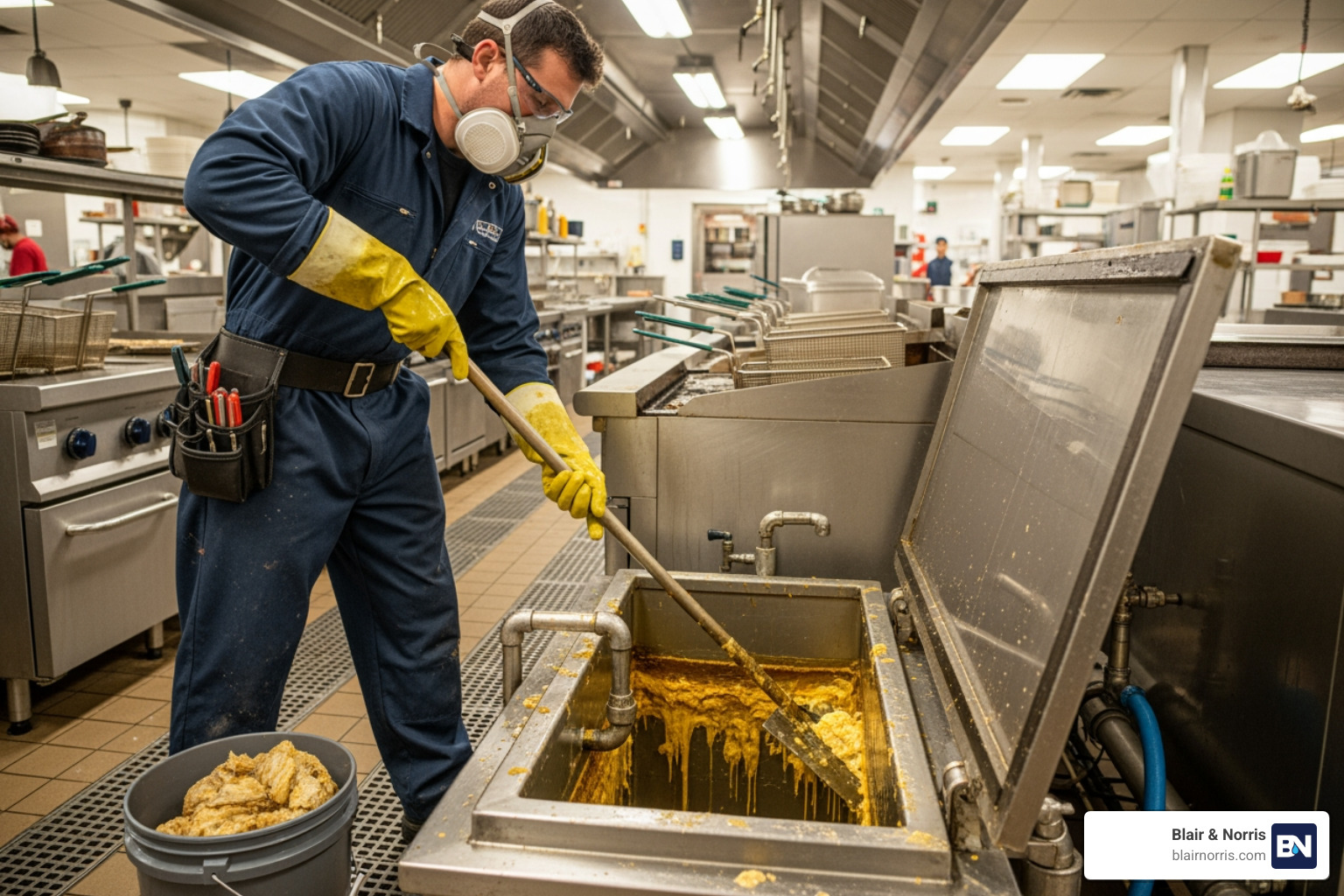
Slow drains are the first sign of trouble, often escalating to full kitchen backups. When an Indianapolis restaurant needs grease trap cleaning, slow drains and recurring odors often signal that**** the trap is overloaded, and the shutdown risk is rising. A clogged grease trap can halt your entire operation. If you’re experiencing slow drains, our Trusted Indianapolis Drain Cleaning Services can resolve the issue before it worsens.
Signs Your Grease Trap Needs Immediate Attention
Your grease trap provides clear warning signs when it’s full. Ignoring them invites disaster. Look for these common indicators:
- Slow draining sinks: The first and most noticeable sign that FOG buildup is restricting flow.
- Gurgling sounds from drains: These noises indicate trapped air from partial blockages, a precursor to a full clog.
- Unpleasant smells: Decomposing FOG releases hydrogen sulfide gas (a rotten egg smell) that can permeate your kitchen and dining area.
- Visible grease buildup: Thick FOG layers in your trap mean it’s time for a cleaning. The Marion County Health Department recommends cleaning when FOG reaches 25% of the trap’s depth.
- Frequent plumbing clogs: Repeated clogs in kitchen drains often originate from an overloaded grease trap.
- Wastewater backups: The most severe sign, indicating a complete blockage that requires immediate shutdown.
How Regular Maintenance Ensures Smooth Operations
Proactive grease trap maintenance prevents these headaches. Scheduling service before the trap reaches the 25% threshold keeps drainage consistent, especially when an Indianapolis restaurant needs grease trap cleaning ahead of inspections. A clean, smoothly operating establishment builds trust and encourages repeat business.
Reason 2: Comply with Indianapolis Regulations and Avoid Hefty Fines
Operating a restaurant in Indianapolis means adhering to strict regulations for public health and city infrastructure. Grease trap maintenance is a legal requirement, and non-compliance carries severe penalties. Citizen’s Energy Group and the Marion County Health Department enforce Best Management Practices (BMPs) for grease traps.
Understanding Specific Indianapolis Grease Trap Compliance
The rules are clear: your grease trap must be properly maintained. Key local compliance points include:
- Cleaning Thresholds: The Marion County Health Department advises cleaning outside grease traps when FOG reaches 25% of the trap’s depth. The legal limit is 30% of capacity; exceeding this is a violation. Inside traps require monthly monitoring and cleaning at least quarterly.
- Cleaning Frequency: General guidelines suggest cleaning every one to three months, but this varies based on your restaurant’s volume, menu, and trap size. Greasier menus require more frequent service.
- Mandatory Record Keeping: You must maintain accurate records of all maintenance, including cleaning dates, volumes removed, and disposal manifests for inspections.
- Using a Permitted Transporter: You must use a City of Indianapolis Permitted Transporter for FOG disposal to ensure legal and responsible waste handling. For more details, consult the City of Indianapolis Department of Public Works.
The High Cost of Non-Compliance for an Indianapolis Restaurant Needs Grease Trap Cleaning
Ignoring these requirements is a high-risk operational choice. The consequences of non-compliance are severe:
- Violation Notices and Fines: A warning is often the first step, followed by steep financial penalties that increase with repeat offenses.
- Forced Shutdown: Non-compliant restaurants may be required to stop operations until the issue is corrected and verified.
- Escalation: Repeated non-compliance can trigger additional enforcement steps and stricter oversight.
Routine maintenance is simpler than emergency response after a backup or inspection failure. If you’re unsure what documentation you need for inspections, a professional service can help you standardize logs and manifests.
Reason 3: Protect Your Property’s Plumbing Infrastructure
Your restaurant’s plumbing system is its lifeblood, and the grease trap is its primary protector. Without a functioning trap, FOG and food solids enter your pipes, where they cool, solidify, and cling to pipe walls. This buildup eventually chokes off flow, leading to costly blockages and damage.
What is a Grease Trap and How Does It Work?
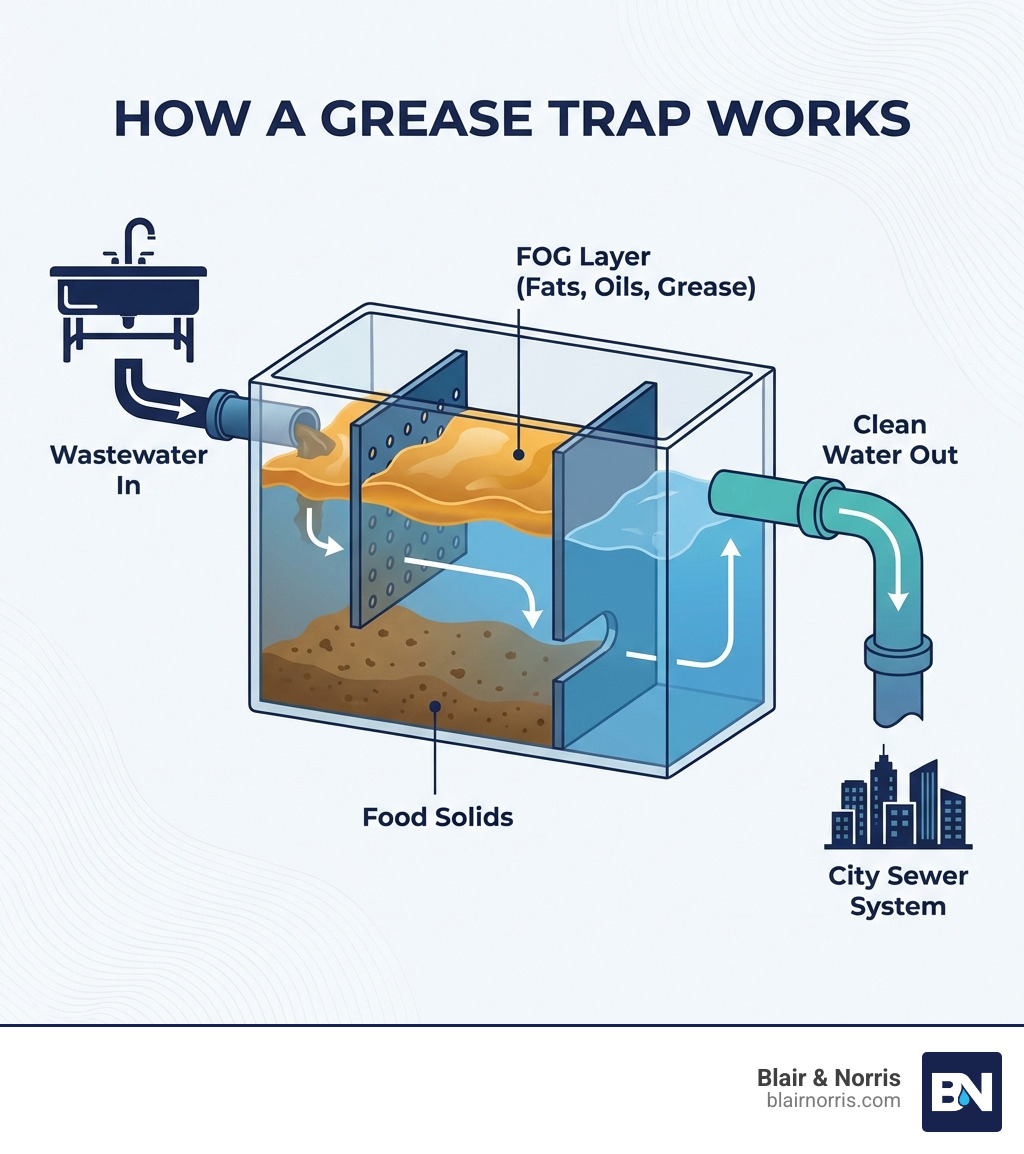
A grease trap, or grease interceptor, is a plumbing device that captures fats, oils, and grease (FOG) from wastewater before it enters the sewer system. It works through a simple process of separation. As wastewater from sinks and drains enters the trap, internal baffles slow the flow. This allows the lighter-than-water FOG to cool, solidify, and float to the top, while heavier food solids sink to the bottom. The cleaner water then flows out through an outlet pipe into the sewer system, protecting your internal plumbing from clogs.
Grease traps come in two main types: smaller under-sink units (often under 250 gallons) located indoors, and large outdoor interceptors (750 to 5000+ gallons) that are typically buried underground to serve high-volume kitchens. Both serve the same purpose but differ in capacity. For more general information, you can read More about grease traps. When these systems are not maintained, the risk to your plumbing and business operations rises sharply.
Reason 4: Safeguard the Environment and Public Sewer System
Beyond your restaurant’s walls, your grease trap plays a crucial role in protecting the Indianapolis community and its environment. When FOG escapes into the public sewer system, it becomes an environmental pollutant and a major threat to municipal infrastructure.
Your Restaurant’s Role in Protecting Indianapolis Waterways
Every restaurant in Indianapolis has a responsibility to prevent FOG discharge. This is about being a good neighbor and protecting shared resources. Proper maintenance of your grease trap is the last line of defense, ensuring it effectively captures these harmful substances. This protects the Citizen’s Energy Group infrastructure from strain and costly repairs. It also helps avoid sanitary sewer overflows (SSOs), which occur when FOG clogs municipal lines and causes raw sewage to back up into streets, parks, and other properties—a public health and environmental disaster. By responsibly managing FOG, your restaurant contributes to cleaner waterways and a healthier environment.
From Your Drain to the City: The Journey of FOG
Without a functioning grease trap, FOG begins a destructive journey. Hot, liquid FOG flows easily from your drains but solidifies as it cools in the pipes. These sticky layers accumulate, narrowing the pipe and trapping debris, which leads to blockages. In large municipal sewers, these FOG accumulations can combine with other waste (like wet wipes) to form massive, congealed masses known as “fatbergs.” These blockages are a primary cause of SSOs, where raw sewage overflows from the system, contaminating local environments. Even if FOG reaches a treatment plant, it can interfere with the treatment process, increasing operational costs. You can read about a massive “fatberg” found in London to understand the scale of the problem.
Reason 5: Trust a Professional for Safe, Compliant, and Thorough Cleaning
You might be tempted to assign grease trap cleaning in-house, but for many commercial kitchens, it increases safety, compliance, and disposal risks. Professional cleaning involves specialized expertise, equipment, and compliance knowledge that DIY methods lack.
| Feature | DIY Grease Trap Cleaning | Professional Grease Trap Cleaning (Blair & Norris) |
|---|---|---|
| Risks | Health hazards, incomplete cleaning, fines for improper disposal, injury | Minimized health risks, thorough cleaning, compliant disposal, safety protocols |
| Equipment | Basic tools, buckets, potential for messy spills | Specialized vacuum trucks, hydro-jetters, scraping tools, safety gear |
| Compliance | High risk of non-compliance, lack of documentation, unaware of specific local regulations | Full compliance with Indianapolis regulations, proper documentation for inspectors, City-permitted transporter |
| Time | Significant employee time diverted from core duties, often inefficient | Efficient, scheduled service, minimal disruption to operations, quick resolution for emergencies |
The Dangers and Inefficiencies of DIY Cleaning
Assigning this task to untrained staff is a recipe for disaster. Key risks include:
- Health and Safety Risks: Grease traps are full of bacteria, and larger interceptors pose confined-space hazards and exposure to noxious gases. Without proper training and gear, staff are at risk.
- Incomplete Cleaning: DIY methods leave behind FOG and solids, causing the trap to fill faster and requiring more frequent, inefficient cleaning.
- Fines for Improper Disposal: FOG waste is regulated. Improper disposal leads to hefty fines and environmental violations.
- Lack of Professional Tools: A thorough, safe, and compliant job requires specialized equipment like vacuum trucks and hydro-jetters.
- Wasted Employee Time: Diverting staff to a messy and dangerous task is inefficient and hurts productivity.
Why Blair & Norris Is the Expert Solution for Indianapolis Restaurants
When your Indianapolis restaurant needs grease trap cleaning, choosing the right partner is critical. Blair & Norris is a reliable, experienced, and compliant provider.
- Licensed, Insured, and Permitted: We are fully licensed, insured, and a City-Permitted FOG Transporter, guaranteeing legal waste disposal.
- Experience and Availability: With over 75 years of family ownership, we bring deep experience to every job. Our 24/7 live phone support means we’re always ready for emergencies.
- Transparency and Compliance: We provide clear estimates and help you maintain the detailed records required for health inspections.
Our team can also coordinate related services like Trusted Indianapolis Drain Cleaning Services Blair Norris and septic services to keep your entire wastewater system reliable. Choosing a professional like Blair & Norris means partnering with a team known for ethical, high-quality work.
Frequently Asked Questions about Grease Trap Cleaning
How often should a restaurant in Indianapolis clean its grease trap?
The frequency depends on several factors. Most commercial kitchens should have their grease traps cleaned every 1-3 months. High-volume kitchens serving fried or greasy food may need weekly or bi-weekly service. For larger outdoor interceptors, the Marion County Health Department recommends cleaning when the FOG layer reaches 25% of the trap’s depth, with the legal limit being 30%. The type of food you serve and your customer volume will ultimately determine your ideal cleaning schedule.
What’s the difference between a grease trap and a grease interceptor?
While the terms are often used interchangeably, the main difference is size and location. Grease traps are smaller units (under 250 gallons) typically located indoors under sinks. Grease interceptors are much larger units (750 to 5000+ gallons), almost always located outdoors and buried underground to serve an entire commercial kitchen. Both work on the same principle of separating FOG from wastewater.
Can I just use chemicals or hot water to clear my grease trap?
No, this is a counterproductive practice that can cause more severe problems. Chemicals and hot water may temporarily liquefy grease, but this only pushes the FOG further down the plumbing system. Once it cools in the sewer lines, it re-solidifies, creating larger, harder-to-clear blockages in your pipes or the municipal system. This is how “fatbergs” begin. Many municipal codes, including those in Indianapolis, prohibit using chemicals or hot water for this reason. Professional cleaning involves physically removing the waste, not dissolving it.
Conclusion
For any Indianapolis restaurant, proactive grease trap cleaning is a cornerstone of responsible business operation. Neglecting it is a significant liability that can lead to financial penalties, shutdowns, emergency repairs, and reputational damage. We’ve explored why an Indianapolis restaurant needs grease trap cleaning: to avoid disruptions, comply with regulations, protect plumbing, safeguard the environment, and avoid the risks of DIY methods. Partnering with an experienced, compliant professional keeps you ahead of inspections and ensures a clean, efficient kitchen.
At Blair & Norris, we understand the challenges facing Indianapolis restaurants. With over 75 years of family ownership and a reputation for ethical, high-quality service, we are your trusted partner. Our team can also help with related systems, like understanding the Purpose of a Drain Trap and septic services.
If your Indianapolis restaurant needs grease trap cleaning, don’t wait for an emergency. If an Indianapolis restaurant needs grease trap cleaning, don’t wait for an inspection or backup. Contact Blair & Norris to schedule professional service and keep your kitchen compliant.