
Why Understanding Well Drilling Costs Matters for Indiana Homeowners
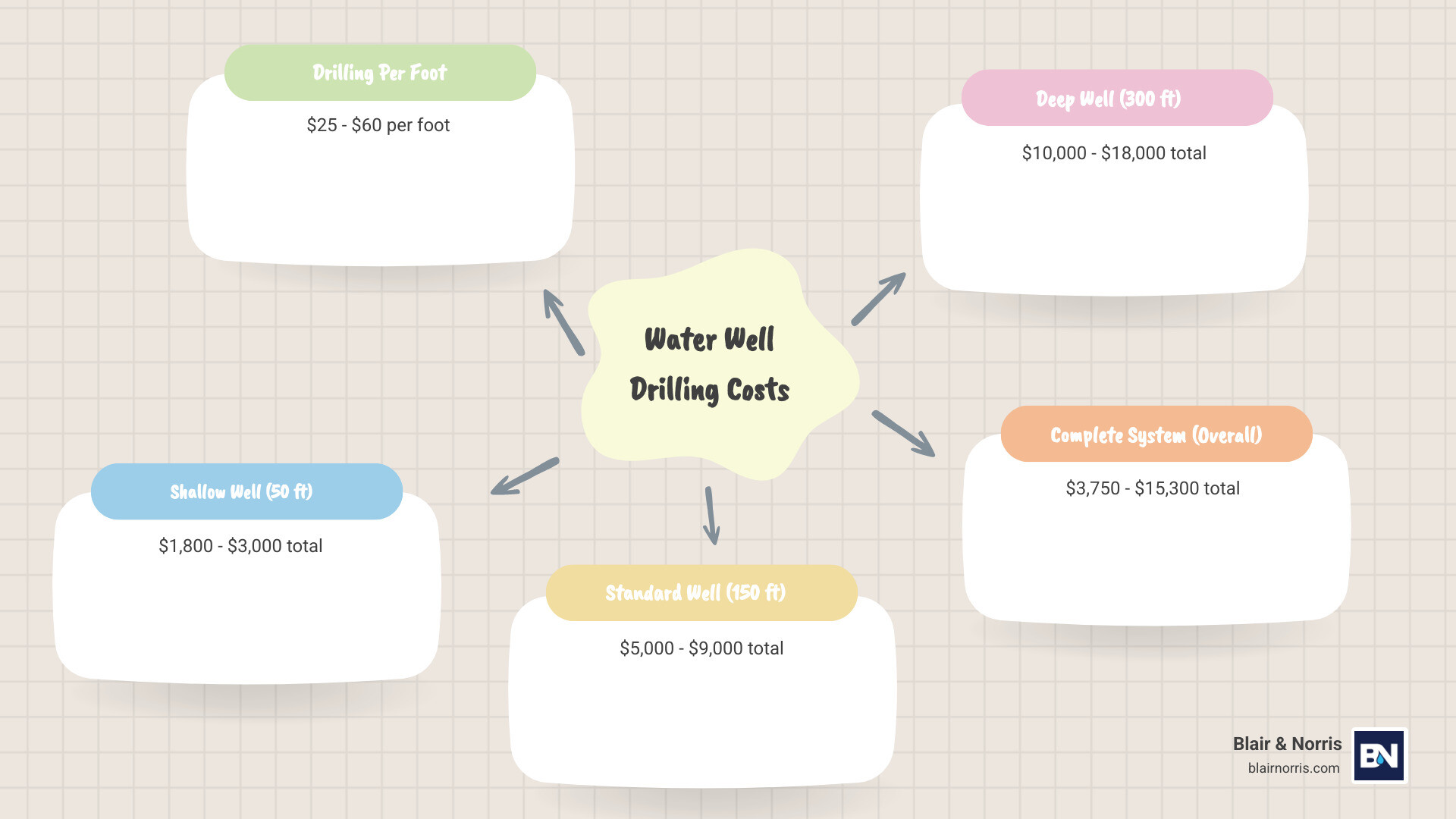
The cost to drill well varies significantly based on your specific property conditions, but most Central Indiana homeowners can expect to pay between $5,325 and $9,180 for a complete residential well system. Here’s what you need to know:
Quick Cost Breakdown:
- Drilling only: $25-$60 per foot
- Complete system: $3,750-$15,300 total
- Shallow well (50 ft): $1,800-$3,000
- Standard well (150 ft): $5,000-$9,000
- Deep well (300 ft): $10,000-$18,000
Whether you’re dealing with unreliable municipal water, high monthly bills, or building on rural property without city connections, drilling a private well can provide decades of reliable water supply. The upfront investment typically pays for itself within 5-10 years through eliminated water bills.
Your final price depends on several key factors: well depth, soil conditions, casing materials, permits, and distance from your house. Rocky ground can increase costs by 50-150%, while sandy soil keeps drilling efficient and affordable.
I’m Mack Blair, and over my 30 years in the water well industry, I’ve helped thousands of Central Indiana families steer the cost to drill well decisions with transparent pricing and honest guidance. My team at Blair & Norris has drilled wells ranging from simple 75-foot residential systems to complex 400-foot agricultural wells, so I understand exactly what drives costs up or down.
The Cost to Drill Well: National Averages & Per-Foot Pricing
If you’re wondering about the cost to drill well for your property, you’re looking at a national average between $5,325 and $9,180 for a complete residential system. Most Central Indiana homeowners end up paying around $7,000, though I’ve seen costs range from as low as $1,775 for a shallow well to over $33,600 for deep wells in challenging conditions.
Here’s the thing about well drilling pricing: we typically quote by the foot, with basic drilling running $25 to $60 per foot. This rate shifts based on how deep we need to go, what diameter casing you need, and what kind of ground conditions we hit. Sandy soil? We can drill efficiently and keep costs down. Hit bedrock or clay? That’s going to slow us down and increase your investment.
The cost to drill well has definitely climbed over the past decade. What used to cost $3,000 might now run $6,000 or more due to inflation and increased demand for private water systems. But here’s the silver lining: even with higher upfront costs, most families see their investment pay for itself within 5 to 10 years through eliminated water bills.
| Well Depth (feet) | Estimated Drilling Cost (per foot) | Estimated Total Drilling Cost |
|---|---|---|
| 50 | $25 – $35 | $1,250 – $1,750 |
| 100 | $25 – $40 | $2,500 – $4,000 |
| 150 | $30 – $45 | $4,500 – $6,750 |
| 200 | $35 – $50 | $7,000 – $10,000 |
| 300 | $40 – $60 | $12,000 – $18,000 |
(Note: These costs are for drilling only and do not include casing, pump, permits, or other system components.)
Sample budget calculations
Let me walk you through some real-world scenarios so you can get a feel for what your cost to drill well might look like.
For a 50-foot shallow well, which works great if you have a high water table, you’re looking at drilling costs around $1,250 to $1,750. Add 4-inch PVC casing at $5-$10 per foot plus a basic pump system, and your total investment lands somewhere between $3,000 and $5,000. These shallow wells are perfect for many rural properties where water sits close to the surface.
Most Central Indiana homes need a 150-foot standard well. At our typical drilling rate of $30-$45 per foot, that’s $4,500 to $6,750 just for the hole. When you factor in 6-inch steel casing (which runs $30-$130+ per foot depending on the grade) and a complete pump and pressure tank system, your total cost to drill well and get everything running usually falls between $7,000 and $15,000.
Now, if your property requires a 300-foot deep well due to geological conditions or water quality needs, the per-foot cost often increases as we go deeper. You might see $40-$60 per foot, pushing drilling costs to $12,000-$18,000. Add the larger diameter casing and more powerful pumps needed for these depths, and you’re easily looking at $20,000+ for the complete system.
The difference between PVC and steel casing can impact your budget significantly. PVC works well for many applications and keeps costs reasonable, while steel casing provides extra durability but increases your investment. 4-inch versus 6-inch diameter also affects pricing, with larger diameter wells costing more upfront but potentially providing better long-term flow rates.
Lifespan & payback period
Here’s what makes a private well such a smart investment: a properly constructed well can serve your family for 40 years or more. I’ve serviced wells that have been running strong for decades with nothing more than regular maintenance.
Your well pump will need replacement every 10 to 15 years, but that’s a manageable expense compared to monthly water bills. When you break down the numbers, most municipal water bills run $20 to $40 monthly. With a private well, your main ongoing costs are electricity for the pump (usually $2-$4 per month) and annual maintenance ($200-$900 yearly).
The return on investment speaks for itself. Even with today’s higher drilling costs, the savings from eliminated water bills add up quickly. Most families recover their initial cost to drill well within that 5 to 10-year window I mentioned. After that? It’s like having free water for the remaining 30+ years of your well’s life.
Plus, there’s something to be said for the peace of mind that comes with water independence. No more worrying about municipal water quality issues or rate increases – you’re in control of your family’s water supply.
What Determines Your Final Price Tag?
When you’re planning to drill a well, the final cost to drill well depends on several interconnected factors that can significantly impact your budget. Think of it like building a house – the deeper you go, the more complex the ground conditions, and the higher quality materials you choose, the more you’ll invest in your water independence.
The biggest cost drivers include well depth, soil composition, drilling method, casing materials, and the distance from your well to your house. But that’s just the beginning. You’ll also need to budget for permits, water testing, pump systems, and electrical connections. Each of these elements plays a crucial role in determining whether you’ll pay closer to $5,000 or $15,000 for your complete well system.
For a comprehensive breakdown of how these factors interact and affect your total investment, check out our detailed guide: More info about cost factors.
Depth & gallons-per-minute requirements
Here’s the simple truth: the deeper we drill, the more it costs. But depth isn’t just about expense – it’s about finding a reliable water source that’ll serve your family for decades.
We’re looking for what’s called a static water level that can produce at least 1 gallon per minute (GPM). That might not sound like much, but it adds up to about 1,440 gallons per day – plenty for most households. The challenge is that sometimes we need to go deeper than expected to hit that sweet spot where water flows consistently.
In some cases, we encounter wells that don’t produce enough water initially. That’s where hydrofracturing comes in – a process where we use highly pressurized water to create or widen cracks in the rock, improving water flow. This technique costs between $1,500 and $3,000 but has an impressive 97% success rate. It’s often much more affordable than drilling a completely new well, and it dramatically improves your well’s drought resilience.
Ground conditions & drilling methods
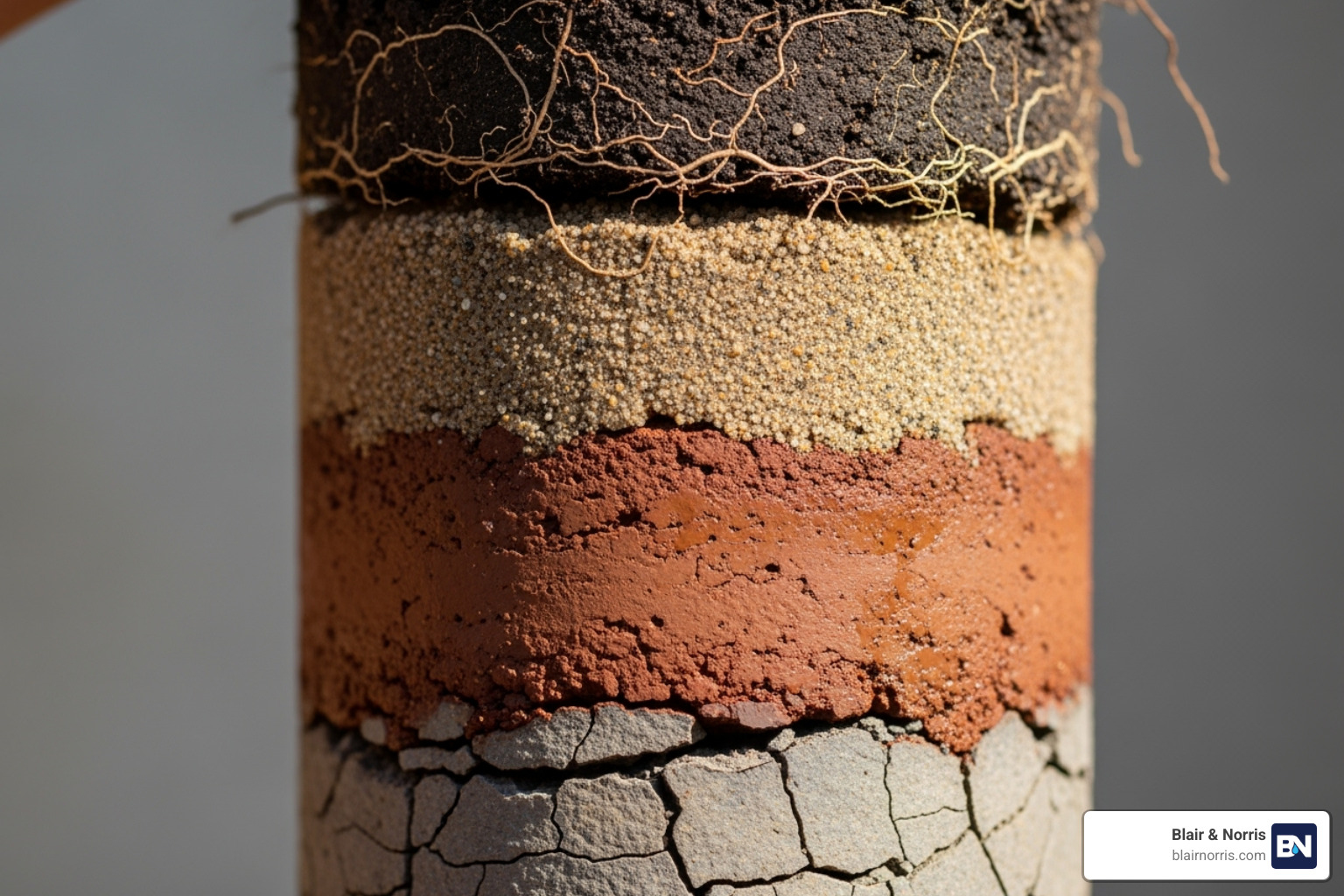
The ground beneath your property is like a geological lottery ticket – you never know what you’re going to get until we start drilling. Sandy soil is our best friend because it drills quickly and efficiently. Clay can slow us down but is still manageable. Bedrock, however, is where costs can really climb.
Here’s what we’ve learned after decades in Central Indiana: partially rocky soil can increase your cost to drill well by about 92%, while solid bedrock can push costs up by 150% or more. It’s not just about the extra time – drilling through rock requires specialized equipment and more wear on our tools.
We use different drilling methods depending on what Mother Nature throws at us. Rotary drilling works well for most ground conditions and can handle various soil types efficiently. Cable tool drilling is slower but sometimes more cost-effective for shallow wells or specific formations.
Artesian wells are fascinating exceptions to the usual rules. These tap into confined aquifers where natural pressure pushes water toward the surface. While the drilling might cost $25-$45 per foot, you often won’t need an electric pump, which saves money for years to come. The science behind these natural pressure systems is quite remarkable – you can learn more through Scientific research on artesian wells.
Casing materials & diameters
Once we’ve drilled your well, we need to line it with casing to prevent collapse and protect your water from surface contamination. This is where material choices significantly impact your cost to drill well.
PVC casing is the most budget-friendly option at $5-$10 per foot. It resists corrosion beautifully and works great for most residential wells. Galvanized steel casing steps up the durability and costs $30-$130+ per foot – necessary when drilling through unstable ground or high-heat conditions. Stainless steel casing is the premium choice, offering maximum longevity and water purity but at the highest cost.
The diameter matters too. A 4-inch casing works fine for basic household needs, while a 6-inch casing provides better flow rates but costs more. We also make sure everything is buried below Central Indiana’s freeze line (typically 32-48 inches deep) to prevent winter problems that could damage your system.
Permits, testing & compliance costs
Before we can break ground, there’s paperwork to handle. Permit fees typically run $200-$700 in most areas, though some jurisdictions can charge up to $3,000. These aren’t just bureaucratic problems – they ensure your well meets health and safety standards that protect both you and your community.
Water testing is absolutely essential once your well is complete. While you can buy DIY test kits for $20-$150, we strongly recommend professional lab testing that costs $50-$650 for basic analysis or $100-$750 for comprehensive testing. This investment gives you accurate results for bacteria, nitrates, and other potential contaminants.
We always advise annual water testing and retesting after any major plumbing work or natural disasters. It’s a small price to pay for peace of mind about your family’s water quality. Understanding water regulations helps ensure your well stays compliant – you can find more information through Scientific research on water regulations.
Well Types & Their Price Ranges
Choosing the right well type is like picking the perfect tool for a specific job – each one serves different needs and comes with its own cost to drill well. Over my three decades in this business, I’ve helped families steer everything from basic drinking water wells to complex geothermal systems, and understanding your options upfront can save you thousands.
When we talk about a complete well system, we’re looking at the whole package: drilling, casing, pump installation, pressure tank, electrical hookups, and any water treatment components you might need. The type of well you choose dramatically affects your final investment.

Residential & drinking water wells
Most of our Central Indiana customers need a straightforward residential well for daily household water use. These workhorses typically run 100 to 300 feet deep with either 4-inch or 6-inch diameter casing, depending on your family’s water needs and the ground conditions we encounter.
The drilling portion usually costs $25-$40 per foot for residential wells. But remember, that’s just the hole in the ground. Once we add your pump system ($900-$2,500), proper casing, electrical connections, and pressure tank, you’re looking at a total cost to drill well system between $3,750 and $15,300.
The beauty of a residential well is its simplicity and reliability. We’ve installed thousands of these systems, and with proper maintenance, they provide decades of clean, dependable water. If you’re trying to decide whether you need a shallow or deep well setup, our guide on Deep Well vs Shallow Well: Key Differences Explained breaks down the technical details in plain English.
Irrigation & agricultural wells
If you’re planning extensive landscaping, maintaining large gardens, or running agricultural operations, an irrigation well changes the game completely. These systems are engineered for high-yield performance – think 20, 50, or even 100+ gallons per minute instead of the 5-10 GPM typical for household wells.
The drilling costs run $25-$50 per foot, similar to residential wells, but everything else scales up. Larger boreholes, more powerful pumps, and robust electrical systems push the total investment for a residential irrigation well to $9,000-$15,000. Large commercial agricultural operations can easily hit $50,000-$100,000 for their water systems.
One thing I always discuss with agricultural clients is water allocation laws – Indiana has specific regulations about how much groundwater you can use, especially during drought conditions. We also consider the risk of fertilizer runoff affecting your groundwater quality over time, which might require additional water treatment down the road.
Geothermal boreholes
Geothermal wells are fascinating systems that don’t actually provide water for drinking or irrigation. Instead, they circulate fluid through underground loops to heat and cool your home using the earth’s constant temperature. It’s like having a conversation with the ground about your comfort needs.
These systems typically cost $15-$40 per foot to drill, or about $3,500-$5,000 per borehole. Most homes need multiple boreholes – a typical 1,500 square foot house might require two 300-foot wells. While the complete system (including the heat pump) can run $12,500-$25,000, the energy savings are remarkable. Many families see their heating and cooling costs drop by 40-60% annually.
Artesian & sand-point options
Artesian wells are the lottery winners of the water well world. When geological conditions align perfectly, we can tap into a confined aquifer where natural pressure pushes water upward, sometimes right to the surface. No pump needed – the earth does the work for you.
The drilling costs run slightly higher at $25-$45 per foot because we need to reach those specific water-bearing rock formations. Your total cost to drill well for an artesian system ranges from $5,000-$15,000, but the long-term savings on electricity and pump replacement can be substantial. Unfortunately, artesian conditions aren’t available everywhere – the geology has to cooperate.
On the budget-friendly end, we have sand-point wells (also called driven wells). These shallow systems work by driving a screened pipe less than 50 feet into sandy soil. DIY kits cost as little as $300-$500, making them tempting for homeowners looking to save money.
However, I always caution folks about sand-point wells for drinking water. Their shallow depth makes them vulnerable to surface contamination, and they’re really better suited for temporary use like garden irrigation. If you’re considering one for household water, rigorous testing and treatment are absolutely essential – and at that point, you might as well invest in a proper drilled well that will serve your family safely for decades.
Regional Differences, DIY vs Pro, & Money-Saving Strategies
The cost to drill well varies dramatically across different regions, and here in Central Indiana, we see this firsthand. In areas with sandy, softer soils, drilling rates might run $15-$30 per foot, while properties with rocky formations or challenging bedrock can push costs to $25-$50 per foot or higher. That’s why I always tell homeowners that getting local estimates is absolutely essential.
Over my three decades in this business, I’ve learned that smart homeowners can significantly reduce their cost to drill well with the right strategies. Timing matters – scheduling your drilling during off-season periods when demand is lower can sometimes open up better rates from contractors. Shopping around is crucial – I always recommend getting at least three detailed quotes from licensed professionals, because prices can vary surprisingly even within the same area.
Location optimization can save you real money too. Placing your well closer to your home reduces the costs for water lines and electrical connections, potentially saving $50-$150 per foot of distance. While it might be tempting to cut corners on materials, investing in quality components upfront prevents expensive repairs later. I’ve seen too many homeowners regret choosing the cheapest pump or casing only to face costly replacements within a few years.
Energy-efficient pumps deserve special mention because they significantly reduce your long-term electricity bills. Combined with water conservation practices, you’ll minimize pump activity and save on energy costs for decades. Regular preventative maintenance is perhaps the most overlooked money-saver – catching small issues early prevents them from becoming expensive problems.
Understanding our complete drilling process helps homeowners make informed decisions: 7 Steps That Need to Happen for Well Drilling.
Can I reduce the cost to drill well by doing it myself?
I get this question at least once a week, and I understand the appeal. DIY drilling rig kits range from $700 to $36,000, and the labor savings look attractive on paper. However, after 30 years of fixing DIY disasters, I strongly advise against drilling your own well for anything beyond very shallow, non-potable uses.
Safety is my biggest concern. Drilling involves heavy machinery, high pressures, and unstable ground conditions that can turn dangerous quickly. I’ve seen experienced professionals get injured, so imagine the risks for someone without proper training.
Legal and permit issues are another major hurdle. Most jurisdictions require licensed drillers to obtain permits, and improperly drilled wells can result in hefty fines. Hidden costs add up fast – even with DIY labor, you’ll still pay for equipment rental, materials, and permits. One mistake damaging underground utilities or neighboring property systems can cost far more than hiring a professional from the start.
Water quality and reliability suffer with DIY attempts. We know how to reach clean, reliable aquifers and properly case wells to prevent contamination. Most DIY wells either run dry quickly or produce unsafe water. Liability concerns are real too – if your DIY well contaminates groundwater or damages neighboring properties, you could face serious legal and financial consequences.
For something as critical as your family’s water supply, the expertise, safety, and long-term reliability we provide are almost always worth the investment.
How much does the cost to drill well vary by depth?
Depth significantly impacts your final price, but it’s not just a simple multiplication. The per-foot drilling rate often increases as we go deeper due to increased complexity, equipment wear, and specialized techniques required for deeper formations.
Budgeting for contingencies is smart planning. Sometimes we need to drill deeper than initially estimated to find sufficient water supply or bypass problematic geological layers. That’s why having a clear contract outlining per-foot rates for additional depth protects both you and us.
If you have an existing underperforming well, redrilling or deepening costs typically range from $3,000 to $6,000, depending on depth and conditions. Hydrofracturing offers an excellent alternative – at $1,500 to $3,000, it has a 97% success rate for improving yield without extensive redrilling, making it our go-to recommendation for boosting well performance.
Frequently Asked Questions
How much water can a well produce daily? A typical residential well should produce at least 1 gallon per minute (GPM), translating to approximately 1,440 gallons per day. This easily meets most household needs, with plenty of capacity for peak usage periods.
Does a well use lots of electricity? Well pump electricity costs are surprisingly low, typically running $100-$400 annually, or about $2-$4 monthly. Choosing an energy-efficient pump keeps these costs at the lower end of that range.
How long does a well last? With proper installation and regular maintenance, water wells easily last 40 years or longer. The well pump typically needs replacement every 10-15 years, but the casing and well structure itself can serve your family for decades when properly maintained.
Conclusion
Making the decision about the cost to drill well is one of the most important investments you’ll make for your family’s long-term water security. Throughout this guide, we’ve walked through everything from national pricing averages and depth calculations to the nitty-gritty details of soil conditions, permits, and regional variations that can impact your final bill.
The truth is, while the upfront investment might seem significant – typically ranging from $5,325 to $9,180 for most Central Indiana homes – the peace of mind and financial savings over decades make it worthwhile. When you consider that a properly installed well can serve your family for 40 years or more, and you’ll eliminate those monthly water bills forever, the math works strongly in your favor.
What sets Blair & Norris apart is our deep understanding of Central Indiana’s unique geological conditions. Over our 75 years of family ownership, we’ve drilled wells in every type of soil from the sandy areas around Indianapolis to the rocky terrain in Carmel and Fishers. We know exactly what to expect when we arrive at your property in Beech Grove, Lawrence, Speedway, Noblesville, Westfield, or Zionsville.
Our commitment goes beyond just drilling your well. We believe in ethical, transparent pricing with no hidden surprises, and our 24/7 live phone support means you’ll never be left wondering about your water system. When you choose us, you’re not just getting a well – you’re gaining a trusted partner who’ll be there for maintenance, repairs, and any questions that come up over the years.
Every property is different, and every family’s water needs are unique. That’s why we always recommend getting a personalized estimate rather than relying solely on averages. We’ll assess your specific soil conditions, discuss your household’s water usage, and provide you with a detailed breakdown of exactly what your project will involve.
Ready to take the next step toward water independence? Visit our comprehensive resource for personalized estimates and to discuss your specific needs: The Well Drilling Cost Guide.