
Is Your Jet Pump Failing? Understanding the Core Problems and Their Implications
Jet pump repair is often needed when your home’s water pressure drops, the pump runs constantly, or water stops flowing altogether. For Central Indiana homeowners, a failing jet pump is more than a minor inconvenience; it is a disruption to the very foundation of a functional household. When water stops, daily essentials like hygiene, laundry, and sanitation are disrupted immediately.
Your jet pump is the heart of your home’s water supply. In rural and suburban areas of Indiana, where municipal water isn’t always an option, the reliability of your well system is paramount. When a jet pump begins to fail, the immediate loss of water is the most obvious symptom, but the underlying issues can be far more insidious. Persistent low pressure can increase the risk of buildup in plumbing lines and reduce overall system performance.
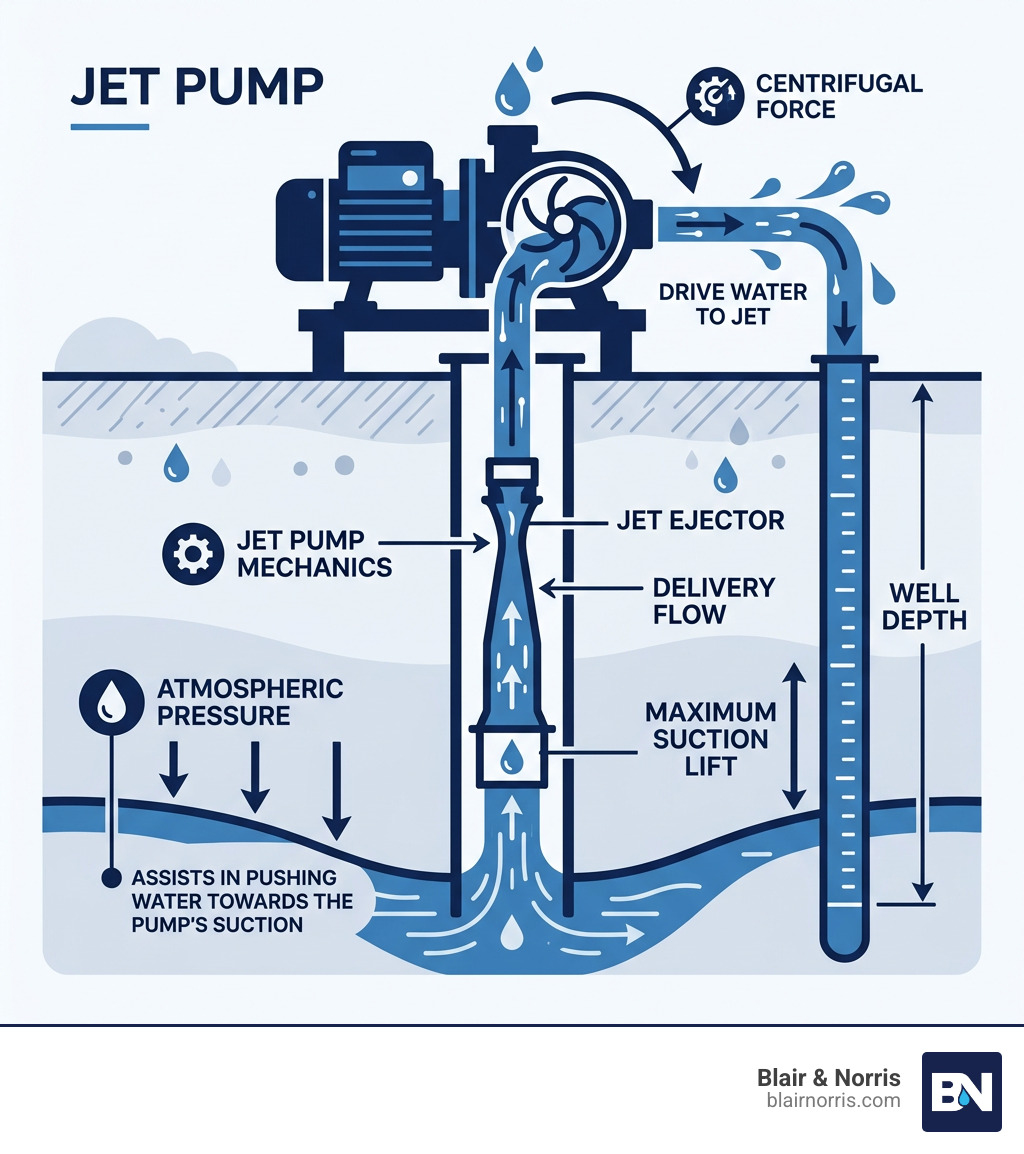
Jet pumps are sophisticated machines that rely on a delicate balance of atmospheric pressure and centrifugal force. Many jet pumps operate reliably for years, but performance depends heavily on water quality, setup, and maintenance. Whether it is a simple re-prime, a worn mechanical seal, or a failing pressure switch, understanding the mechanics of your system is the first step toward a resolution.
After decades working on well systems across the Midwest, I’ve seen how small issues can quickly turn into urgent jet pump repair calls. At Blair & Norris, we specialize in diagnosing these issues before they become catastrophic. This guide is designed to help you understand the complexities of your system and why professional intervention is often the safest and most cost-effective path forward.
Quick-Reference: Common Jet Pump Issues
| Problem | Likely Cause | Implication |
|---|---|---|
| No water or low pressure | Lost prime, clogged foot valve | Potential bacterial growth in stagnant lines |
| Pump runs but no water | Air leak in suction line | Motor overheating and permanent damage |
| Short cycling | Waterlogged pressure tank | Premature failure of the pressure switch and motor |
| Pump won’t start | Faulty pressure switch or electrical failure | Total loss of household sanitation |
| Strange noises | Worn impeller or cavitation | Internal structural damage to the pump housing |
Identifying Common Jet Pump Problems and Their Implications
When a jet pump starts acting up, it usually doesn’t happen in total silence. It sends out “distress signals” that something is wrong under the hood. Recognizing these 13 signs your well pump needs to be repaired early can be the difference between a minor part replacement and a total system overhaul. In Central Indiana, the geological conditions—ranging from sandy aquifers to heavy clay—can exacerbate these issues, leading to unique wear patterns on internal components.
A common jet pump repair symptom is low water pressure throughout the home. If your morning shower feels more like a leaky faucet, the pump might be struggling to pull water from the well. This is often caused by a clogged nozzle or a worn-down impeller. Low pressure can also prevent appliances from running correctly and may stress plumbing fixtures over time.
Another common headache is short cycling. This is when the pump turns on and off rapidly, even when you aren’t using much water. Typically, this points to a problem with the pressure tank—it might be waterlogged, meaning the internal bladder has failed, or the air charge is simply too low. Short cycling accelerates wear on the motor and pressure-switch components. The startup phase of an electric motor is when it experiences the most heat and electrical stress. A pump that cycles every 30 seconds instead of every 5 minutes will reach its end-of-life exponentially faster.

If you start hearing strange noises, like grinding or rattling, don’t ignore them. These sounds often indicate cavitation, a condition where air bubbles form and implode inside the pump with enough force to pit the metal of the impeller. Furthermore, if you see air in your lines (sputtering faucets), you likely have a leak in the suction line. This allows air to enter the system, which can cause the pump to lose its prime entirely. According to our complete well pump troubleshooting guide, sediment buildup is another major factor. In Central Indiana, fine sand or grit can get sucked into the pump, acting like sandpaper on the internal components, leading to motor failure or a jammed impeller.
The Technical Challenges of Jet Pump Repair
Understanding the parts of a well pump is essential before attempting any fix. Jet pumps are unique because they are “above-ground” pumps that use centrifugal force combined with a “jet” (a venturi nozzle) to move water. This design is efficient but relies on precise physics that can be easily disrupted by wear or improper maintenance.
There are two main types of configurations: shallow well and deep well. A shallow well jet pump is used for wells where the water level is 25 feet or less from the pump. It relies primarily on atmospheric pressure to “push” water up the pipe. A deep well jet pump, however, can reach depths of up to 110 feet because it uses a two-pipe system: one pipe to push water down to a jet assembly in the well, and another to bring the pressurized water back up. The complexity of the two-pipe system means that a failure could be located at the pump, in the piping, or deep within the well itself.
The Indiana Department of Natural Resources regulates water well drilling and pump installation in our state. They emphasize that proper installation is key to pump longevity. If the suction lift exceeds the pump’s rating, it will constantly struggle and eventually fail. This is a common issue in areas where the water table has dropped over time, turning a once-functional shallow well system into an inefficient and failing setup.
| Feature | Shallow Well Jet Pump | Deep Well Jet Pump |
|---|---|---|
| Max Depth | Up to 25 feet | Up to 110 feet |
| Number of Pipes | Single suction pipe | Two pipes (Drive & Delivery) |
| Jet Location | Inside the pump housing | Submerged in the well |
| Primary Mechanism | Atmospheric pressure & Centrifugal force | Venturi effect at depth |
Diagnosing Low Pressure for Jet Pump Repair
If your pressure gauge is reading lower than it used to, we start by looking at the “intake” side. A clogged nozzle is a very common culprit. Because the nozzle has a small opening, even a tiny piece of debris can block the flow. A worn impeller is another possibility. The impeller is the spinning disc that creates the centrifugal force. If the edges are rounded off by sand or corrosion, it can’t move water efficiently. We also check for suction leaks. Even a pinhole leak in the pipe connecting the well to the pump can allow air in, dropping the pressure and eventually causing the pump to lose its prime. As noted by Purdue University Extension, regular maintenance of the foot valve and strainer at the bottom of the well is vital. If the strainer is covered in silt, the pump has to work twice as hard to get half the water, leading to premature motor burnout.
The Risks of DIY Jet Pump Repair
While the internet is full of tutorials on how to fix your own well system, the reality of jet pump repair is fraught with significant risks that can lead to injury, property damage, and water contamination. Many homeowners attempt to save money by handling repairs themselves, only to find that the complexity of the system leads to much higher costs in the long run.
Electrical Hazards and High-Voltage Risks
First and foremost is the danger of electrical shock. Most jet pumps run on 115V or 230V circuits. Working with high-voltage electricity in a damp basement or a wet pump house is inherently hazardous. Improper electrical work can cause serious injury and damage equipment. Furthermore, improper wiring can lead to electrical fires or the destruction of the pump’s motor, which is often the most expensive component to replace.
High-Pressure Accidents and Structural Damage
There is also the risk of high-pressure accidents. A jet pump system is designed to operate within a specific pressure range (usually 30/50 or 40/60 PSI). If a DIYer incorrectly adjusts the pressure switch or fails to properly calibrate the pressure tank, the system can reach dangerous pressure levels. Incorrect pressure settings can damage plumbing components and create serious safety hazards. The Indiana Department of Health warns that improper handling of pressurized water systems can lead to severe physical injury.
Water Contamination and Health Risks
Opening up your well system for repair exposes your water supply to contamination. If bacteria, insects, or surface debris enter the well or the pump housing during a DIY repair, you could be putting your family’s health at risk. Professional technicians follow strict disinfection protocols, often using calculated chlorine treatments to ensure the water remains potable after the system is sealed. Without proper disinfection, there’s an increased risk of introducing harmful bacteria into the water supply.
Warranty and Long-Term Costs
Attempting a complex repair without specialized tools—such as torque wrenches for specific seal settings and high-end voltmeters for diagnosing subtle motor issues—can lead to structural damage to the pump. Furthermore, most manufacturers will void your warranty if the pump has been tampered with by an unlicensed individual. Knowing well pump repair or replacement: the important considerations is vital; often, an amateur repair on an aging pump is a waste of resources compared to a professional replacement that offers energy efficiency and a fresh warranty.
Positioning the Expert Solution: Professional Jet Pump Repair
When you choose a professional for your jet pump repair, you aren’t just paying for a part; you are paying for the peace of mind that comes with decades of expertise and specialized equipment. At Blair & Norris, we approach every repair with a comprehensive diagnostic process that looks beyond the immediate symptom to find the root cause of the failure.
What the Professionals Handle
1. Precision Priming and Seal Replacement: A jet pump cannot pump air; it must be full of water to create the vacuum needed to pull more water from the well. While priming seems simple, a professional ensures that the mechanical seal—the component that prevents water from leaking into the motor—is seated perfectly. If this seal is damaged during a DIY attempt, it can lead to a shorted motor within hours of operation.
2. Advanced Pressure Switch Calibration: The pressure switch is the “brain” of the pump. We use calibrated gauges to ensure the cut-in and cut-out points are exactly where they need to be for your specific home’s elevation and plumbing demands. This prevents the short cycling that destroys motors and ensures consistent pressure at every tap.
3. Ultrasonic Leak Detection: Detecting an air leak in a suction line can be like finding a needle in a haystack. Professionals use advanced techniques, including ultrasonic leak detection and vacuum testing, to identify pinhole leaks that the “soapy water test” might miss. This ensures the integrity of the entire suction line, preventing future loss of prime.
4. Pressure Tank Optimization for Jet Pump Repair (The 2 PSI Rule): To prevent short cycling, your pressure tank must have the correct air charge. We don’t just guess; For many systems, technicians set tank pre-charge slightly below cut-in so the pump cycles correctly (follow manufacturer guidance). This technical precision is what extends the life of your system by years. The National Ground Water Association emphasizes that this balance is critical for the health of the entire well system.
The Blair & Norris Advantage
In Central Indiana, the water table and soil composition vary significantly from Hamilton County to Marion County. A professional technician understands these local nuances. We know which aquifers are prone to sand and which areas have high mineral content that can lead to scale buildup in your pump’s venturi nozzle. By choosing an expert, you are ensuring that your repair is tailored to the specific environment of your well.
Frequently Asked Questions about Jet Pump Repair
How do I know if my jet pump has lost its prime?
The most obvious sign is that the motor is running, but no water is coming out of your faucets. You might also notice the pump housing feels very hot to the touch because the water inside isn’t being circulated and cooled. If your pressure gauge stays at zero despite the pump running, it has lost its prime. This is an emergency situation, as running a pump dry will quickly destroy the internal seals and potentially warp the impeller.
Can I use a shallow well jet pump for a 50-foot well?
No. A shallow well jet pump is physically limited by physics to a maximum lift of about 25 feet. Beyond that, atmospheric pressure isn’t strong enough to push the water up. For a 50-foot well, you must use a deep well jet pump with a two-pipe system and a submerged jet assembly. Attempting to use the wrong pump type will lead to constant failure and zero water delivery.
Why is my jet pump making a clicking noise?
A clicking noise usually originates from the pressure switch. This component acts as the communication hub between your water demand and the pump’s motor. If the switch is clicking rapidly, it often indicates that the system is short cycling, likely due to a waterlogged pressure tank. Ignoring this clicking can lead to the contacts inside the switch welding together, causing the pump to run indefinitely and eventually burn out.
How often should I perform maintenance on my jet pump?
We recommend an annual “check-up” by a professional. This includes checking the air charge in your pressure tank, inspecting the pressure switch for bugs or corrosion, and listening for any changes in the motor’s sound. Regular maintenance can extend the life of your pump by several years and prevent a total water outage during the hottest months of the year when demand is highest.
Conclusion: Your Partner in Reliable Water Supply
A functioning jet pump is non-negotiable for a comfortable and safe home. While the temptation to handle repairs yourself is understandable, the risks of electrical hazards, system damage, and water contamination make professional jet pump repair the only logical choice for the long-term health of your well system.
At Blair & Norris, we’ve been serving the Indianapolis area for over 75 years. As a family-owned business, we understand how stressful it is to be without water. That’s why we offer 24/7 live phone support to our neighbors in Carmel, Fishers, Noblesville, Zionsville, and throughout Central Indiana, including Hamilton, Marion, and Hancock counties. We pride ourselves on ethical, high-quality service that gets your water back on as quickly and safely as possible. Our technicians are trained to handle the most complex deep well systems and the simplest shallow well fixes with the same level of precision and care.
Don’t let a failing pump disrupt your life or risk the safety of your home with a DIY fix. Whether you need a quick diagnostic, a complex seal replacement, or a full system overhaul, our team is ready to provide the expert solution you deserve. We stand behind our work with clear workmanship standards and service support designed for long-term reliability.
Need an expert eye on your well system? Contact Blair & Norris today for an estimate or service and let us put our 75 years of experience to work for you. We are dedicated to ensuring your family has clean, pressurized water for years to come.