
Fast Well Pump Replacement Starts With a Safe, Quick Diagnosis
A fast well pump replacement can often restore water the same day when the pump is confirmed as the problem and the right equipment is available. When private well water suddenly stops flowing, daily household routines halt immediately. From cooking and bathing to running sanitation systems, a sudden lack of water creates immediate stress for homeowners. If your water has stopped completely, water pressure has dropped sharply, faucets sputter with trapped air, or the pump runs endlessly without shutting off, take these initial diagnostic and safety steps right away:
- Check that the electrical circuit breaker and pressure switch have not tripped.
- Stop using large amounts of water to avoid pulling sediment or straining the pressure tank.
- Clear physical access to the sanitary well head, electrical panel, and driveway.
- Call a qualified well professional for prompt diagnosis and emergency service.
A shallow, above-ground jet pump can often be replaced in a few hours. A deep submersible pump usually takes longer because the technician must safely pull the pump motor, waterproof electrical wiring, and water-filled drop pipe from hundreds of feet below the surface. Deep wells, corroded steel pipe, compromised wiring, and a failing pressure tank can extend the timeline, but most professional replacements are completed within a single day.
For Central Indiana homeowners, quick action matters. A trained technician can confirm whether the issue is truly the pump motor or a repairable component, such as a pressure switch, control box, wiring connection, or captive-air pressure tank, before replacing major equipment.
I am Mack Blair, and I have spent more than 30 years working with Central Indiana well systems, including fast well pump replacement when families need clean water restored without unnecessary delay. At Blair & Norris, our focus is clear communication, careful diagnosis, and dependable work that helps protect your home’s water supply.
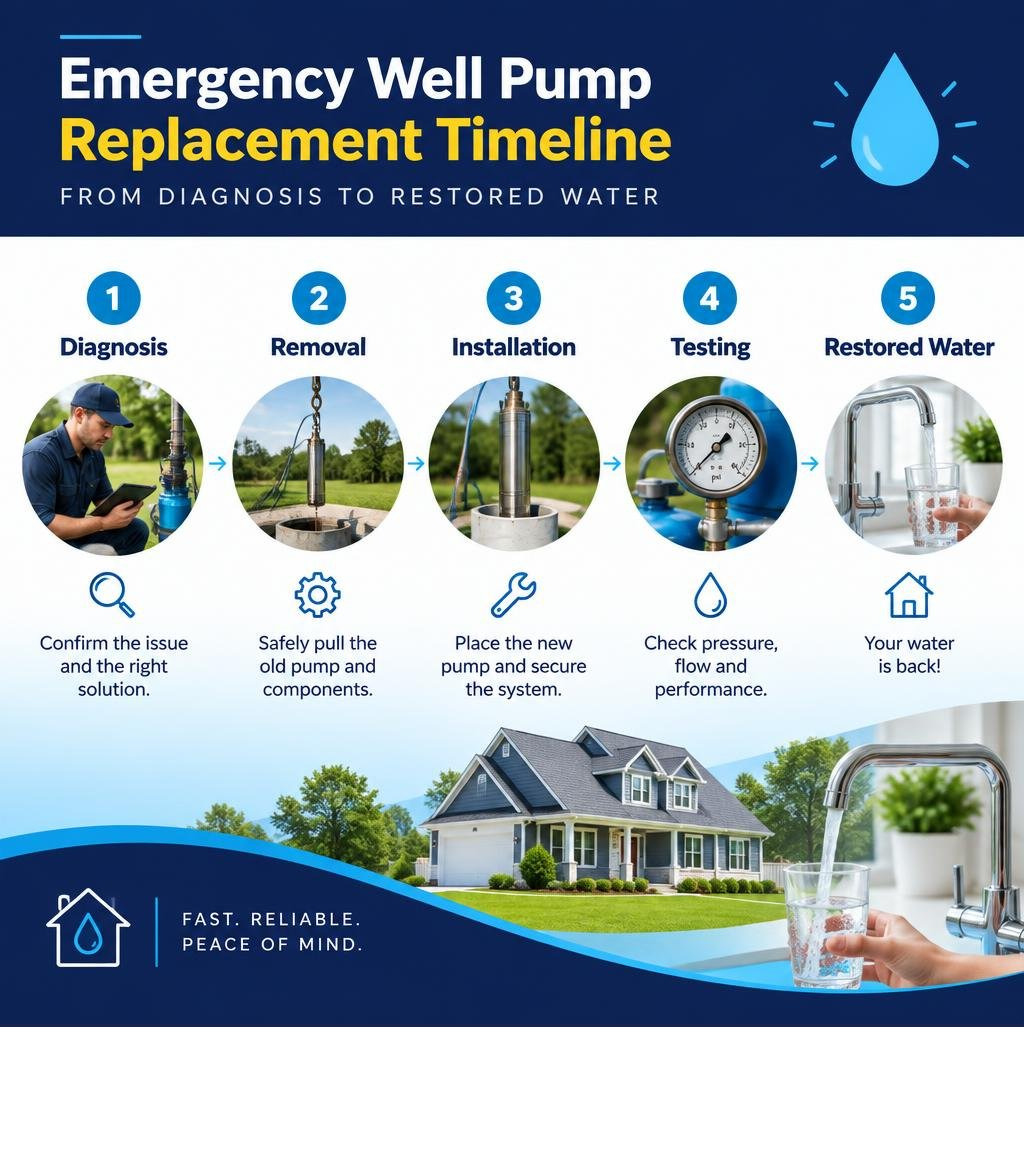
Fast well pump replacement terms explained:
- emergency well service
- well pump failure repair
- downhole motor extraction
- pitless adapter maintenance
Critical Signs You Need Immediate Well Pump Replacement
When a private water system begins to fail, it rarely happens without preliminary warning signs. Recognizing early symptoms allows homeowners to plan an orderly repair rather than facing an unexpected total outage during freezing weather or holiday weekends.
Faucets that spit air or sputter intermittently when turned on are common early indicators. Sputtering usually signals that the water level inside the well has dropped below the pump intake level or that the drop pipe has developed a pinhole corrosion leak, drawing pockets of air directly into the plumbing lines. A sudden drop in water pressure across multiple plumbing fixtures also points toward mechanical wear inside the internal pump impellers.
When addressing domestic water disruptions, evaluating system performance against a complete well pump troubleshooting guide helps isolate the root cause before replacing hardware. Another major warning sign is a pump motor that runs continuously without shutting down. If the pump cannot build enough hydraulic pressure to satisfy the pressure switch cut-out threshold, the motor will overheat quickly and burn out its internal windings.
Repeatedly tripping the electrical circuit breaker indicates an internal electrical short, worn motor bearings, or a jammed impeller drawing excessive amperage. When your electrical panel constantly cuts power to the water system, it is time to inspect the setup for broader mechanical failures.
Unusual noises coming from your pressure tank or basement plumbing lines should never be ignored. Clicking sounds from the pressure switch cycling rapidly on and off indicate that the pressure tank bladder has ruptured, causing the pump to short-cycle dozens of times per hour. Cloudy or sediment-heavy water flowing from taps is another red flag, indicating that the pump is pulling silt from the bottom of the casing or that the well screen has degraded.
Jet Pumps vs. Submersible Well Systems
The physical design of your water system determines how extraction, diagnosis, and replacement are handled in the field:
- Shallow Well Jet Pumps: Mounted above ground in a basement, crawlspace, or well house, these units use atmospheric suction and an internal venturi nozzle to pull water from depths shallower than 25 feet. Because the mechanical components are accessible without pulling heavy drop pipe from the ground, replacing an above-ground jet pump is a relatively brief project requiring minimal heavy machinery.
- Deep Well Submersible Pumps: Positioned hundreds of feet down inside the drilled well casing, submersible pumps push water up into the home rather than pulling it. These units operate under significant hydrostatic pressure and require dedicated hoisting rigs to extract safely. Finding prompt submersible pump repair near me is essential when deep downhole hardware fails.
What to Expect During a Fast Well Pump Replacement
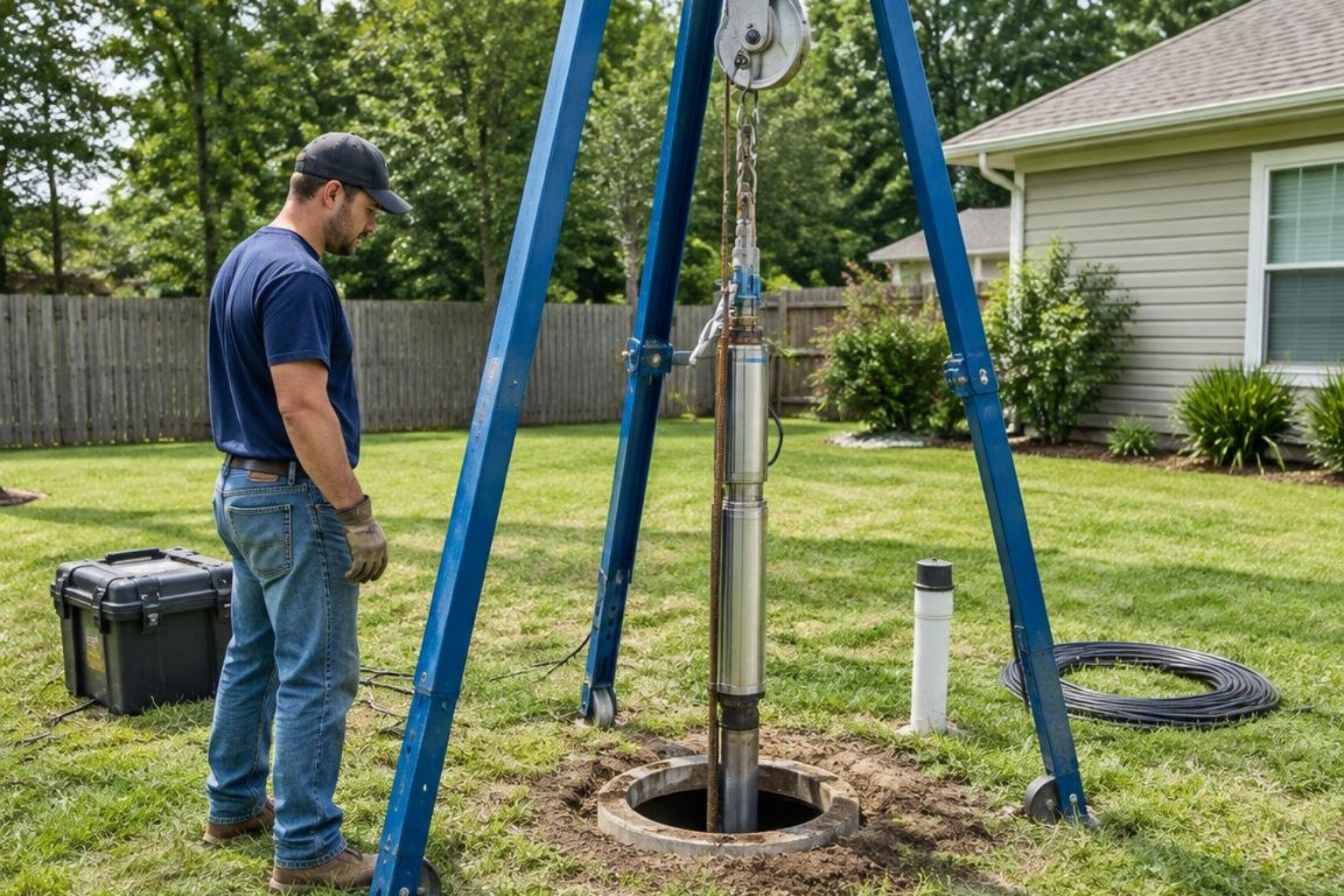
A professional crew follows a systematic sequence to replace a failing pump safely while protecting your water quality and property.
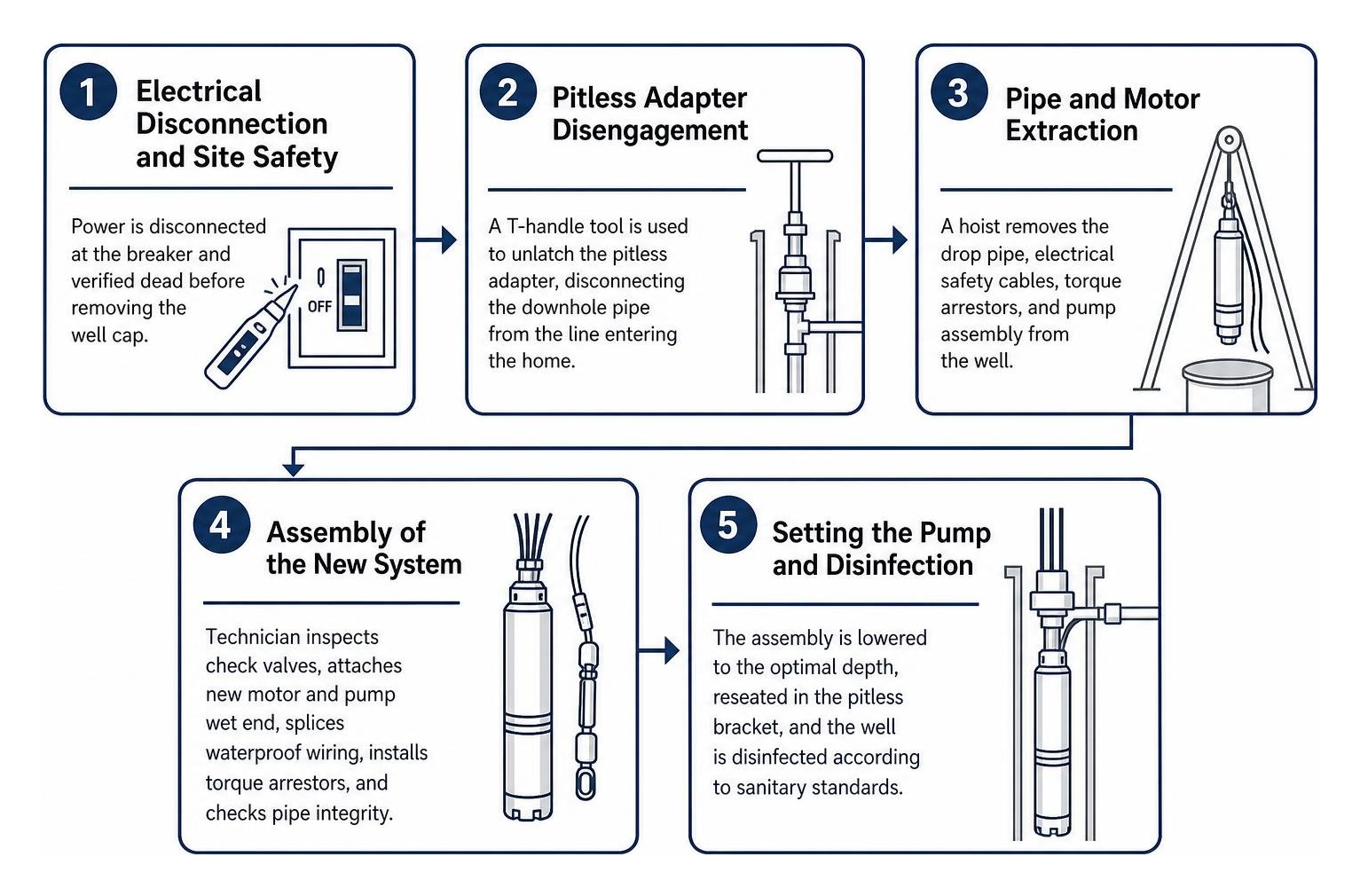
- Electrical Disconnection and Site Safety: The technician disconnects power at the dedicated breaker and uses a calibrated non-contact voltage tester to verify the circuit is dead before removing the sanitary well cap.
- Pitless Adapter Disengagement: For submersible systems, a specialized T-handle tool reaches down inside the casing to unlatch the pitless adapter, disconnecting the downhole pipe from the underground lateral line entering your home.
- Pipe and Motor Extraction: A truck-mounted boom hoist or mechanical pump puller draws the drop pipe, electrical safety cables, torque arrestors, and pump assembly out of the ground in controlled sections.
- Assembly of the New System: The technician inspects check valves, attaches a new motor and pump wet end, splices waterproof heat-shrink wiring connections, installs fresh torque arrestors, and checks overall pipe integrity.
- Setting the Pump and Disinfection: The assembly is lowered to the optimal operating depth, reseated into the pitless bracket, and sanitized according to health department sanitary standards.
- System Calibration and Pressure Testing: The technician charges the pressure tank bladder and handles setting your well pump pressure switch to match household demand.
Understanding typical timeframes helps set realistic expectations for your service call. According to industry data on how long it takes to replace a well pump, shallow jet pump replacements generally take 2 to 4 hours, standard submersible replacements require 4 to 8 hours, and very deep systems over 400 feet take between 6 and 10 hours of dedicated field labor.
Factors That Accelerate or Delay Fast Well Pump Replacement
Well depth is the primary factor dictating project duration. In a 200-foot well, pulling the water-filled drop pipe, safety cable, and pump motor means managing over 500 pounds of deadweight. Beyond depth, unexpected physical complications downhole can alter the job timeline.
| Well System Depth & Type | Typical Replacement Duration | Common Delay Factors |
|---|---|---|
| Shallow Jet Pump (0 to 25 ft) | 2 to 4 Hours | Restricted crawlspace access, corroded intake pipe, priming difficulties |
| Moderate Submersible (25 to 150 ft) | 3 to 5 Hours | Brittle wiring insulation, stuck pitless adapter, silt buildup |
| Deep Submersible (150 to 350 ft) | 4 to 8 Hours | Over 500 lbs pipe weight, pipe corrosion, failing check valves |
| Extra-Deep Submersible (350+ ft) | 6 to 10 Hours | High downhole pressure, heavy hoisting loads, electrical control upgrades |
Corroded or stuck pipes can add 1 to 3 hours to the removal process. Mineral encrustation along the inside of the well casing can grip torque arrestors, requiring slow, deliberate pulling to avoid snapping the pipe. Weather conditions such as heavy snow, freezing ground, or torrential rain can also impact how quickly field equipment can be staged and operated.
Preparing Your Property for Fast Well Pump Replacement
Homeowners can take practical steps before the service truck arrives to eliminate site delays:
- Clear a direct, unobstructed path for heavy service trucks to park near the well casing.
- Remove decorative landscaping, wishing wells, artificial rocks, or planters surrounding the sanitary well head.
- Ensure clear indoor access to the main electrical panel, pressure tank, and pressure switch.
- Keep household pets contained safely indoors or away from work areas.
- Locate your well log or installation records if available to provide depth and pump horsepower history.
The Hidden Risks and Delays of DIY Pump Swaps

Attempting to pull a deep well pump without commercial hoisting machinery carries severe property and financial risks. While some homeowners research how to install a well pump as a potential weekend project, the mechanical reality of downhole weight and high-voltage wiring often creates severe complications.
The most catastrophic DIY mistake is dropping the pump assembly into the bottom of the well casing. If a manual grip slips or an undersized clamp fails, hundreds of feet of water-filled pipe and heavy copper electrical wiring will slide straight down into the borehole. Retrieving a lost pump requires specialized downhole fishing tools, sonic cameras, and high-capacity pulling rigs. In worst-case scenarios, a lost pump wedges permanently across the aquifer zone, forcing the drilling of an entirely new well at significant expense.
Incorrect torque arrestor placement is another common DIY pitfall. Submersible motors produce high rotational starting torque every time they energize. Without a properly fitted rubber torque arrestor placed 12 inches above the pump, the motor will twist aggressively inside the casing, wearing through wire insulation within months and causing a permanent ground fault.
Electrical safety is another critical concern. Submersible pumps run on 230-volt high-amperage circuits. Improper heat-shrink splicing, incorrect wire gauge sizing, or poorly sealed crimp connectors can lead to short circuits, breaker trips, and premature motor failure under high water pressure. Furthermore, attempting to prime and pressurize a water system without proper disinfection procedures risks contaminating your household water supply with harmful coliform bacteria.
Choosing the Right 24/7 Emergency Well Service Partner
When clean running water stops, selecting an experienced contractor ensures lasting reliability. As Your Local Central Indiana Provider, we recommend evaluating contractors across a clear spectrum of service quality:
- Good: A service provider with basic hand tools that can pull shallow drop pipes manually or replace accessible above-ground pressure switches and basic control boxes.
- Better: A licensed company equipped with dedicated mechanical pump-pulling machinery, carrying common replacement parts on service trucks for same-day repairs.
- Best: A full-service water systems contractor maintaining fully stocked service vehicles, advanced downhole diagnostic cameras, 24/7 live dispatch, and heavy-duty drilling and recovery rigs. For complex drilling operations, industry-leading contractors utilize advanced Mud Puppy solids control and fluid recycling systems, ensuring clean mud recycling and drilling without damaging residential lawns or generating excessive site waste.
A reputable provider maintains a broad service scope. In addition to residential well systems, comprehensive contractors manage commercial waste streams and liquid handling needs. These include pumping restaurant grease traps, servicing car wash drainage pits, and handling routine septic tank pumping. It is important to remember that professional septic maintenance focuses on septic system service, cleaning, and pumping to keep wastewater flowing smoothly without system backups.
Homeowners seeking peace of mind can verify contractor track records directly through verified reviews. To see firsthand feedback on dependability and response times, check out the Google Reviews for Blair & Norris Well and Pump Services. When immediate assistance is needed, reviewing diagnostic steps will help you connect with technicians ready to dispatch emergency water well service at any hour of the day or night.
Frequently Asked Questions About Well Pump Replacement
How long does a professional well pump replacement take?
A professional replacement typically takes 2 to 4 hours for an above-ground jet pump and 4 to 8 hours for a standard deep well submersible system. Deeper systems past 350 feet or wells with heavy mineral scaling, corroded drop pipe, or restricted pitless adapters may require 6 to 10 hours. Most residential replacements are completed within a single business day so that your family has running water before nightfall.
What factors determine the replacement investment?
The overall investment depends on well depth, pump horsepower requirements (such as 0.5 HP, 0.75 HP, 1.0 HP, or 1.5 HP), downhole pipe conditions, electrical cable replacement needs, and whether you require after-hours emergency dispatch. Reviewing our well pump replacement guide provides further detail on system sizing, electrical control boxes, and component options suited for your specific water demand.
Can you replace my pressure tank during the pump installation?
Yes. Replacing an aging or waterlogged pressure tank during a pump swap is standard best practice. If the internal rubber bladder inside the tank has failed, the pump will short-cycle rapidly, turning on and off every time a faucet is opened. This constant cycling destroys the new motor in a fraction of its normal lifespan. Installing a fresh pressure tank alongside the new pump protects your warranty and ensures balanced water pressure throughout the home.
How long should a new well pump last?
A high-quality, properly sized submersible well pump typically lasts between 10 and 15 years with routine maintenance. Above-ground jet pumps usually last between 8 and 12 years. Factors that influence longevity include water sediment levels, electrical power quality, cycle frequency, and proper tank pre-charge maintenance.
How do I know if the problem is my pump or my pressure switch?
A malfunctioning pressure switch often exhibits burnt electrical contacts or fails to click when pressure drops. A certified technician uses a multimeter to test voltage across the switch terminals and measure amperage draw on the pump motor, accurately identifying the failing part before removing any downhole equipment.
Reliable Water Restoration for Central Indiana Homes
Losing your household water disrupts cooking, cleaning, personal sanitation, and daily family comfort. Getting your plumbing system back online requires swift diagnosis, professional extraction tools, and quality replacement hardware installed to state sanitary codes.
Blair & Norris brings over 75 years of continuous family-owned experience to every project throughout Central Indiana, including Marion, Hamilton, Hendricks, Boone, Johnson, Morgan, Hancock, Shelby, and surrounding counties. With 24/7 live phone support, fully stocked service vehicles, and factory-trained technicians, we ensure your water system is restored safely and efficiently.
Beyond private well pumps, our experienced team provides extensive septic tank pumping, commercial grease trap cleaning, and car wash drainage pit maintenance to protect your complete liquid waste infrastructure. When you need immediate diagnosis or a dependable well pump replacement, contact Blair & Norris today for an accurate estimate and prompt, professional service. Explore our comprehensive professional well and pump services to keep your domestic water running reliably year-round.